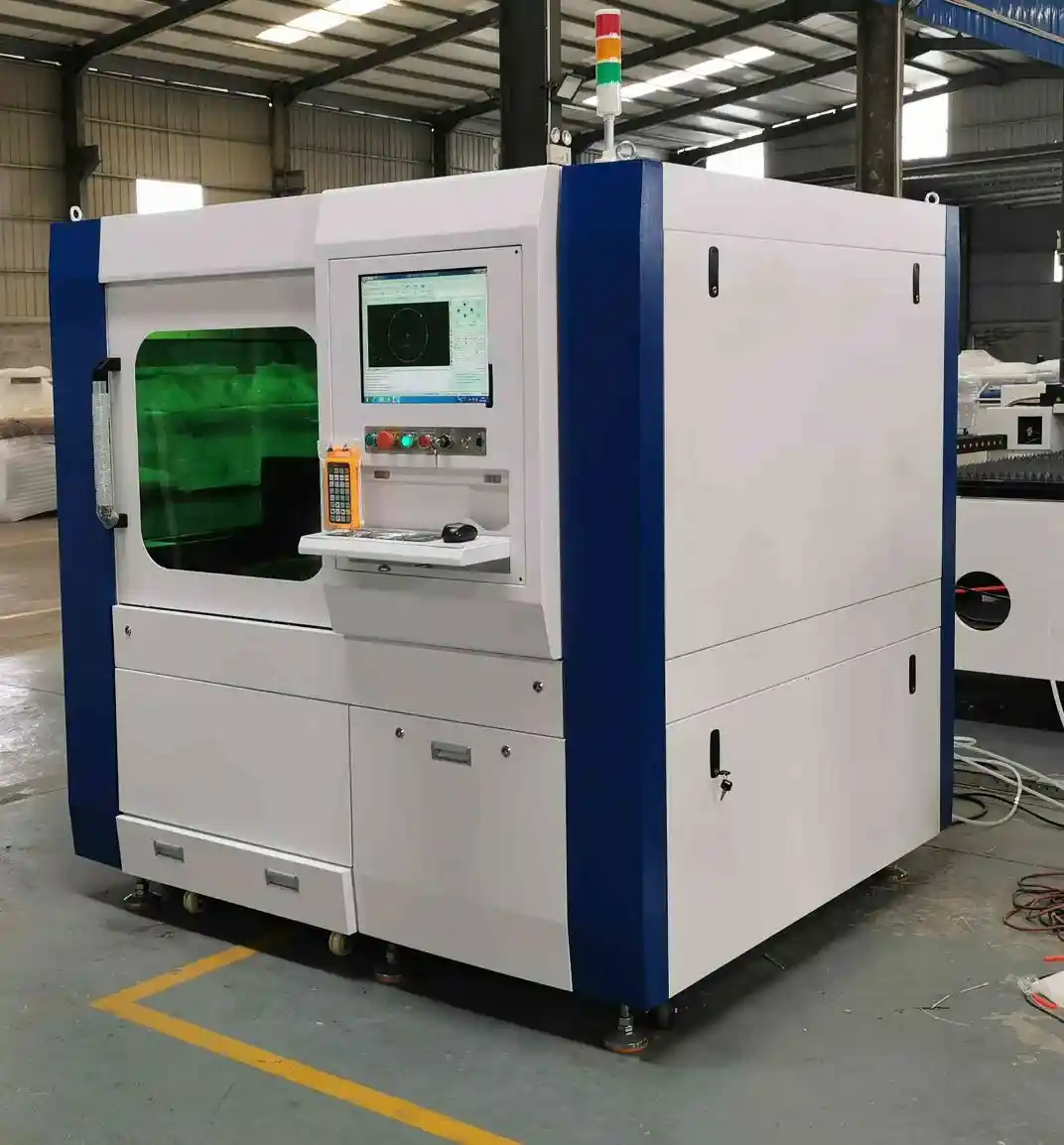
We get asked "how much does a [power] fiber laser cutting machine cost" at every tier from 500W to 30,000W, and the honest answer is the same at every tier: we don't publish a price list, because worktable size, automation, and source brand all move the final number as much as power does. What we can do is walk through what actually drives price at each tier, so you know what to ask about beyond the power number itself.

DF Series Fiber Laser Cutting Machine (DF2040) -- covers the 1000W-3000W range referenced in the tier table below.
What Drives Price at Each Power Tier
| Power | Typical Line | What Actually Drives Price at This Tier |
|---|---|---|
| 500W | SF Series Small Precision Fiber Laser Cutting Machine | Entry-tier thin-gauge work -- price here is dominated by worktable size and control software, since the source itself is the least expensive part of the machine at this power. |
| 750W | SF Series Small Precision Fiber Laser Cutting Machine | Still thin-to-light gauge -- similar price drivers to 500W, with a modest step up for the higher-rated source. |
| 1000W | DF Series Fiber Laser Cutting Machine (DF2040) | The most common general-purpose entry point -- price starts to reflect worktable size and any automation added on top of the base configuration. |
| 1500W | DF Series Fiber Laser Cutting Machine (DF2040) | A meaningful step up in thickness capability -- source cost and structural rigidity for the higher power both start to matter more here. |
| 2000W | DF Series Fiber Laser Cutting Machine (DF2040) | A common mid-tier choice for general fabrication -- automation options (feeding, pallet changers) become a larger relative share of price at this tier. |
| 3000W | DF Series Fiber Laser Cutting Machine (DF2040) | The top of many general fab shops' regular range -- source brand and head quality differences between suppliers become more noticeable in both price and performance. |
| 4000W | LF Series Industrial CNC Laser Cutter | Moving into heavier industrial territory -- structural bed quality (welded, tempered, stress-relieved) starts to differentiate price between suppliers more than at lower tiers. |
| 6000W | LF Series Industrial CNC Laser Cutter | A genuinely industrial tier -- expect automation and heavier-duty structural components to make up a larger share of the price than the laser source alone. |
| 8000W | LF Series Industrial CNC Laser Cutter | Higher-volume industrial production -- price differences between suppliers at this tier often come down to automation level and control system sophistication. |
| 10000W | LF Series Industrial CNC Laser Cutter | A serious industrial investment -- worktable size, bed construction quality, and automation dominate the price conversation more than the source rating itself. |
| 12000W | LF Series Industrial CNC Laser Cutter | Near the top of our LF Series' range -- expect this tier to be quoted as a specific configuration rather than a standard catalog unit. |
| 15000W | GF Series Large-Format Gantry Fiber Laser Cutting Machine | Large-format gantry territory (our GF Series) -- bed length and structural engineering for a much larger machine footprint become the dominant cost factor. |
| 20000W | GF Series Large-Format Gantry Fiber Laser Cutting Machine | Heavy industrial / structural-scale cutting -- these are highly configuration-specific quotes built around your exact plate size and thickness requirements. |
| 30000W | GF Series Large-Format Gantry Fiber Laser Cutting Machine | The top of our published power range -- a fully custom, build-to-order configuration where price reflects the specific engineering requirements of your application. |
This describes what moves price up or down at each tier, not a dollar figure -- send your specific requirements for a written quote.
Budgeting Approach by Tier Range
Rather than fixating on an exact number before you've confirmed a configuration, a more useful planning approach is bracketing: entry tiers (500W-1000W) suit thin-gauge, lower-volume shops and represent the lowest capital commitment; mid tiers (1500W-3000W) cover most general fabrication and represent the most common order profile; upper tiers (4000W-12000W) suit heavier industrial production where duty cycle and thickness both push higher; and the largest tiers (15000W-30000W) are effectively custom industrial projects planned around a specific structural or heavy-plate application rather than a standard purchase. Bracket your own requirement into one of these four before requesting a quote, and the conversation moves faster on both sides.
Why Two Machines at the Same Power Can Cost Very Differently
- Worktable size -- a larger bed at the same power tier means more steel, longer rails, and a bigger gantry structure.
- Laser source brand -- Raycus, IPG, and other source brands sit at different price points for the same rated power.
- Automation -- feeding systems, pallet changers, and automated loading all add cost independent of power tier.
- Bed construction quality -- a heavier, stress-relieved, plate-welded bed built for 20-year durability costs more to manufacture than a lighter-duty frame at the same power rating.
New vs. Used at Any Power Tier
The used-machine calculation is the same at every power tier: no manufacturer warranty and unknown maintenance history on the laser source are real risks regardless of whether you're looking at a 1000W entry machine or a 15000W gantry system. Run the numbers against a new configuration before deciding budget alone points to used.
Two Perspectives Worth Considering
financing and total landed cost (freight, duties, installation) matter as much to a price-by-power readers buyer's decision as the machine price itself -- we treat that as part of the quote conversation, not a follow-up surprise after the fact.
heat-affected zone width and edge microstructure are real engineering concerns on price-by-power readers parts that get welded, heat-treated, or stressed after cutting -- a narrower HAZ from a well-tuned fiber laser cut gives more margin in downstream processing than a wider one from an under-optimized setup.
Software, Warranty, and Export at Every Tier
Regardless of power tier, every machine we ship runs the same nesting and cutting-parameter software family, carries a manufacturer warranty with documented maintenance schedules, and ships with installation guidance and operator training included. The power tier changes the hardware and automation options available -- it doesn't change the level of support behind the machine.
Why We Frame This Page Around Drivers, Not a Chart
Plenty of sites publish a chart mapping power directly to a dollar figure, and we'd rather not join them -- a chart like that implies a precision that doesn't reflect how these machines are actually priced. Two buyers asking about the identical power tier can walk away with quotes that differ by a meaningful margin once worktable size, automation, and source brand are factored in, and a single chart number would understate that range in a way that sets the wrong expectation before we've even discussed your actual job.
A Worked Example Across Two Tiers
Consider two shops both asking about "price": one cutting mostly 3mm mild steel brackets, the other cutting 12mm structural plate. The first fits comfortably in the 1000W-1500W range on a standard DF worktable with modest automation -- price there is dominated by worktable size and control software choice. The second needs 2000W-3000W or more depending on volume, on the same DF platform or stepping up to LF for heavier duty cycle -- price there shifts toward source power and structural bed quality. Same general price question, two very different actual configurations and cost structures behind it.
Common Concerns Before Ordering
Buyers sizing a machine purely by power sometimes end up either overpaying for headroom they won't use, or underbuying and hitting a thickness ceiling within the first year. Both are avoidable by sending your actual thickest regular job and monthly volume before settling on a target power tier -- that conversation costs nothing and prevents the more expensive mistake either direction.
How to Get an Exact Number
Send your material, thickness range, and monthly volume for whichever power tier you're considering -- we'll confirm whether that tier actually fits your job, recommend worktable size and automation level, and provide written pricing for the specific configuration rather than a generic power-based estimate.

Frequently Asked Questions
Why is there no price list for any power tier?
Worktable size, automation, source brand, and shipping destination all move price as much as power does -- a published number by power tier alone would be more misleading than useful.
What's the cheapest power tier to start with?
500W-1000W machines are the lowest entry cost, but the right starting tier depends on your actual thickness range, not just budget -- undersizing power to save money is the most common expensive mistake we see.
Does price scale linearly with power?
No -- worktable size and bed construction quality often move price more than the power tier itself, especially at the higher end of the range.
Is a 30000W machine a standard catalog item?
No -- our highest power tiers are fully custom, build-to-order configurations engineered around your specific application rather than a standard unit.
Should I buy more power than I need for future growth?
Sometimes, if you're confident volume or thickness requirements will grow within a year or two -- but paying for headroom you won't use for several years is rarely the better financial choice. We can walk through that tradeoff for your specific situation.
How do worktable size and power interact on price?
They're independent cost drivers that both scale price up -- a small worktable at high power, or a large worktable at modest power, can end up at a similar price point despite very different specs.
Does warranty coverage change at higher power tiers?
The warranty structure is consistent across our lines -- every machine ships with documented maintenance schedules and manufacturer warranty terms regardless of power tier, though exact coverage periods should be confirmed for your specific configuration.
What's the fastest way to narrow down the right tier?
Send your thickest regular job's material and thickness -- that single data point rules out most of the wrong tiers faster than comparing price ranges first.
Can two shops asking about the same power tier end up with very different quotes?
Yes -- worktable size, automation, and source brand can differ even when the power number is identical, which is exactly why we ask about your actual job before quoting.
Is it cheaper to buy a slightly underpowered machine and upgrade later?
Rarely -- upgrading laser power after purchase is usually not a simple retrofit, so sizing power correctly at purchase time is generally the more cost-effective path.