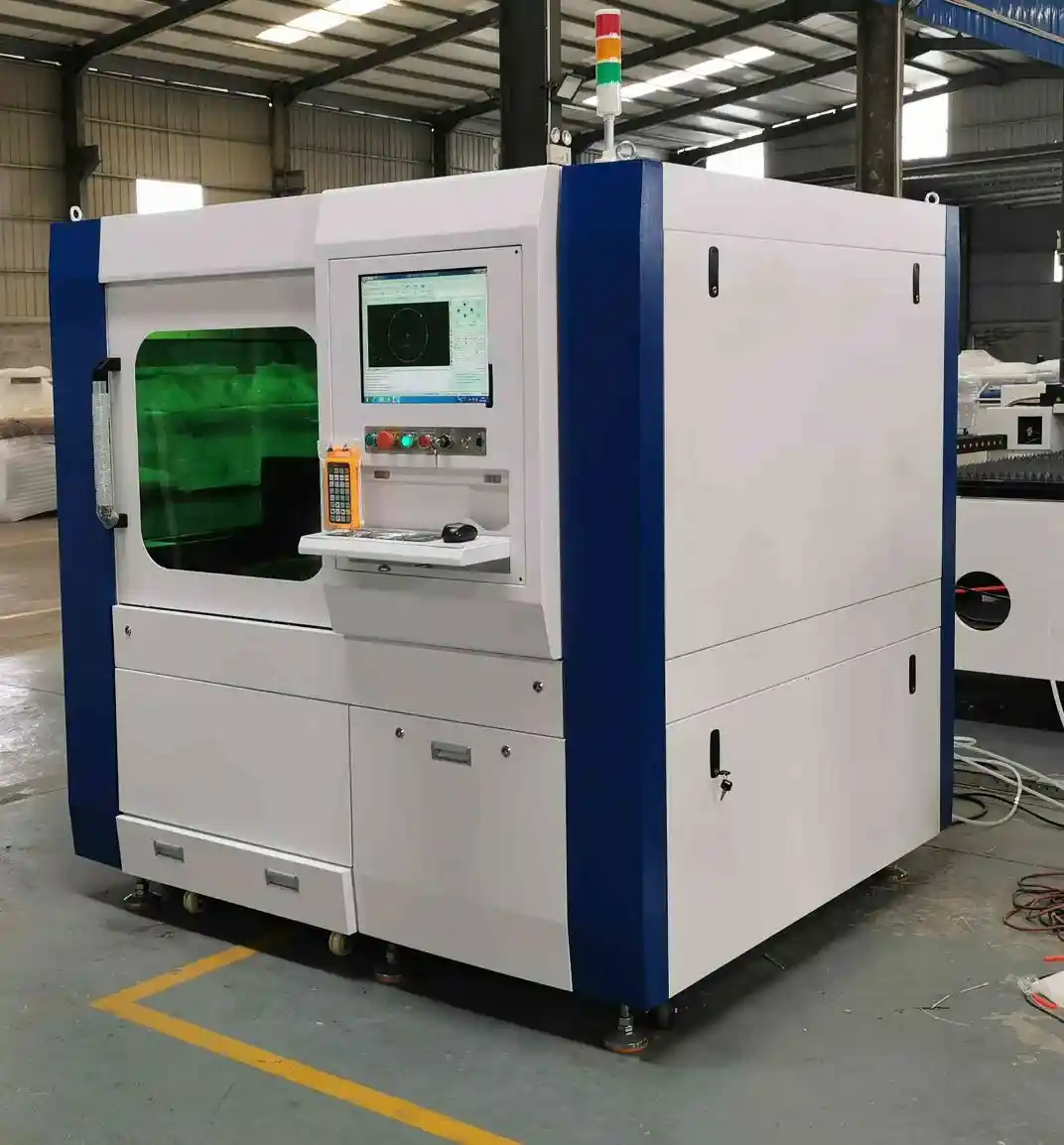
Buyers comparing fiber laser cutting machines side by side often focus on laser power and worktable size and treat everything else as a checkbox list. In practice, the features below are what actually determine how a machine performs in daily production -- and which ones matter to your shop depends heavily on job mix and volume, not a single universal answer.

LFS Series Coil-Fed Laser Cutting Line -- automation features like automatic feeding are built into this line from the ground up.
This page walks through nine features and options buyers ask about most, what each one actually does, and which shop profile benefits most from paying for it.
CNC Control System
The control system is where an operator actually spends the working day -- more time than at the laser source itself. Our machines run CypCut/FSCUT-family or comparable industrial control software depending on the line, handling nesting, cutting-parameter presets, and job queuing from one screen. A control system that's genuinely easy to learn shortens the ramp-up time for a new operator far more than any spec-sheet number does.
Automatic Feeding System
For coil-fed or high-repeat production, an automatic feeding system removes the manual load/unload step between parts entirely. Our LFS Series pairs a hydraulic decoiler and precision leveler with high-speed CNC servo feeders, letting the machine run unattended through a shift change rather than idling between sheets.
Automatic Loading/Unloading System
On sheet-fed lines, an automated loading and unloading system (a pallet-style shuttle or robotic arm feeding raw sheet in and finished parts out) keeps the laser head cutting instead of waiting on an operator -- the practical benefit is measured in cutting hours per shift, not a single spec.
Chiller Cooling System
Every fiber laser source needs stable temperature control to hold beam quality and protect the optics -- an industrial chiller sized to the laser source's rated power is standard equipment on every configuration we ship, not an optional add-on, since running a laser source outside its temperature spec shortens its service life.
Exhaust / Fume Extraction System
What actually needs to be extracted depends on the material being cut -- galvanized zinc, coated sheet, and certain alloys need real extraction capacity, not just a shop fan. We spec extraction per job mix rather than bolting on a generic system, since undersizing it is a genuine health-and-safety issue, not just a housekeeping one.
Nesting Software
Nesting software decides how much usable part comes out of each sheet or length of stock -- our tube and coil-fed lines document nesting software that cuts material waste by roughly 20% versus manual layout, a real published figure rather than a marketing round number. On expensive stock, that software often pays for itself faster than any other single feature on this list.
Pallet Changer
A pallet changer lets one pallet load while the other is cutting, which removes load/unload time from the machine's cutting cycle entirely rather than just speeding it up. It matters most on shops running a steady queue of similar-sized sheets where that dead time adds up across a full shift.
Protective Enclosure
A full protective enclosure contains stray reflections and fume at the cutting zone and is standard on our industrial lines -- this isn't an aesthetic add-on, it's part of how a Class 4 laser system is made safe to operate on a shop floor with people working nearby.
Rotary Axis Attachment
A rotary axis (or a dedicated tube/pipe platform like our Tube CNC Fiber Laser Cutting Machine) extends a flat-bed machine into round, square, and profiled tube and pipe work -- worth planning for at purchase time if tube cutting is even an occasional part of your job mix, since retrofitting it later is rarely as clean as ordering it configured from the start.
Which Features Actually Matter for Your Shop
Not every feature on this list earns its cost for every shop. A rough way to prioritize:
- Low-volume or prototyping: control software ease-of-use and nesting software matter more than any automation feature -- you won't run enough volume to recoup automation cost quickly, and a simpler machine is also faster to reconfigure between one-off jobs.
- Mixed job-shop production: a pallet changer or automated loading pays back fastest here, since load/unload time is a bigger share of total cycle time on shorter runs, and a shop juggling several customer jobs a day feels that dead time directly in how many jobs it can quote.
- High-volume single-material production: automatic feeding and a coil-fed line change the economics entirely -- unattended run time becomes the dominant factor in effective daily output, often more than raw cutting speed at the laser head itself.
- Any material needing fume control: exhaust extraction isn't optional regardless of volume -- size it to your material, not your budget, since a health-and-safety requirement doesn't scale down just because order volume is low.
Feature Combinations We See Most Often
Three combinations cover most of the orders we actually build, rather than every buyer picking a unique mix of all nine options:
The Prototyping Combination
A base machine with a strong control system and nesting software, no automation beyond the standard chiller and enclosure. This keeps upfront cost proportional to a shop that's cutting one-off parts and short runs rather than a repeat production queue.
The Job-Shop Combination
Base machine plus a pallet changer or basic automated loading, giving back load/unload time on a queue of mixed customer jobs without committing to a fully automated line the job mix doesn't justify yet.
The Production Combination
Automatic feeding or a full coil-fed line, paired with heavier-duty fume extraction sized to sustained multi-shift operation. This is where the upfront automation cost is easiest to justify against a known, steady volume.
Configuring the Right Combination
Most orders combine two or three of these features rather than all nine -- a chiller and enclosure come standard on every industrial-class machine, while feeding, loading, pallet changing, and rotary axis attachments are selected based on your specific job mix. Send us your typical part, material, and volume and we'll recommend which combination actually earns its keep rather than upselling a full option list.
Standard vs. Optional, at a Glance
| Feature | Standard or Optional |
|---|---|
| CNC control system | Standard on every machine |
| Chiller cooling system | Standard on every machine |
| Protective enclosure | Standard on industrial-class lines |
| Nesting software | Standard, with efficiency varying by software version |
| Exhaust / fume extraction | Sized per job -- confirm scope during your order |
| Automatic feeding system | Optional -- coil-fed configurations only |
| Automatic loading/unloading | Optional -- sheet-fed configurations |
| Pallet changer | Optional |
| Rotary axis attachment | Optional -- tube/pipe capability |
A Real Example: Configuring a Job-Shop Machine
A typical inquiry looks like this: a fabricator running mixed steel and stainless sheet, quoting new customer jobs weekly, wants to know which of these nine features actually matter for them. Working through the list, the answer usually lands on a solid control system and nesting software (non-negotiable at any volume), a chiller and enclosure (standard on any industrial-class machine), and a pallet changer once their queue is busy enough that load/unload time visibly eats into cutting hours -- automatic feeding and a rotary axis attachment stay off the list unless their job mix genuinely includes coil stock or tube work. That's a realistic walk-through, not a hypothetical -- most job-shop inquiries land on a similar combination once we've actually discussed their volume.
Common Concerns Before Adding Options
Buyers sometimes worry that more features mean more that can go wrong on the shop floor. In our experience the opposite is usually true for the automation features on this list -- they remove manual steps (loading, feeding, nesting by hand) that are actually where human error and downtime creep in, rather than adding new failure points. The features that do add real maintenance overhead, like a coil-fed line's decoiler and leveler, come with the same warranty and spare-parts support as the rest of the machine.
The other common concern is overbuying: paying for automation a job mix doesn't yet justify. That's exactly why we walk through your actual volume and part mix before recommending a configuration, rather than defaulting every quote to the fullest option list available.

Tube CNC Fiber Laser Cutting Machine -- referenced above.
Frequently Asked Questions
Do I need automatic feeding if I'm not running coil stock?
No -- automatic feeding is built around coil-fed production specifically. For cut sheet, an automated loading/unloading system or pallet changer addresses the same load/unload time problem without needing coil stock.
Is a protective enclosure required by law?
Enclosure and safety requirements vary by country and local regulation -- we build our industrial lines with a full enclosure as standard practice for Class 4 laser safety, and can confirm what applies in your specific market.
Can I add a rotary axis or feeding system later instead of at purchase?
Sometimes, but not always cleanly -- confirm with us at the time of your original order whether your specific configuration supports a later retrofit, since it's often simpler and cheaper to configure it up front.
How much does nesting software actually save?
Our published figure for tube and coil-fed nesting software is roughly 20% material savings versus manual layout -- actual savings depend on part geometry and how tightly your current process nests today.
What's included standard versus optional on a new machine order?
Chiller cooling and a protective enclosure are standard on our industrial-class lines; feeding, loading automation, pallet changers, and rotary axis attachments are configuration options we'll help you size to your job mix.
Does a fancier control system cost significantly more?
Control software differences are usually a smaller share of total machine cost than power tier or automation level -- ask us for a live demo of the actual nesting and cutting-parameter interface before assuming cost is the deciding factor.
Which feature has the fastest payback for a small shop?
For most small shops, nesting software efficiency and control-software ease of use pay back fastest -- automation features like feeding and pallet changers generally need higher volume to justify their added cost.
Do more features mean more maintenance?
Not necessarily -- automation features generally replace manual steps rather than adding new failure points, and carry the same warranty and spare-parts support as the rest of the machine.
Can I mix and match features across the combinations described above?
Yes -- the three combinations are common starting points, not fixed packages. Tell us your specific job mix and we'll adjust from there.
Is a rotary axis attachment worth adding if I only cut tube occasionally?
It depends on how occasional -- if tube work is a regular part of your mix even at low volume, configuring it in from the start is usually cleaner than retrofitting later.
Do automation features slow down changeover between different jobs?
Well-designed automation shouldn't -- a pallet changer or automated loading is meant to remove dead time, not add complexity to switching between job types.
Should a brand-new shop buy every feature to be safe?
No -- we'd rather size features to your actual current job mix and add automation later as volume justifies it, since paying for unused capability ties up capital you could use elsewhere.