The right fiber laser cutting machine configuration has as much to do with how much you're running as what you're cutting. A prototyping shop and a mass-production line can be cutting the exact same material and thickness and still need completely different machines -- this page walks through configuration by production scale rather than by material.
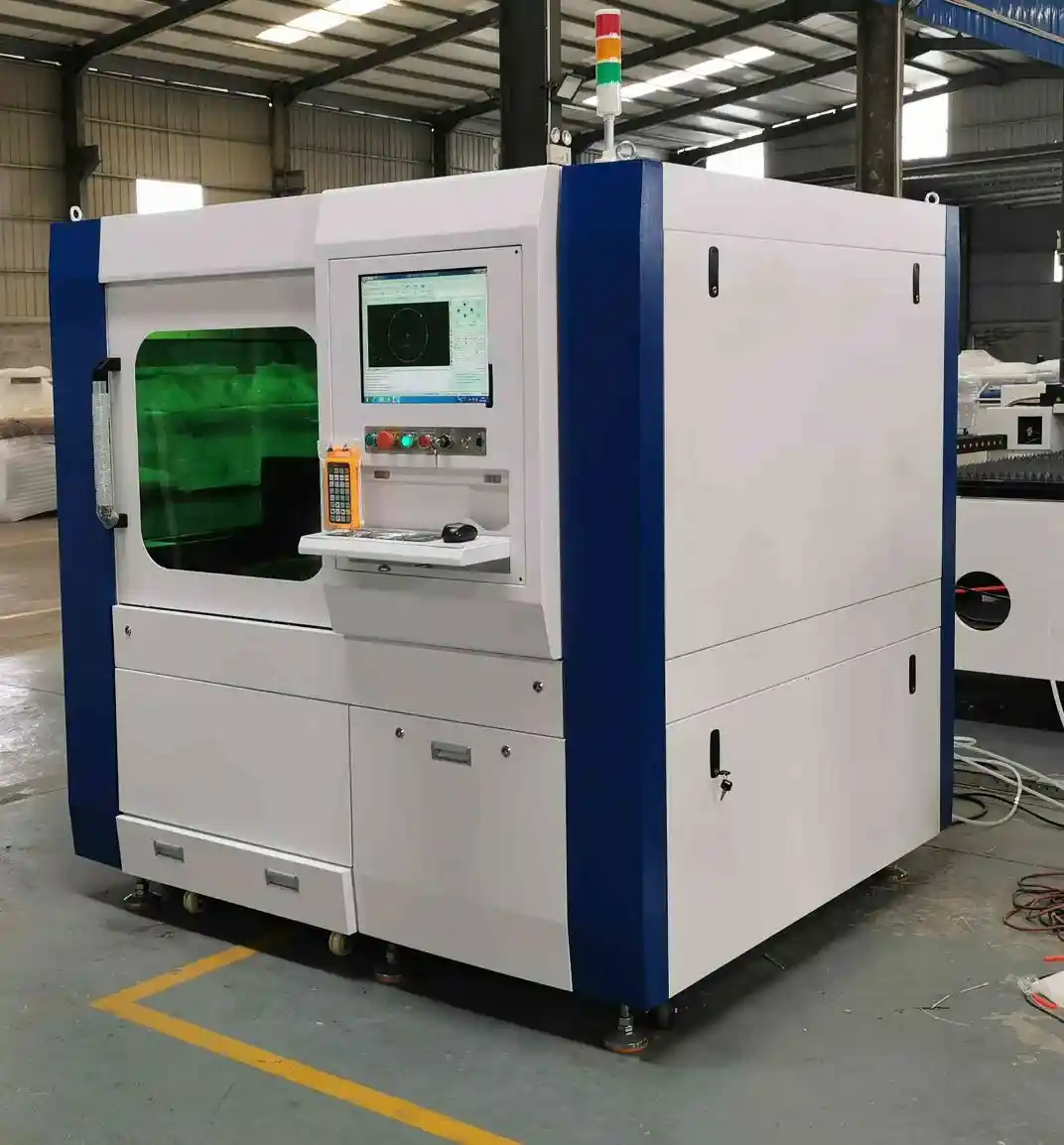
SF Series Small Precision Fiber Laser Cutting Machine -- a common starting point for prototyping and low-volume custom work.
Prototyping and Custom Fabrication
For prototyping and one-off custom fabrication, flexibility matters more than raw throughput -- our SF Series or an entry-tier DF configuration covers this well, since you're paying for precision and quick job changeover rather than automation you won't use on a single part run. Nesting efficiency matters less here too, since you're not optimizing a repeat production run.
The economics at this scale favor a lower upfront cost and fast setup time over any automation feature -- a prototyping shop's real bottleneck is usually design iteration and part verification, not the cutting step itself, so the machine should stay out of the way rather than requiring its own specialized programming for every one-off part.
Job Shops: High-Mix, Variable-Volume Production
A job shop quoting a wide mix of customer parts on short notice needs a machine that switches between materials and thicknesses without a hardware change -- typically a DF or LF configuration with solid nesting software, since changeover time between jobs matters as much as raw cutting speed when your queue changes daily.
Cost per part is harder to pin down at this scale than at either extreme, since job mix varies week to week -- the practical answer is sizing power and worktable to your typical job rather than your largest one, and treating an occasional oversized job as a case for subcontracting rather than a case for buying a bigger machine than your regular queue justifies.
High-Volume and Mass Production
Once volume justifies it, automation changes the economics entirely -- our LFS Series coil-fed line removes the load/unload cycle from production almost completely, and can run unattended through a shift change. At this scale, nesting efficiency and unattended run time matter more to total output than peak cutting speed alone.
Unattended run time matters more to mass-production shops throughput than peak cutting speed in a lot of real shop schedules -- a machine that can run a coil-fed or heavily automated job through a lunch break or shift change adds effective daily output without adding a second operator.
Total Cost by Production Scale
The same running-cost drivers (assist gas, electricity, wear parts) apply at every scale, but their relative weight shifts: at prototyping volume, machine idle time and setup cost per part dominate; at job-shop volume, changeover time between jobs is the bigger factor; at mass-production volume, per-part running cost and nesting efficiency compound into a much larger total than either of the smaller scales, which is exactly why automation investment pays back fastest there.
Staffing Changes Across Production Scale
Staffing needs shift alongside configuration as much as machine capability does. A prototyping setup often runs with one operator splitting time between the laser and other shop tasks. A job shop typically dedicates at least one operator per shift to the laser given the constant attention mixed jobs require. A mass-production coil-fed line can run with lighter direct attention during a cutting run, but usually needs someone monitoring quality and handling finished-part logistics, since automation reduces load/unload labor without eliminating the need for oversight entirely.
A Note on Seasonal or Variable Demand
Not every shop sits neatly in one category year-round -- seasonal demand spikes or a lumpy order book can push a job shop temporarily into production-scale territory and back. Sizing for your typical month rather than your busiest one, and treating a genuine sustained shift in volume as the trigger for a configuration upgrade, keeps you from overbuying for a demand pattern that may not hold.
Signs You've Outgrown Your Current Tier
- You're turning down orders because your current machine's queue is already full, not because of a skills or equipment gap elsewhere in the shop.
- Operators spend more time loading/unloading between parts than the laser spends actually cutting, which is the clearest signal automation would pay back.
- Your job mix has shifted toward a dominant material and thickness that would justify dedicated automation rather than the flexible, general-purpose setup you started with.
- Overtime or a second shift has become a regular fix for capacity rather than an occasional one, which usually costs more over a year than the automation upgrade that would remove the need for it.
The underlying principle across every scale is the same: match the configuration to the volume you actually have, not the volume you hope to have -- growth is easier to fund from a right-sized machine's profits than from capital tied up in unused capacity.
Transitioning Between Scales Without a Production Gap
Moving from a job-shop machine to a dedicated production line works best when the new machine arrives and is commissioned before the old one is retired, rather than assuming a clean handoff -- overlapping capacity for a few weeks during training and ramp-up avoids a production gap that a strict one-out-one-in transition risks if commissioning takes longer than planned.
Floor Space and Layout by Scale
Physical footprint grows with scale in ways worth planning for beyond the machine itself: prototyping and job-shop configurations need modest staging space around the machine; a production-scale coil-fed line needs room for the decoiler and leveler ahead of the machine plus a clear path for finished-part accumulation, since it's designed to run largely unattended and shouldn't need constant manual intervention to keep pace. Underestimating this footprint at the planning stage is a common reason a shop discovers mid-installation that its intended location doesn't actually fit the configuration it ordered.
A Worked Example: The Same Part at Three Scales
Take a simple bracket cut from 3mm mild steel. At prototyping scale -- a handful of units for design verification -- an SF or entry DF configuration cuts it with no automation, and the programming time for that single part matters more than cutting speed. At job-shop scale -- this bracket alongside dozens of other customer parts weekly -- a DF configuration with solid nesting software and maybe a pallet changer handles the changeover between it and the next different job efficiently. At mass-production scale -- thousands of this exact bracket monthly -- an LFS coil-fed line running that one part nearly unattended changes the entire cost structure per part. Same bracket, three genuinely different right answers.
Scaling Up Without Overbuying
The honest advice we give most buyers: size to your current volume plus a realistic one-to-two year growth estimate, not an aspirational five-year one. A machine sized well beyond your current job mix sits underused and ties up capital that a right-sized machine plus a planned upgrade later would have used more efficiently.
Two Perspectives Worth Considering
integrating a new machine into an existing CAD/CAM and nesting workflow is as much the engineering question as the laser spec itself -- a machine that speaks the software your production-scale readers shop already runs saves real integration time over one that needs a parallel toolchain.
the most common mistake we see production-scale readers buyers make is sizing a machine to their current job mix and nothing else -- if you expect volume or material mix to change in the next two to three years, that belongs in the conversation before you order, not after.
Common Concerns Before Ordering
Buyers scaling up from a job shop into dedicated production sometimes worry that automation locks them into one material or part geometry. In practice, coil-fed and automated-loading configurations can still handle a change in stock width or thickness within their designed range -- confirm the flexibility range of any specific automated configuration against your actual product roadmap before ordering, rather than assuming automation always means rigidity.

LFS Series Coil-Fed Laser Cutting Line -- referenced above.
Frequently Asked Questions
What's the difference between a job-shop and mass-production configuration?
A job-shop configuration prioritizes changeover speed and material flexibility; a mass-production configuration prioritizes automation and unattended run time on a narrower, higher-volume job mix.
Can I start small and upgrade later?
Often yes -- starting with an entry-tier configuration sized to your current volume and upgrading automation or power later is frequently the safer financial choice over overbuying up front.
Does prototyping need a different machine than production?
Not necessarily a different machine, but different priorities -- precision and changeover flexibility matter more than throughput for prototyping, while automation and nesting efficiency matter more at production volume.
How do I know if my volume justifies automation?
If load/unload time between parts is eating a significant share of your shift, or you're regularly running overtime for capacity reasons, that's usually the signal automation would pay back.
What's the risk of overbuying capacity?
Capital tied up in automation or power you don't use yet, plus a machine sized for a job mix you may not actually run for years -- we'd rather size you accurately than sell you more than you need.
Do mass-production lines need a different control software?
The same control software family generally scales across our lines -- what changes at production volume is the automation hardware around it (feeding, pallet changing), not the underlying software.
Does automation lock me into one material or thickness?
Not entirely -- most automated configurations handle a defined range of stock width and thickness, but confirm that range against your product roadmap before ordering.
How should a shop with seasonal demand spikes size a machine?
Size to your typical month rather than your busiest one, and treat a genuine sustained volume increase -- not a temporary spike -- as the trigger for a configuration upgrade.
Can the same part genuinely need three different machine configurations?
Yes -- production scale, not the part's material or thickness alone, is often what changes the right configuration, since load/unload time and per-part cutting cost matter very differently at low versus high volume.
What's the risk of buying a mass-production configuration before you have mass-production volume?
Capital and floor space tied up in automation you can't yet keep busy -- it's usually better to scale up as volume actually arrives rather than ahead of it.


