A buying guide that just says "buy based on your budget" isn't much of a guide. The checklist and specification comparison below are what we actually walk buyers through on an inquiry call, in the order that catches the most expensive mistakes first.
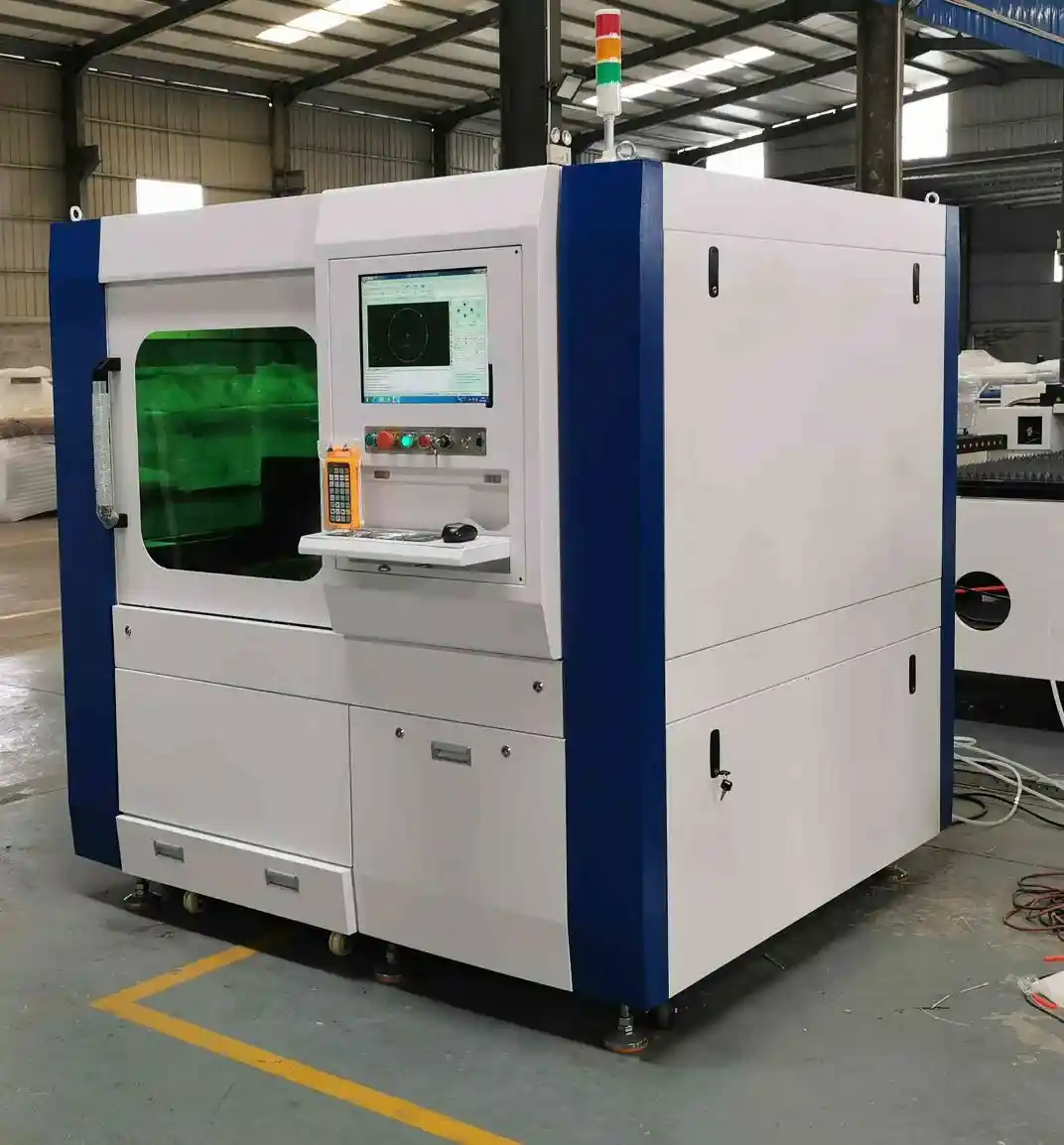
SF Series Small Precision Fiber Laser Cutting Machine -- one of five product lines compared by specification below.
The Buyer's Checklist
- Power sized to your thickest regular job, not your thinnest -- undersizing power is the most common regret we hear from buyers who chose on price alone, since a machine that's just short of your real thickness ceiling means every heavy job runs slower than it should.
- Worktable size matched to your actual stock, with nesting room rather than a bed sized to the exact sheet dimension -- a bed that's too tight limits nesting efficiency even if it technically fits the sheet.
- Assist gas delivery -- confirm the machine and your shop's gas supply setup support the gas type and pressure your materials need, including whether your current gas supplier can keep up with a higher-volume nitrogen or argon requirement.
- Control software your operators can actually learn quickly -- ask for a live demo of the nesting and cutting-parameter interface, not just the spec sheet, since this is what determines your team's actual ramp-up time.
- Automation level matched to your actual volume, not an aspirational future volume you haven't hit yet -- it's usually cheaper to add automation later than to carry its cost for years before you need it.
- Floor space and utilities -- power service, gas lines, and exhaust ducting all need to be confirmed before a machine arrives, not after, especially for larger-format or coil-fed lines with a bigger footprint.
- Warranty and spare-parts availability in your region, especially for source-specific consumables -- ask specifically how fast a replacement part reaches you, not just whether one exists.
- Export experience of whoever you're buying from -- ask how many machines they've actually shipped to your country and what that process looked like, including who handled customs clearance and installation on arrival.
Common Buying Mistakes We See
Beyond the checklist above, a few specific mistakes come up again and again on inquiry calls: buying based on the lowest quoted price without comparing bed construction or source brand behind it; sizing power to an average job rather than the thickest regular one; and assuming "fiber laser" is a single interchangeable category when source brand, head brand, and build quality vary meaningfully between suppliers at a similar headline power number.
A subtler mistake: treating the purchase decision as machine-only and not planning for installation logistics, operator training time, and the first few months of ramp-up as part of the real cost and timeline. A machine that arrives before your team or facility is ready adds delay that a little earlier planning avoids entirely.
Software and Control System: What to Actually Evaluate
Beyond the spec sheet, ask to see the actual nesting and cutting-parameter interface your operators will use daily -- how many clicks it takes to import a part file, nest it, and start a cut says more about real-world productivity than any power rating. A control system your team can learn in days rather than weeks pays off in reduced setup time on every job that follows.
Cutting Speed: What the Spec Sheet Number Actually Means
Unattended run time matters more to buying-guide readers throughput than peak cutting speed in a lot of real shop schedules -- a machine that can run a coil-fed or heavily automated job through a lunch break or shift change adds effective daily output without adding a second operator.
A published "cutting speed" figure is almost always measured at thin gauge and full rated power -- real-world throughput on your actual job depends on material, thickness, and how much of the nest is piercing versus continuous cutting motion. Ask for a speed estimate on your specific part rather than treating the headline number as a guarantee.
Comparing Our Product Lines by Specification
Rather than a single "best" machine, here's how our five main lines actually compare on the specifications that matter most:
| Line | Worktable / Format | Power Range | Accuracy | Best Fit |
|---|---|---|---|---|
| SF Series | Compact precision bed for thin sheet | 0.1mm-5mm sheet | ±0.01mm repositioning accuracy | Thin-to-medium gauge, high precision, small footprint |
| DF Series (DF2040) | 2000mm x 4000mm | 1000W-3000W published | ±0.02mm positioning accuracy | General-purpose production, the most common starting configuration |
| LF Series | 1500mm x 3000mm (LF1530), larger formats available | 1kW-12kW fiber laser | Heavy-duty plate-welded, tempered bed | Industrial multi-shift production |
| GF Series | 6 to 24+ meters bed length | 6kW-30kW fiber laser | ±0.03mm repeatability | Very large-format plate, structural fabrication |
| LFS Series | Continuous coil-fed processing line | Fiber laser integrated with decoiler/leveler | N/A -- continuous line | High-volume coil-fed production, unattended runs |
Figures are the manufacturer's published specifications for each line. Confirm exact configuration and accuracy for your specific order directly.
Specifications Glossary
| Term | What It Means |
|---|---|
| Positioning accuracy | How precisely the machine can move the head to a commanded coordinate |
| Repeatability | How consistently the machine returns to the same position across repeated moves |
| Laser source | The actual fiber laser generator brand (e.g. Raycus, IPG) -- affects beam quality and cost |
| Cutting head | Focuses the beam and controls nozzle standoff -- autofocus heads (e.g. Raytools) adjust automatically to material thickness |
| Worktable / bed | The physical cutting area -- sized to your sheet stock, with nesting margin |
Two Perspectives Worth Considering
integrating a new machine into an existing CAD/CAM and nesting workflow is as much the engineering question as the laser spec itself -- a machine that speaks the software your buying-guide readers shop already runs saves real integration time over one that needs a parallel toolchain.
consistency across a long run is what actually gets noticed -- if part 200 needs the same touch-up as part 2, that's a parameter or gas-purity problem worth flagging before it becomes a full-shift's worth of rework on a buying-guide readers order.
Total Cost Behind the Specification Sheet
A specification sheet describes what a machine can do, not what it costs to run -- pair the checklist above with a realistic running-cost estimate (assist gas, electricity, consumables) before comparing two machines purely on their headline specs. See our dedicated cost and pricing guide for the full running-cost breakdown.
A Sample Buying Timeline
A typical path from first inquiry to delivered machine runs through a few clear stages: initial conversation about material, thickness, and volume; a specific configuration recommendation with a written quote; confirmation of terms and any customization; manufacturing and testing against your requirements; then shipping, with lead time depending on configuration and current factory schedule. Knowing this sequence ahead of time helps buyers plan their own production ramp-up around a realistic delivery window rather than an assumed one.
None of the checklist items above are meant to slow down a straightforward purchase -- most buyers move through them in a single inquiry conversation once they know what to ask. The goal is simply making sure the questions get asked before the order is placed, not after, since a gap discovered post-delivery is always more disruptive than the same gap caught during quoting.
Getting a Second Opinion on Any Spec Sheet
It's reasonable to bring a specification sheet from any supplier -- including ours -- to your own engineering team or a trusted outside contact for a second read before committing. Numbers that look impressive in isolation (a very high maximum power, for instance) sometimes obscure a narrower practical range once worktable size, accuracy at that power, or realistic duty cycle are factored in, and a second set of eyes with no stake in the sale often catches that faster than reading the sheet alone.
Matching Specifications to Your Actual Parts, Not a Generic Job
The most reliable way to use a specification sheet is backward from your own parts: take your three or four most common jobs, note the material, thickness, and any tight-tolerance features, and check each candidate machine's published capability against that specific list rather than against a generic "general fabrication" description. A machine that looks identical to a competitor's on a headline power number can differ meaningfully once you check accuracy at your specific part size or thickness capacity on your specific material -- generic specs compare machines; your own parts compare machines for your business.
Reading a Specification Sheet Like an Engineer
A specification sheet is written to be accurate, not necessarily to highlight what matters for your specific job -- two figures worth reading more carefully than the headline power number are the accuracy/repeatability spec (measured under what conditions, and does it hold at your typical part size) and the power-thickness table (measured at what cutting speed, since a slower cut can push the same power through more thickness than the published "standard" figure suggests). Ask directly about either number if the spec sheet doesn't state the test conditions behind it.
Questions Worth Asking on a Demo Call
- Can you run a test cut on a sample of my actual material and thickness, not just a demonstration piece?
- What does the nesting workflow look like for a part with a complex hole pattern like mine?
- How is a cutting-parameter preset saved and reused for a repeat job?
- What happens on screen if the machine detects an error mid-cut?
Common Concerns Before Ordering
Buyers new to specification comparison sometimes worry about being sold more machine than they need, or the reverse -- being undersold on power to hit a lower price point. Both concerns are legitimate, which is why we walk through your actual thickness range and volume before recommending a specific line and configuration, rather than leading with a single one-size-fits-all recommendation.

Frequently Asked Questions
What's the single most important spec to check first?
Power tier relative to your thickest regular job -- more buyers regret undersizing power than any other single decision.
Is a higher positioning accuracy always better?
Only if your parts actually need it -- our SF Series' ±0.01mm accuracy matters for fine-detail thin-gauge work, but a general fabrication shop cutting thicker plate won't notice the difference over a ±0.02mm-class machine.
How do I compare cutting speed between two machines fairly?
Ask for a speed estimate on your specific material, thickness, and part geometry -- a headline "meters per minute" figure measured at thin gauge doesn't predict real throughput on a thicker or hole-heavy job.
Which product line should a general job shop start with?
For most general fabrication shops, the DF Series is the most common starting configuration -- it covers a wide thickness range at a moderate footprint before stepping up to LF or GF for heavier or larger-format work.
Do all your machines use the same laser source brand?
No -- source brand (Raycus, IPG, or others) varies by configuration and power tier; confirm which is specified for your exact machine.
What does 'repeatability' mean in practice?
It's how consistently the machine returns to the same position on repeated moves -- it matters most on high-volume production where part-to-part consistency across a long run is the priority.
Can I get a spec sheet before requesting a full quote?
Yes -- ask for the published specification sheet for any line above and we'll send it directly, no quote commitment required.
What's the most common buying mistake you see?
Comparing quotes on price alone without checking bed construction, source brand, or warranty terms behind the number -- two machines at a similar price can differ significantly in build quality.
How do I evaluate control software before buying?
Ask for a live demo of the actual nesting and cutting-parameter interface your operators would use daily, not just a description of features on a spec sheet.
How long does the process take from inquiry to delivered machine?
It varies by configuration and current factory schedule -- expect initial conversation and quoting to take days, with manufacturing and shipping adding several weeks to a few months depending on customization.
Should I request a test cut before ordering?
Yes, where possible -- a test cut on your actual material and thickness tells you more than any spec sheet about real-world cut quality and speed.
What happens if my requirements change after I've placed an order?
Raise it with us as early as possible -- changes are easier to accommodate before manufacturing is underway than after.


