Strategic Industrial Evolution: H-Beam Plasma Cutting in Montevideo
The industrial landscape of Montevideo, Uruguay, is currently undergoing a significant transition toward automated structural steel fabrication. As a primary logistics hub for the Southern Cone, the region requires high-throughput manufacturing capabilities to support maritime infrastructure, large-scale civil engineering, and energy sector projects. Central to this evolution is the implementation of the H-Beam Plasma Cutter, a specialized CNC system designed to handle the complexities of three-dimensional structural profiles. The integration of these systems allows local fabricators to meet international standards for structural integrity, particularly regarding weld preparation and geometric accuracy.
The move toward plasma-based automation in Uruguay is driven by the need for higher precision than traditional oxy-fuel cutting can provide. While oxy-fuel remains viable for extreme thicknesses, plasma technology offers a superior balance of speed and reduced thermal distortion for the standard ranges of H-beams and I-beams used in modern construction. By utilizing high-definition plasma power sources, facilities in Montevideo are now capable of executing complex geometries that were previously labor-intensive or technically unfeasible.
Technical Specifications of 45-Degree Beveling
In structural steel fabrication, the bevel angle is the most critical factor in determining the quality of a welded joint. The 45-degree bevel is the industry standard for creating V-grooves and J-grooves, which are essential for achieving Full Penetration Welding. When an H-beam is subjected to heavy structural loads, the weld must be as strong as the base metal itself. A precise 45-degree cut ensures that the welding electrode can reach the root of the joint, allowing for a complete fusion of the flanges and webs.
The H-Beam Plasma Cutter achieves this through a multi-axis torch head, typically involving a 5-axis or 6-axis robotic configuration. Unlike standard 2D plasma tables, these systems must calculate the torch height and angle in real-time as the head moves across the varying planes of the H-beam. This requires sophisticated inverse kinematics software that compensates for the thickness of the material and the plasma arc’s natural kerf. In Montevideo’s high-output facilities, these machines are calibrated to maintain angular tolerances within +/- 0.5 degrees, ensuring that the fit-up phase of assembly is seamless and requires zero manual grinding.
Robotic Integration and 5-Axis Motion Control
The core of the modern H-beam processing unit is the integration of 5-axis robotic motion. This technology allows the plasma torch to rotate (C-axis) and tilt (A/B-axis) while moving along the X, Y, and Z coordinates. For a fabricator in Uruguay, this means a single machine can perform the web cuts, flange notches, bolt holes, and the 45-degree bevels in a single pass. The elimination of manual layout and secondary handling significantly reduces the margin for human error.
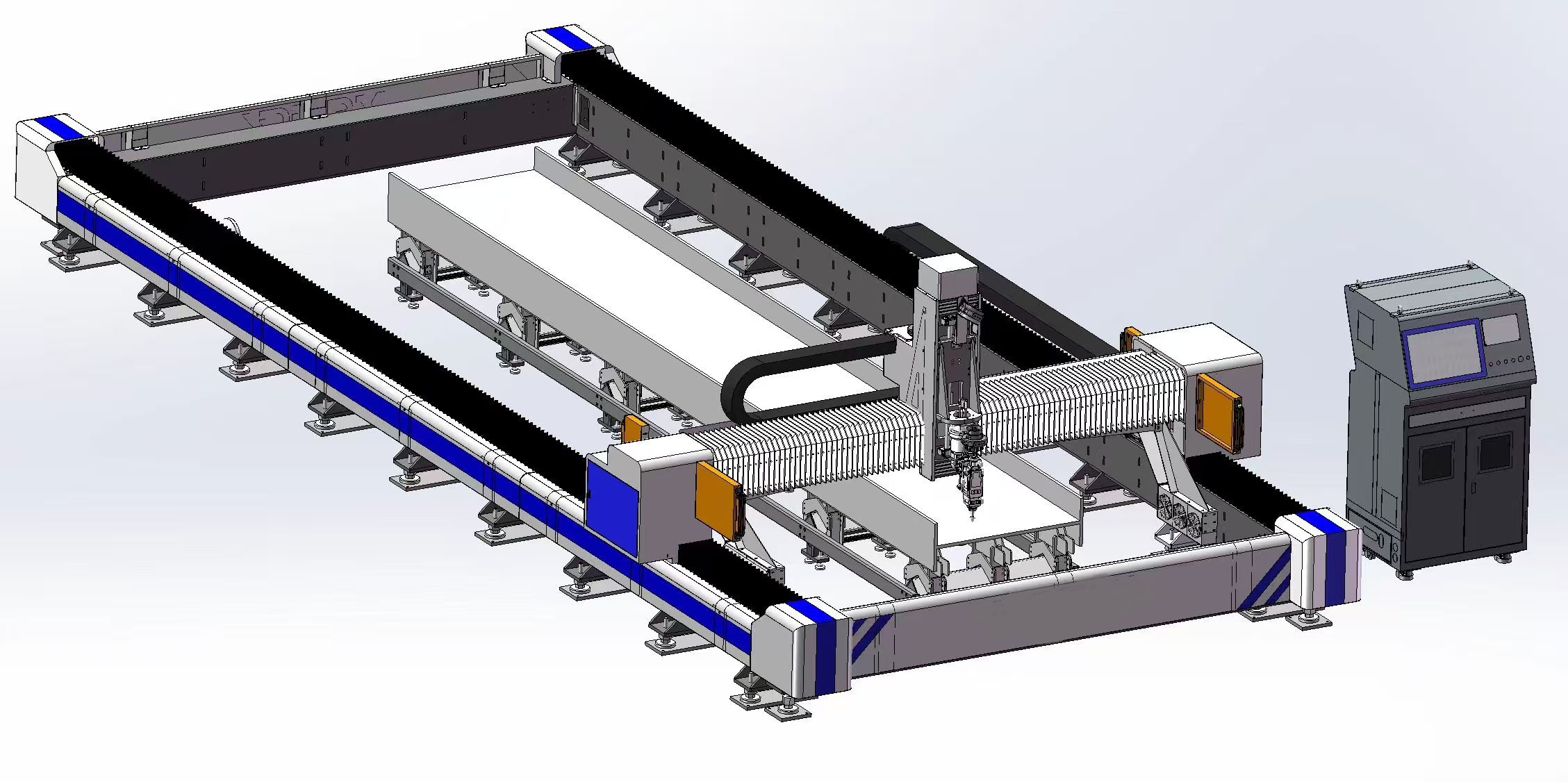
Industrial Application of H-Beam Plasma Cutter
These robotic systems utilize laser profiling sensors to scan the actual dimensions of the H-beam before cutting. Structural steel often possesses mill tolerances, meaning a beam may have slight twists or variances in flange height. The H-Beam Plasma Cutter uses this scanned data to adjust the cutting path dynamically. This “measure-then-cut” workflow is vital for 45-degree beveling, as even a 2mm deviation in flange height could result in an improper bevel geometry if the torch followed a theoretical CAD model rather than the physical reality of the steel.
Thermal Management and the Heat Affected Zone (HAZ)
A critical technical consideration in plasma cutting is the Heat Affected Zone (HAZ). When cutting thick-walled H-beams for structural applications in Montevideo, managing the thermal input is essential to prevent metallurgical changes that could embrittle the steel. High-definition plasma systems use a constricted arc with high energy density, which allows for faster travel speeds compared to conventional plasma or oxy-fuel. Faster travel speeds result in less time for heat to dissipate into the surrounding material, thereby narrowing the HAZ.
For 45-degree beveling, the torch must travel a longer path through the material than it would for a straight 90-degree cut. This increased “effective thickness” requires precise amperage and gas pressure regulation. Modern cutters utilize secondary shielding gases—often a mix of Oxygen, Nitrogen, or H35 (Argon-Hydrogen)—to cool the cut edge and prevent oxidation. This results in a clean, weld-ready surface that meets the stringent requirements of ISO and AWS standards, facilitating a seamless transition from the cutting floor to the welding station.
Operational Efficiency and Economic Impact in Uruguay
The adoption of H-beam plasma technology in Montevideo provides a competitive advantage in the MERCOSUR market. By automating the beveling process, fabricators can reduce total processing time per beam by up to 70%. In a traditional setup, a beam would be cut to length, moved to a layout station, marked manually, and then beveled using a hand-held plasma torch or a track burner. Each of these steps introduces potential for error and adds to the labor cost.
With a CNC H-Beam Plasma Cutter, the digital file (typically a DSTV or STEP file exported from Tekla or Revit) is imported directly into the machine’s controller. The machine executes all operations with high repeatability. This digital workflow ensures that every beam in a large-scale project, such as a port terminal or a high-rise frame, is identical. For Uruguayan contractors, this precision translates to faster on-site erection times, as the components fit together without the need for field corrections, which are costly and hazardous.
Concluding Industry Insight
As the global construction industry moves toward “Design for Manufacturing and Assembly” (DfMA) protocols, the role of high-precision structural processing becomes paramount. In Montevideo, the shift toward 45-degree automated beveling is not merely a localized upgrade but a synchronization with global supply chain requirements. The future of structural steel fabrication lies in the total integration of CAD data with robotic execution. We are moving toward an era where the “weld-ready” part is the baseline expectation, not a premium service. For the South American market, investment in H-Beam Plasma Cutter technology represents a transition from traditional heavy industry to a high-tech manufacturing model. This evolution ensures that local infrastructure projects are built with the same precision and structural reliability found in the world’s most advanced industrial zones, effectively bridging the gap between raw material and sophisticated engineering.
Industrial Expertise & Support
Are you looking for high-performance H-Beam Plasma Cutter tailored for the Global market? Our engineering team provides comprehensive solutions for modern manufacturing.

