Introduction: The Industrial Shift in Curitiba’s Steel Fabrication Sector
Curitiba, Brazil, has established itself as a critical hub for industrial manufacturing and structural steel engineering. As global demand for infrastructure increases, the regional fabrication facilities are transitioning from traditional mechanical cutting methods to advanced automated solutions. Central to this transition is the implementation of the H-Beam Plasma Cutter. However, the adoption of high-speed plasma technology brings significant environmental and occupational health challenges, specifically regarding the generation of fine metallic dust and hazardous fumes. To align with modern Environment, Health, and Safety (EHS) standards, the integration of dust-free operational protocols is no longer an optional upgrade but a fundamental requirement for operational viability in the global market.
The Technical Dynamics of H-Beam Plasma Cutting
Structural steel processing requires high precision to ensure the structural integrity of H-beams, I-beams, and channels. The H-Beam Plasma Cutter utilizes a high-definition plasma arc, often controlled by a multi-axis robotic arm, to execute complex geometries including bolt holes, copes, and miter cuts. Unlike plate cutting, H-beam processing involves varying thicknesses and internal corners where heat dissipation and gas flow patterns fluctuate. This complexity necessitates a system capable of real-time parameter adjustment to maintain edge quality and dimensional accuracy.
The cutting process involves the ionization of gas to create a plasma stream exceeding 20,000 degrees Celsius. As the plasma torch penetrates the steel, it vaporizes the metal, creating a high-velocity stream of molten particles. Without a dedicated mitigation strategy, these particles rapidly oxidize and disperse as airborne contaminants, posing risks to both equipment longevity and personnel health.
Dust Generation and Particulate Matter (PM) Characteristics
During the operation of an H-Beam Plasma Cutter, the primary byproduct is Particulate Matter (PM2.5). These particles are often less than 2.5 micrometers in diameter, allowing them to remain suspended in the factory atmosphere for extended periods. In the context of Curitiba’s industrial zones, local regulations and international EHS standards, such as ISO 45001, mandate strict limits on the concentration of these particles. The chemical composition of the dust—often containing iron oxide, manganese, and chromium—requires specialized filtration to prevent respiratory issues and long-term neurological effects in workers.
Engineering Dust-Free Operations
To achieve a dust-free environment, the integration of a high-efficiency Fume Extraction System is essential. In H-beam processing, “dust-free” refers to the containment and filtration of 99.9% of airborne particulates at the source. This is achieved through several engineered layers of protection.
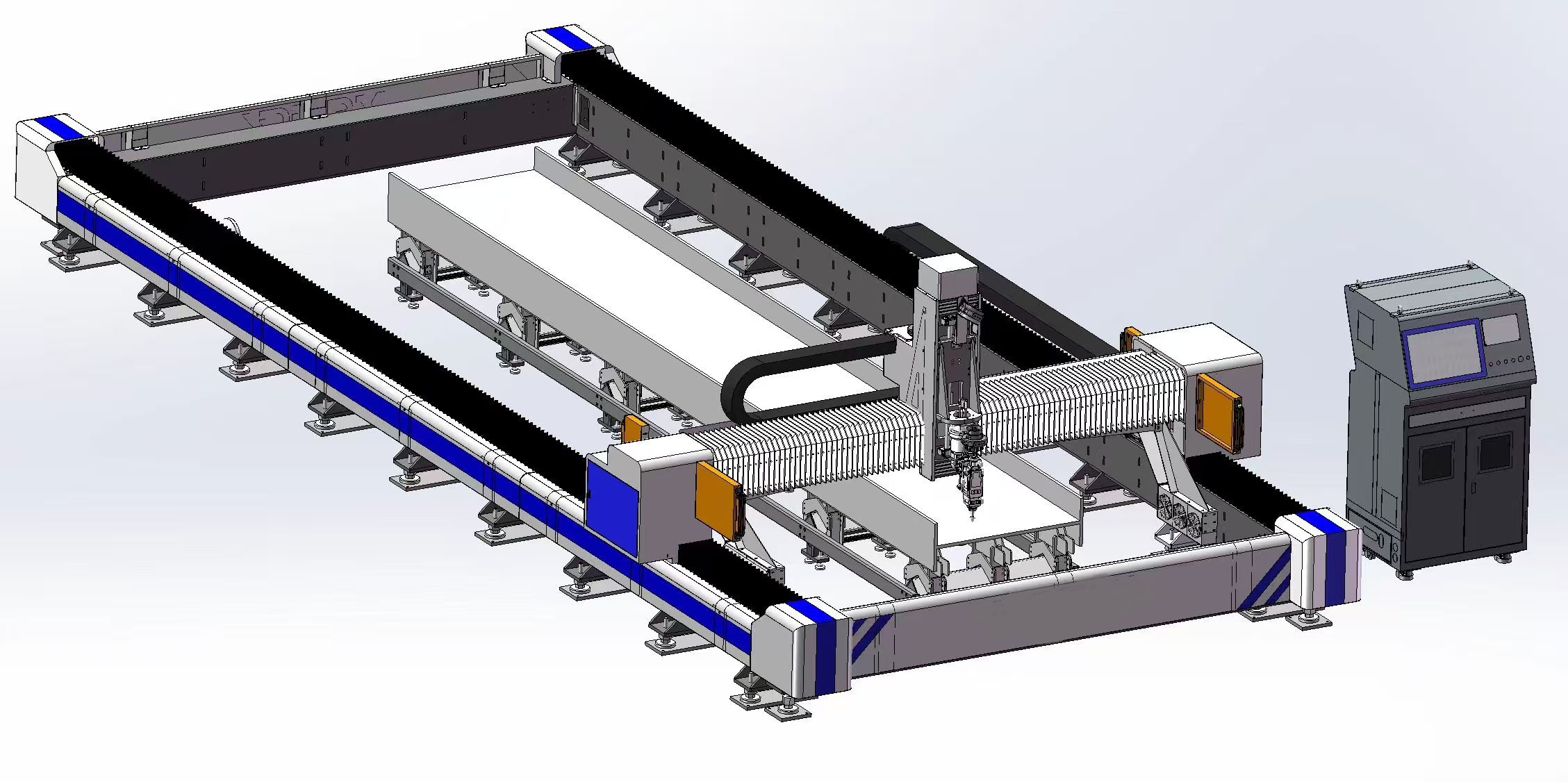
Industrial Application of H-Beam Plasma Cutter
Zoned Extraction and Downdraft Tables
Modern H-beam systems utilize zoned extraction modules. As the robotic plasma head moves along the length of the beam, sensors activate vacuum suction only in the specific zone where the cutting occurs. This concentrates the static pressure, ensuring that the velocity of the air intake is sufficient to capture heavy metallic dust before it escapes the machine enclosure. For H-beams, which have complex profiles, the extraction must be designed to pull air from both the top and bottom of the flange simultaneously.
Pulse-Jet Filtration Technology
The extracted air is directed into a filtration unit equipped with PTFE-coated (Polytetrafluoroethylene) cartridges. These filters are designed to capture sub-micron particles. To prevent the filters from clogging (blinding), a pulse-jet cleaning system is employed. High-pressure compressed air is periodically blasted through the center of the filter, dislodging the dust cake into a sealed collection hopper. This allows for continuous operation without a drop in suction pressure, maintaining the integrity of the dust-free environment during high-volume production shifts.
Compliance with Brazilian and International EHS Standards
In Brazil, the Ministry of Labour enforces Regulatory Standards (Normas Regulamentadoras), specifically NR-12 (Machinery and Work Equipment Safety) and NR-15 (Unhealthy Activities and Operations). For a facility in Curitiba to remain compliant, the H-Beam Plasma Cutter must be equipped with localized exhaust ventilation (LEV). The transition to dust-free operation directly impacts the “Insalubridade” or hazard pay requirements under Brazilian law, potentially reducing operational overhead by providing a demonstrably safe working environment.
Furthermore, global B2B partners increasingly demand “Green Supply Chain” certification. Demonstrating that structural components are manufactured in a facility that prioritizes air quality and waste management provides a competitive edge in international tenders. The data-driven monitoring of air quality within the plant serves as a verifiable metric for EHS audits.
Economic Impacts of Clean Operation
While the initial capital expenditure for a dust-free Robotic 3D Profiling system is higher than that of a standard plasma cutter, the Total Cost of Ownership (TCO) is lower. Metallic dust is abrasive and conductive. When allowed to settle on CNC rails, electronic encoders, and power sources, it causes premature wear and short circuits. By maintaining a clean atmosphere, the mean time between failures (MTBF) for the robotic components is significantly extended. Additionally, the reduction in manual cleaning time and the elimination of the need for heavy-duty respiratory PPE for all floor staff contribute to higher throughput and improved employee retention.
Technical Specifications for Implementation
For engineers in Curitiba looking to specify these systems, the following parameters are critical:
1. Airflow Capacity: The extraction system should offer a minimum of 6,000 to 10,000 m3/h depending on the plasma amperage.
2. Filtration Efficiency: HEPA or MERV 16 rated filters are required to handle the fine metallic oxides produced by high-definition plasma.
3. Noise Mitigation: Dust extraction units must be fitted with silencers to maintain ambient noise levels below 85 dB(A), in accordance with NR-15.
Concluding Industry Insight: The Future of Clean Fabrication
The evolution of the H-Beam Plasma Cutter in the Curitiba industrial corridor reflects a broader global trend toward “Invisible Manufacturing.” In this paradigm, the heavy industrial processes of the past are refined through automation and environmental engineering to the point where the external impact—noise, dust, and vibration—is virtually eliminated. As the structural steel industry moves toward more complex architectural designs and higher-strength alloys, the precision of the cut will remain paramount, but the sustainability of the process will become the primary differentiator for market leaders. Facilities that invest in dust-free, EHS-compliant technology today are not merely following regulations; they are future-proofing their operations against tightening carbon and environmental mandates that will soon define the global B2B landscape. The integration of high-definition plasma with advanced filtration marks the end of the “dirty” fabrication shop and the rise of the high-tech steel processing center.
Industrial Expertise & Support
Are you looking for high-performance H-Beam Plasma Cutter tailored for the Global market? Our engineering team provides comprehensive solutions for modern manufacturing.

