Industrial Evolution: The Role of H-Beam Plasma Cutting in Bogotá’s Manufacturing Sector
Bogotá, Colombia, has emerged as a strategic nexus for structural steel fabrication in Latin America. As the demand for complex infrastructure—ranging from high-rise commercial frames to industrial warehouses—accelerates, the regional manufacturing sector is transitioning from traditional mechanical drilling and sawing to advanced automated thermal cutting. The integration of the H-Beam Plasma Cutter equipped with energy-efficient fiber source technology represents a significant shift in the technical capabilities of the local metalworking industry. This transition is not merely a matter of speed but a fundamental change in the efficiency of structural steel processing, focusing on precision, lower operational costs, and reduced environmental impact.
The global B2B market is increasingly looking toward regions like Bogotá for high-output fabrication solutions that utilize European and North American engineering standards while maintaining competitive operational overhead. By adopting fiber-based plasma sources, facilities in this region are addressing the critical challenges of power consumption and consumable longevity, which are paramount in high-volume structural production.
Technical Architecture of Fiber-Integrated Plasma Systems
The core of the modern H-Beam Plasma Cutter lies in its power delivery system. Traditional plasma systems relied heavily on high-frequency transformers and complex gas delivery mechanisms that often resulted in significant energy loss. In contrast, energy-efficient fiber source technology utilizes solid-state components to generate a high-density plasma arc. This architecture allows for a higher wall-plug efficiency, meaning a greater percentage of electrical input is converted directly into cutting energy rather than being dissipated as waste heat.
In the context of H-beam processing, the machine must navigate the complex geometry of the flange and the web. Systems deployed in Bogotá’s industrial zones often feature 6-axis robotic kinematics or multi-axis CNC gantries. These systems allow the plasma torch to maintain a perpendicular orientation to the material surface or execute precise bevel cuts for weld preparation. The fiber source ensures that the arc remains stable even during rapid changes in torch height or orientation, which is essential for maintaining the structural integrity of the H-beam’s cross-section.
Energy Efficiency and Operational Cost Analysis
For industrial operations in Colombia, energy costs are a variable that can significantly impact the bottom line of large-scale projects. Fiber-based plasma sources provide a dual advantage: they require less cooling capacity and exhibit a lower idle power draw. When compared to legacy CO2 or older air-plasma systems, the fiber-integrated H-Beam Plasma Cutter can reduce total energy consumption per meter of cut by up to 30 percent.
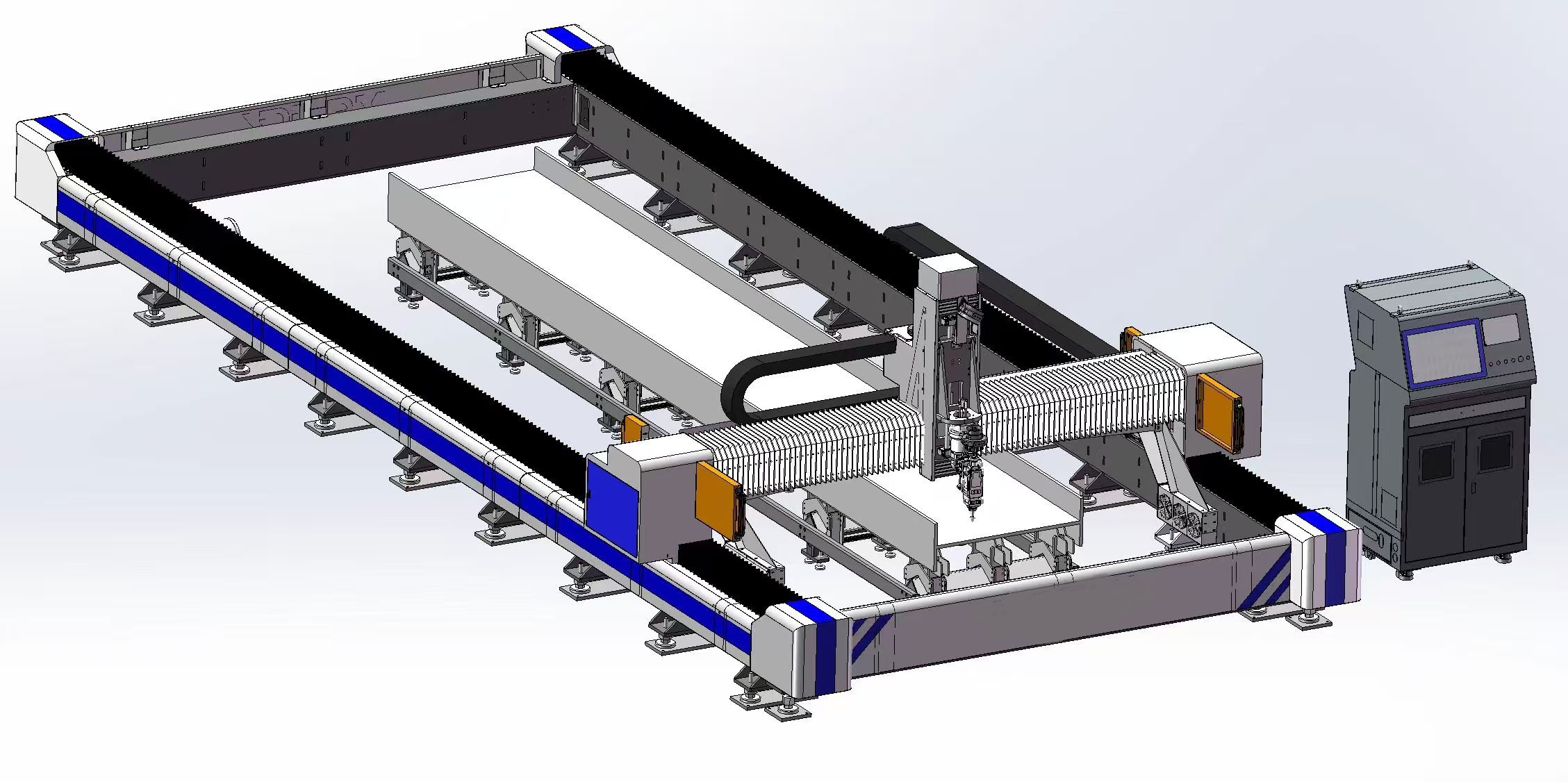
Industrial Application of H-Beam Plasma Cutter
Furthermore, the precision of the fiber source minimizes the Heat Affected Zone (HAZ). A narrower HAZ means that the metallurgical properties of the structural steel are preserved, reducing the need for secondary grinding or heat treatment. This is particularly critical for high-tensile H-beams used in seismic-resistant structures, a standard requirement for construction in the Andean region. The reduction in secondary processing directly correlates to lower labor costs and faster project turnaround times.
Precision Engineering: Kerf Width and Material Utilization
Material waste is a significant cost driver in structural steel fabrication. The implementation of kerf width optimization through advanced software integration allows Bogotá-based fabricators to maximize material yield. Fiber source technology produces a highly constricted arc, resulting in a narrower kerf compared to conventional plasma systems. This precision allows for tighter nesting of parts and more intricate cutouts within the H-beam web, such as service holes for HVAC, plumbing, and electrical conduits.
The synchronization between the CNC controller and the fiber power source allows for real-time adjustments of gas flow and current intensity. As the torch moves from the thicker flange to the thinner web of the H-beam, the system automatically recalibrates the cutting parameters. This ensures a consistent surface finish (Ra value) across the entire profile, eliminating the dross accumulation that typically occurs during manual or semi-automated cutting processes.
Integration with Industry 4.0 and BIM Workflows
The deployment of these machines in Bogotá is increasingly tied to Building Information Modeling (BIM) workflows. Technical data from structural models (such as TEKLA or Revit) is exported directly to the plasma cutter’s control system. This digital thread ensures that every bolt hole, cope, and miter cut is executed with sub-millimeter accuracy. The fiber source’s reliability is a key component here; because the electrical components are solid-state, the variability in cut quality over long production shifts is virtually eliminated.
Moreover, these systems are equipped with IoT-enabled sensors that monitor the health of the fiber source and consumables in real-time. Data regarding electrode wear, nozzle integrity, and coolant temperature is analyzed to predict maintenance intervals. For global B2B partners, this level of technical transparency provides assurance that production schedules will be met without the interruptions caused by unexpected equipment failure.
Industry Insight: The Future of Structural Steel Processing
The shift toward energy-efficient fiber technology in Bogotá’s H-beam processing sector is indicative of a broader global trend: the convergence of sustainability and high-performance manufacturing. As carbon footprint regulations become more stringent, the ability to produce structural components with lower energy intensity will become a mandatory requirement rather than a competitive advantage. The fiber source is the primary driver of this transition, offering a modular and scalable solution that fits the volatile demands of modern construction.
Looking forward, the industry will likely see further integration of artificial intelligence in plasma cutting path planning to further reduce cycle times. For Bogotá, the adoption of these technologies positions the city not just as a regional fabricator, but as a sophisticated player in the global supply chain for structural steel. The investment in fiber-integrated H-Beam Plasma Cutter technology is a clear signal that the region is prioritizing long-term operational efficiency and technical precision over short-term CAPEX savings. This strategic focus ensures that the infrastructure of tomorrow is built with a level of accuracy and resource-consciousness that was previously unattainable in heavy industrial applications.
Industrial Expertise & Support
Are you looking for high-performance H-Beam Plasma Cutter tailored for the Global market? Our engineering team provides comprehensive solutions for modern manufacturing.

