Introduction to Advanced Thermal Cutting in Southern Peru
The industrial landscape of Arequipa, Peru, has undergone a significant transformation driven by the expansion of the mining and civil infrastructure sectors. As a primary hub for the Andean mining corridor, the demand for precision-engineered structural components has necessitated the adoption of high-specification automated systems. Among these, the H-Beam Plasma Cutter stands out as a critical tool for fabricating complex steel geometries. However, the regional requirement to process non-ferrous materials, specifically copper and aluminum, has introduced technical hurdles regarding thermal conductivity and surface reflectivity. Modern fabrication facilities in Arequipa are now integrating anti-reflection technology and specialized arc stabilization to address these challenges, ensuring that structural integrity and dimensional tolerances meet international ISO standards.
The Structural Dynamics of H-Beam Fabrication
H-beams, characterized by their wide flanges and central web, require multi-axis processing that traditional 2D plasma tables cannot provide. In the context of Arequipa’s heavy industry, these beams are used in the construction of massive leaching plants, conveyor supports, and seismic-resistant frameworks. The H-Beam Plasma Cutter utilizes a robotic arm or a multi-axis gantry system to maneuver the plasma torch around the fixed workpiece. This allows for the execution of cope cuts, bolt holes, and miter cuts in a single pass.
The technical complexity arises from the need to maintain a constant torch-to-workpiece distance across varying planes. High-definition plasma systems employed in the region utilize voltage-regulated height control to adjust the torch position in real-time. This is particularly vital when dealing with the heavy-gauge steel typical of mining infrastructure, where any deviation in the arc lead-in can result in significant dross accumulation or kerf angularity issues.
Addressing Reflectivity in Copper and Aluminum Processing
Arequipa’s proximity to major copper deposits makes the fabrication of copper busbars and specialized aluminum cooling components a frequent requirement. Unlike carbon steel, copper and aluminum possess high Non-Ferrous Thermal Conductivity and surface reflectivity. In laser cutting, reflectivity can damage the resonator; in plasma cutting, the challenge manifests as arc instability and “puddling” due to the rapid dissipation of heat away from the cut zone.
Anti-reflection technology in this context refers to the integration of advanced power supply modulation and specialized gas chemistry. To prevent the plasma arc from wandering on the reflective surface of polished aluminum, manufacturers utilize Secondary Inverter Circuitry. This circuitry allows for ultra-fast switching of the pilot arc, ensuring that the main cutting arc remains constricted and focused even when the material’s surface properties fluctuate. By stabilizing the electromagnetic field around the plasma stream, the system compensates for the high electron mobility inherent in copper and aluminum alloys.
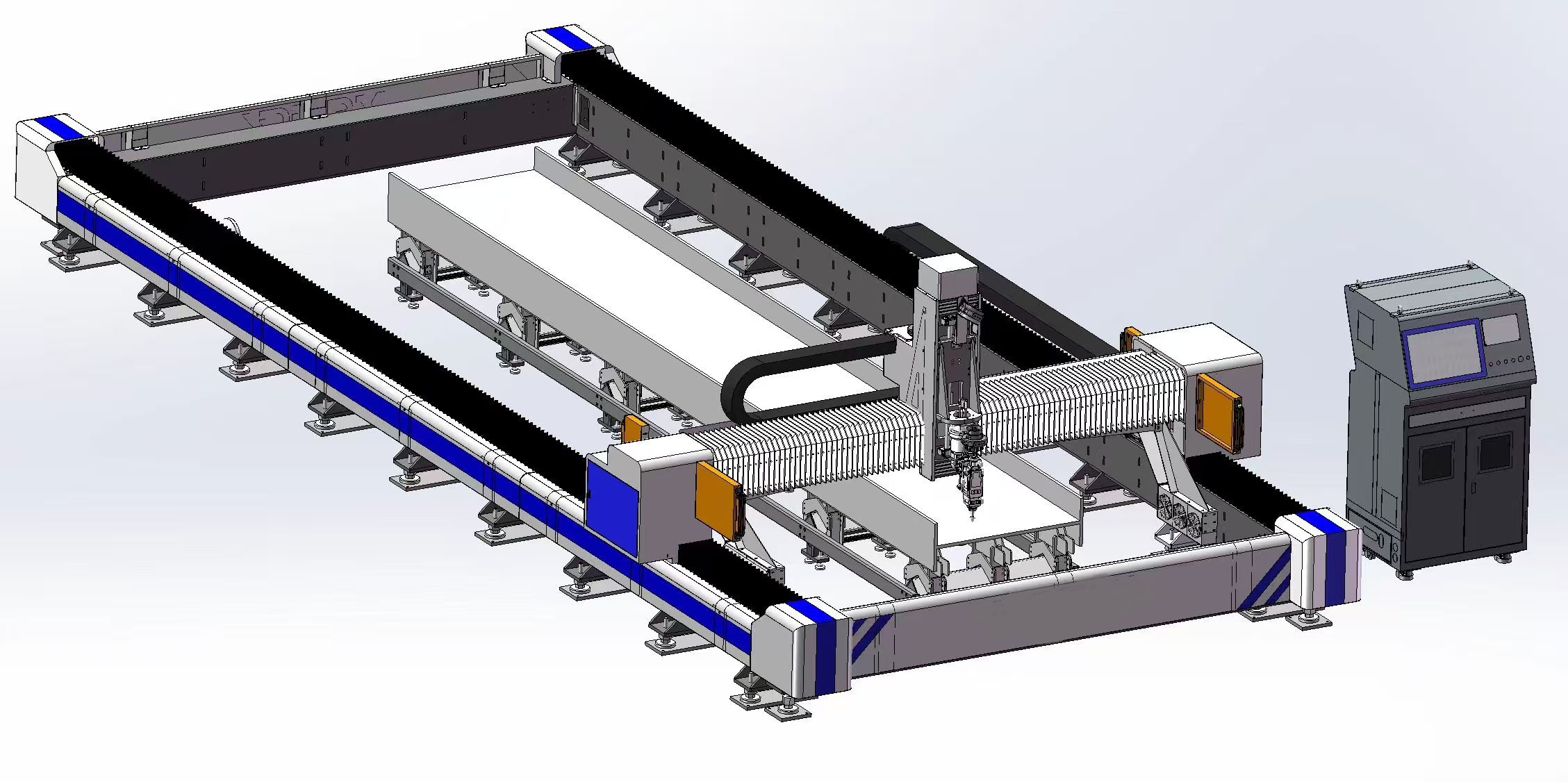
Industrial Application of H-Beam Plasma Cutter
Gas Dynamics and Kerf Quality Management
The choice of shielding and plasma gases is paramount when processing non-ferrous metals in high-altitude industrial zones like Arequipa. Standard air plasma often results in heavy oxidation on aluminum and copper surfaces. To achieve a weld-ready finish, technical operators utilize H35 (a mixture of 35 percent hydrogen and 65 percent argon) or nitrogen-water injection processes. These gas mixtures increase the energy density of the arc, which is necessary to overcome the thermal sink effect of copper.
Furthermore, the Kerf Compensation algorithms within the CNC software must be recalibrated for non-ferrous materials. Because copper conducts heat so efficiently, the melt zone tends to be wider than that of steel. The anti-reflection control systems work in tandem with the CNC to adjust the feed rate dynamically, preventing the “rounding” of corners and ensuring that the internal dimensions of H-beam web penetrations remain within a 0.5mm tolerance threshold.
Robotic Integration and 5-Axis Kinematics
The implementation of the H-Beam Plasma Cutter in Arequipa often involves 5-axis or 6-axis robotic kinematics. This is essential for beveling the flanges of H-beams to prepare them for full-penetration welds. The software must calculate the complex intersection of the plasma arc with the beam’s radius—the area where the web meets the flange. In traditional setups, this area is a frequent point of failure due to the thickness change. Modern systems use predictive height sensing to “anticipate” the transition, adjusting the amperage and gas pressure milliseconds before the torch reaches the transition zone.
This robotic precision is complemented by the anti-reflection sensors that monitor the back-EMF (Electromotive Force). If the sensor detects a spike in reflected energy or a drop in arc voltage—common when the torch passes over a highly reflective aluminum inclusion—the system automatically modulates the pulse frequency to maintain arc attachment.
Operational Efficiency in the Andean Industrial Sector
From a B2B perspective, the investment in anti-reflection capable plasma systems provides a clear ROI through the reduction of secondary grinding operations. In the competitive mining supply chain of Southern Peru, the ability to deliver H-beams that require zero post-process cleaning is a significant market advantage. The integration of High-Frequency Arc Ignition systems also reduces the wear on consumables, such as nozzles and electrodes, which can be a significant operational cost in remote regions where supply chain logistics for spare parts are complex.
Industry Insight: The Future of Plasma in Non-Ferrous Fabrication
The convergence of robotic automation and specialized power electronics is redefining the boundaries of plasma cutting. While fiber lasers have traditionally dominated the thin-gauge reflective metal market, the H-Beam Plasma Cutter equipped with anti-reflection technology is proving to be the superior choice for heavy-duty structural applications in Arequipa. The ability to handle the massive physical dimensions of an H-beam while maintaining the surgical precision required for copper and aluminum indicates a shift toward hybrid fabrication centers.
As global mining operations push toward deeper and more complex extraction environments, the demand for structural components that can withstand extreme stresses will only increase. The technical evolution seen in Peru suggests that the future of the industry lies in “intelligent” power sources—systems that do not merely output a constant current but instead react to the metallurgical properties of the workpiece in real-time. For global B2B stakeholders, the Arequipa model demonstrates that localized technical expertise, supported by high-end anti-reflection hardware, can effectively bridge the gap between raw material extraction and sophisticated structural engineering.
Industrial Expertise & Support
Are you looking for high-performance H-Beam Plasma Cutter tailored for the Global market? Our engineering team provides comprehensive solutions for modern manufacturing.

