Integration of Fiber Laser Welding Technology in the São Paulo Industrial Corridor
São Paulo remains the primary industrial engine of South America, hosting a dense concentration of automotive, aerospace, and medical device manufacturing facilities. As these sectors transition toward Industry 4.0, the demand for precision joining technologies has shifted from traditional arc welding to advanced laser systems. The adoption of the Fiber Laser Welder within this region is not merely a pursuit of throughput but a strategic alignment with tightening global Environmental, Health, and Safety (EHS) standards. In modern manufacturing, the mitigation of airborne particulate matter and metallic fumes is a critical metric for operational compliance and worker safety.
The transition to fiber laser technology in the ABC region and the interior of São Paulo state reflects a broader global trend: the requirement for “dust-free” or high-cleanliness manufacturing environments. Traditional Metal Inert Gas (MIG) and Tungsten Inert Gas (TIG) processes generate significant quantities of weld spatter and hexavalent chromium fumes, necessitating extensive localized exhaust ventilation (LEV) and frequent facility maintenance. Conversely, fiber laser systems provide a concentrated energy source that minimizes the volume of vaporized material, facilitating a cleaner production floor.
Technical Parameters of Dust-Free Laser Operations
The concept of dust-free operation in laser welding is rooted in the physics of the Heat Affected Zone (HAZ). A fiber laser operates at a wavelength of approximately 1070 nm, allowing for exceptional absorption rates in most metallic substrates. Because the energy is focused into a spot size often measured in microns, the volume of molten material is strictly controlled. This precision prevents the overheating of the surrounding substrate, which is the primary cause of material vaporization and the subsequent creation of fine dust particles.
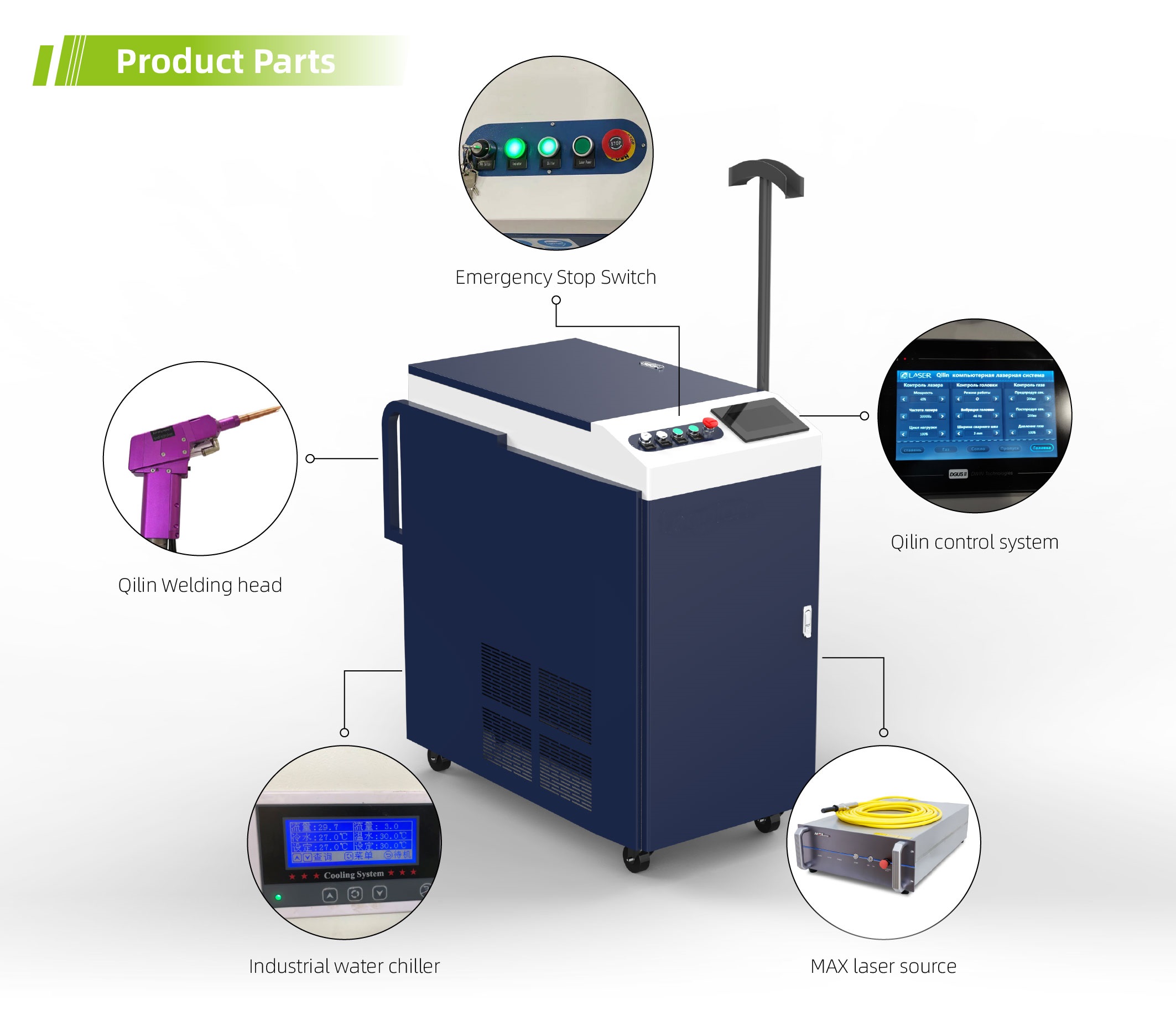
Industrial Application of Fiber Laser Welder
In the context of São Paulo’s high-precision sectors, such as surgical instrument assembly or electronics housing, the absence of spatter is a non-negotiable requirement. Fiber laser welders utilize high-frequency modulation and specialized beam delivery systems to maintain a stable keyhole during the welding process. This stability ensures that the molten pool remains contained, significantly reducing the emission of metallic aerosols. For facilities operating under ISO 14001 or equivalent environmental certifications, this reduction in particulate output simplifies the filtration requirements for HVAC systems and reduces the frequency of hazardous waste disposal associated with traditional welding slag.
Compliance with Modern EHS Standards in Brazil
The Brazilian regulatory environment, specifically through the Norma Regulamentadora (NR) framework, places stringent demands on air quality and machine safety. NR-12 (Machinery and Work Equipment Safety) and NR-15 (Unhealthy Activities and Operations) dictate the permissible limits for noise and airborne contaminants. The implementation of a Fiber Laser Welder allows manufacturers to meet these standards more effectively than traditional methods.
A critical component of this compliance is the integration of high-efficiency particulate air (HEPA) extraction units directly synced with the laser’s control system. In a typical São Paulo-based manufacturing cell, the laser process is enclosed in a Class 1 safety housing. This enclosure serves two purposes: it protects operators from reflected radiation and serves as a primary containment zone for any residual fumes. Because the laser process produces significantly less “smoke” than plasma or arc welding, the extraction systems can operate at lower volumes, reducing energy consumption and noise pollution within the facility.
The Role of the Beam Delivery System in Particle Control
The efficiency of a dust-free operation is heavily dependent on the Beam Delivery System. Modern fiber laser units in the Brazilian market utilize programmable wobble heads. These heads oscillate the laser beam in various patterns (circles, zig-zags, or eights), which allows for better gap bridging and a more uniform distribution of heat. By optimizing the energy distribution, the system avoids localized “hot spots” that would otherwise lead to material ejection or “sparking.”
Furthermore, the use of high-purity shielding gases—typically Argon or Nitrogen—plays a dual role. Beyond preventing oxidation of the weld bead, the gas flow is engineered to create a laminar curtain that directs any generated vapors toward the extraction intake. This aerodynamic control is essential for maintaining the longevity of the laser’s protective optics. In a high-volume production environment in São Paulo, maintaining clean optics is a prerequisite for consistent power density and, by extension, consistent weld quality.
Economic Advantages of Clean Manufacturing
While the initial capital expenditure for fiber laser technology is higher than that of traditional welding equipment, the total cost of ownership (TCO) is optimized through reduced secondary operations. In conventional welding, post-weld cleaning—such as grinding, pickling, or sandblasting—is required to remove spatter and oxidation. These processes are inherently “dirty” and contribute significantly to the dust load within a factory.
By utilizing a Fiber Laser Welder, manufacturers in the São Paulo region can often move parts directly from the welding station to assembly or painting. The elimination of post-processing steps leads to:
- Reduction in consumable costs (grinding discs, chemicals, and cleaning agents).
- Lower labor costs associated with manual part finishing.
- Increased floor space availability due to the removal of bulky cleaning stations.
- Extended lifespan of factory infrastructure, as metallic dust is highly abrasive and corrosive to other machinery.
Operational Implementation and Local Support
The successful deployment of dust-free laser welding in Brazil requires a robust local supply chain. São Paulo serves as the logistical hub for technical support, gas supply, and spare parts. Companies implementing these systems must ensure that their Environmental Health and Safety (EHS) protocols are updated to include laser-specific safety training. This includes the use of specific PPE, such as laser safety eyewear (OD 7+ for 1070nm), and the calibration of fume extraction sensors.
Local integrators are now offering turnkey solutions that combine the fiber laser source with robotic automation. This further enhances the “dust-free” aspect by removing the human operator from the immediate proximity of the weld zone, ensuring that even the minimal emissions produced are managed by automated systems without human exposure.
Industry Insight: The Future of Sustainable Joining
The shift toward fiber laser welding in São Paulo is indicative of a global movement where manufacturing efficiency is no longer decoupled from environmental responsibility. As carbon taxes and stricter air quality regulations become standardized, the “cleanliness” of a manufacturing process will become a primary competitive advantage. The ability to maintain a dust-free environment is not merely a health and safety preference; it is a requirement for the next generation of high-tech manufacturing, where sensitive electronics and high-purity alloys are the norm.
Looking forward, the integration of real-time monitoring and AI-driven process control will further refine the efficiency of fiber lasers. We anticipate that “zero-emission” welding cells will become the benchmark for the Brazilian aerospace and medical sectors by the end of the decade. For global B2B stakeholders, investing in the São Paulo industrial ecosystem means engaging with a market that is rapidly maturing in its technical capabilities and its commitment to modern EHS standards. The Fiber Laser Welder is the cornerstone of this evolution, providing a path to high-precision output without the environmental footprint of the past.
Industrial Expertise & Support
Are you looking for high-performance Fiber Laser Welder tailored for the Global market? Our engineering team provides comprehensive solutions for modern manufacturing.

