Introduction: The Industrial Evolution of Rosario’s Metalworking Sector
Rosario, Argentina, has long served as a critical nexus for South American manufacturing, particularly within the agricultural machinery, automotive, and aerospace sectors. As global demand shifts toward lightweight materials and high-conductivity components, the local industrial base is transitioning from traditional Gas Tungsten Arc Welding (GTAW) and Metal Inert Gas (MIG) processes toward high-precision laser systems. The integration of the Fiber Laser Welder into Rosario’s production lines represents a significant leap in processing efficiency, specifically when addressing the metallurgical challenges associated with non-ferrous metals.
The primary hurdle in welding materials such as C10100 copper or 6061 aluminum alloys is their inherent high reflectivity and thermal conductivity. Standard laser systems often suffer from catastrophic failure due to back-reflection, where the laser energy is bounced back into the delivery fiber and the resonator. This article examines the technical implementation of anti-reflection technology within fiber laser systems and how Rosario-based manufacturers are utilizing these advancements to stabilize the production of high-reflectivity components.
The Physics of Reflectivity in Copper and Aluminum Processing
Copper and aluminum exhibit low absorption rates for the standard 1070 nm wavelength produced by most ytterbium-doped fiber lasers. At room temperature, copper reflects approximately 95% of the incident infrared laser energy. This physical property necessitates a high power density to initiate the “keyhole” effect, where the material transitions from a solid to a molten state, significantly increasing the absorption rate.
However, during the initial phase of the pulse, the reflected energy can travel back through the beam delivery optics. Without specialized back-reflection mitigation, this energy can cause thermal damage to the optical sensors, the beam combiner, or the laser diodes themselves. In the industrial environment of Rosario, where high-duty cycles are required for agricultural implement manufacturing, equipment downtime due to optical failure is a critical cost factor that modern anti-reflection technology seeks to eliminate.
Technical Architecture of Anti-Reflection Systems
To combat the risks associated with high-reflectivity alloys, modern fiber laser welders incorporate a multi-stage protection strategy. This architecture is essential for maintaining the integrity of the optical isolation systems within the laser source. The protection is typically categorized into passive and active measures.
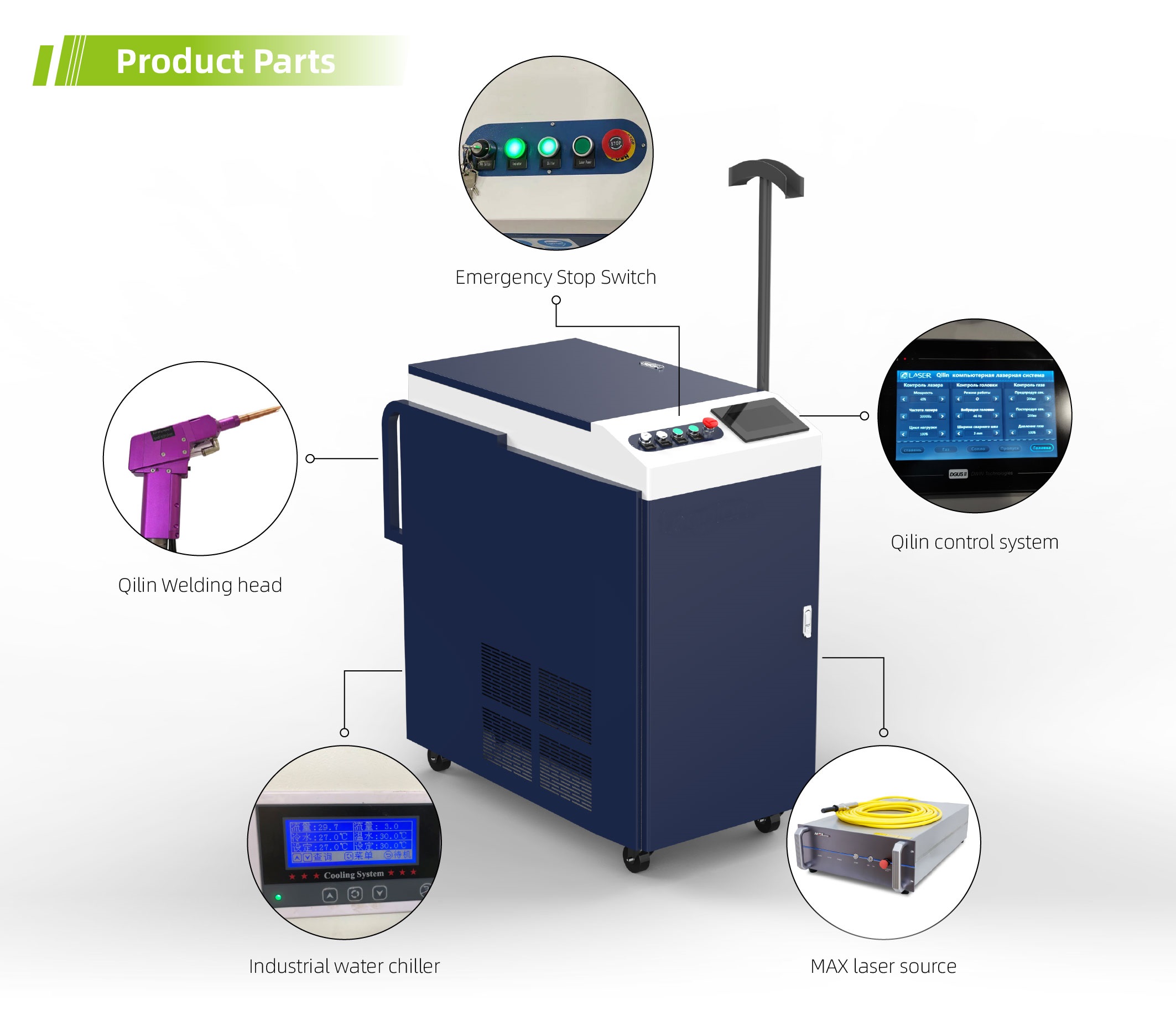
Industrial Application of Fiber Laser Welder
Passive protection involves the use of optical isolators and cladding power strippers. These components are designed to divert reflected light away from the sensitive gain medium and into a water-cooled heat sink. Active protection involves real-time monitoring via back-reflection sensors. These sensors detect sudden spikes in reflected energy and can trigger a microsecond-scale shutdown of the power supply to prevent hardware degradation. For Rosario’s manufacturers, this allows for the continuous welding of pure copper busbars and aluminum battery enclosures without the risk of expensive resonator repairs.
Implementation of Beam Oscillation Technology
Beyond protecting the hardware, achieving a high-quality weld in reflective materials requires precise control over the melt pool. Beam oscillation technology, often referred to as “wobble” welding, is a critical feature in the latest generation of fiber lasers deployed in the region. By utilizing galvanometric mirrors within the welding head, the laser beam can be moved in various patterns—such as circles, lines, or figure-eights—at frequencies ranging from 0 to 300 Hz.
This oscillation serves two primary technical purposes. First, it increases the effective width of the weld seam, compensating for fit-up tolerances common in large-scale aluminum structures. Second, and more importantly for copper, the constant movement of the beam helps to stabilize the keyhole and promotes a more uniform distribution of energy. This reduces the occurrence of porosity and spatter, which are frequent defects when welding 5000 and 6000 series aluminum. The result is a weld joint with superior mechanical properties and aesthetic finish, reducing the need for post-process grinding.
Impact on Rosario’s Automotive and Energy Infrastructure
The adoption of these technologies in Rosario is particularly evident in the production of components for the electric vehicle (EV) market and renewable energy infrastructure. Copper welding is foundational for the fabrication of battery interconnects and power distribution units. Traditional methods often result in high electrical resistance at the joint due to impurities or poor fusion. The Fiber Laser Welder, equipped with anti-reflection optics, ensures deep penetration and a narrow heat-affected zone (HAZ), which preserves the electrical conductivity and structural integrity of the copper.
In the aluminum sector, particularly for the manufacturing of heat exchangers and structural frames for the transport industry, the use of anti-reflection tech allows for higher processing speeds. Data suggests that switching from TIG welding to fiber laser welding can increase production throughput by a factor of four while reducing energy consumption by up to 30%. This efficiency is vital for Rosario-based firms looking to maintain a competitive edge in the global B2B marketplace.
Operational Parameters and Optimization Data
Successful welding of reflective materials is dependent on the optimization of several key parameters. For a standard 2kW fiber laser system, the following technical benchmarks are typically observed in the field:
1. Power Density: To overcome the initial reflectivity of copper, a power density exceeding 10^6 W/cm2 is required to establish a stable keyhole.
2. Shielding Gas: The use of high-purity Argon or Nitrogen is essential to prevent oxidation, which can further complicate the absorption of laser energy.
3. Focal Position: Maintaining the focal point slightly below the material surface (negative defocus) can improve the stability of the melt pool in aluminum alloys.
By strictly adhering to these parameters, technicians in Rosario are achieving weld depths of 3mm to 5mm in aluminum with minimal thermal distortion, a feat previously difficult to attain with conventional methods.
Concluding Industry Insight: The Future of Laser Processing
The industrial landscape in Rosario, Argentina, is indicative of a broader global trend: the democratization of high-end laser technology. The transition from basic cutting and welding to the complex processing of high-reflectivity materials signals a maturation of the local engineering sector. As the global transition toward electrification accelerates, the demand for copper and aluminum processing will only intensify.
The industry insight for the coming decade points toward the integration of Artificial Intelligence (AI) with real-time melt-pool monitoring. Future systems will likely go beyond simple back-reflection protection, using closed-loop feedback to adjust laser power and oscillation patterns instantaneously based on the thermal signature of the weld. For manufacturers in Rosario, staying at the forefront of these optical advancements is no longer a luxury but a technical necessity to meet the rigorous quality standards of international supply chains. The convergence of robust hardware protection and sophisticated beam control ensures that the fiber laser remains the most viable tool for the next generation of metallic fabrication.
Industrial Expertise & Support
Are you looking for high-performance Fiber Laser Welder tailored for the Global market? Our engineering team provides comprehensive solutions for modern manufacturing.

