Industrial Integration of Fiber Laser Welding in the Santiago Manufacturing Sector
Santiago, Chile, has emerged as a primary industrial hub in South America, bridging the gap between raw material extraction and advanced metallurgical processing. As the global demand for copper and aluminum increases—driven largely by the transition to electric vehicles (EVs) and renewable energy infrastructure—the technical requirements for joining these materials have become more stringent. Traditional welding methods, such as TIG (Tungsten Inert Gas) and MIG (Metal Inert Gas), often struggle with the high thermal conductivity and optical reflectivity of non-ferrous metals. This has led to the rapid adoption of the Fiber Laser Welder as the standard for precision manufacturing in the region.
The implementation of laser systems in Santiago’s industrial parks is not merely an upgrade in speed; it is a fundamental shift in how metallurgical challenges are addressed. Specifically, the integration of anti-reflection technology has solved the historical “back-reflection” problem that previously limited the use of solid-state lasers on high-purity copper and aluminum alloys. This article examines the technical architecture of these systems and their specific application within the Chilean industrial landscape.
The Physics of Reflectivity in Non-Ferrous Metals
Copper and aluminum are notoriously difficult to weld using standard laser optics because of their high initial reflectivity at the 1070 nm wavelength, which is the typical output of a fiber laser. At room temperature, copper can reflect over 90 percent of incident laser energy. This creates two primary technical hurdles: insufficient energy absorption to initiate a stable melt pool and the risk of catastrophic damage to the laser source due to reflected photons returning through the delivery fiber.
In Santiago’s high-precision workshops, engineers utilize high-brightness fiber lasers that employ a specific power density threshold to overcome this. Once the material reaches its melting point, its absorption rate increases significantly. However, the transition phase is where the risk of back-reflection is highest. Without specialized protection, the reflected light can cause thermal runaway in the laser’s gain medium or damage the optical combiners.
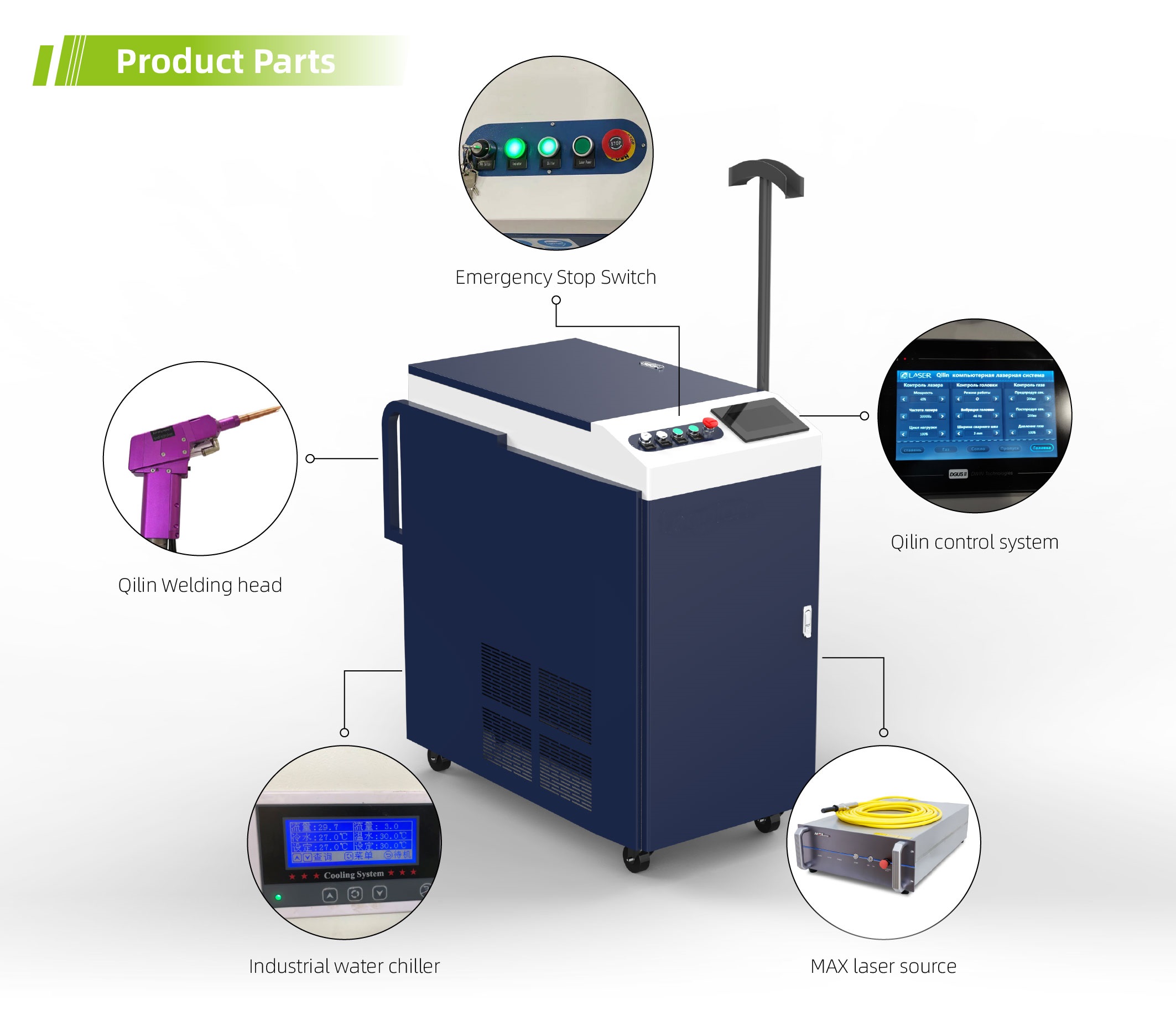
Industrial Application of Fiber Laser Welder
Advanced Back-Reflection Isolation Systems
To mitigate the risks associated with processing reflective materials, modern laser systems deployed in Chile incorporate multi-stage back-reflection isolation mechanisms. These systems function through a combination of optical hardware and real-time electronic monitoring. An optical isolator acts as a one-way valve, allowing the laser beam to exit while diverting reflected light into a water-cooled dump before it can reach the sensitive diode modules.
Furthermore, these welders are equipped with secondary sensors that monitor the power levels of returning light. If the back-reflection exceeds a predetermined safety threshold—measured in milliseconds—the system’s control logic executes an emergency shutdown of the laser emission. This level of protection allows operators in Santiago to weld oxygen-free copper and 6000-series aluminum alloys with high reliability, ensuring equipment longevity even in high-duty cycle environments.
Beam Oscillation and Wobble Technology
A significant advancement in the Fiber Laser Welder units found in the Chilean market is the integration of beam oscillation technology, commonly referred to as “wobble” welding. Because fiber lasers produce a very concentrated, small-diameter beam, the resulting melt pool is often narrow, which can lead to issues with fit-up tolerances and porosity in aluminum welds.
Wobble heads utilize internal galvanometers to move the laser spot in various patterns—such as circles, lines, or figure-eights—at frequencies up to 500 Hz. This oscillation widens the weld seam, allows for better degassing of the melt pool, and reduces the cooling rate of the metal. In the context of Santiago’s electrical component manufacturing, this results in joints with higher tensile strength and lower electrical resistance, as the process minimizes the formation of brittle intermetallic compounds.
Optimizing Optical-to-Optical Efficiency
For industrial operations in Chile, energy consumption and thermal management are critical operational parameters. The optical-to-optical efficiency of a fiber laser system determines how much electrical power is converted into usable laser energy at the workpiece. High-end fiber lasers achieve wall-plug efficiencies of over 30 percent, which is significantly higher than CO2 or Nd:YAG alternatives.
In the high-altitude and variable climate conditions of the Santiago metropolitan region, the stability of the laser’s chiller system is paramount. Efficient energy conversion reduces the heat load on the cooling system, allowing for a more compact footprint and lower maintenance requirements. Technical data suggests that for every kilowatt of laser power used in copper welding, the anti-reflection tech ensures that the energy is absorbed by the material rather than dissipated as waste heat, further enhancing the cost-per-weld metric for local manufacturers.
Material Specifics: Aluminum 6061 and C11000 Copper
The Santiago industrial sector frequently processes Aluminum 6061 for structural components and C11000 ETP (Electrolytic Tough Pitch) copper for busbars and power distribution units. Aluminum 6061 is prone to solidification cracking; however, the precise control of the heat-affected zone (HAZ) provided by fiber lasers mitigates this risk. By utilizing a high-peak-power pulse mode, the laser can break the surface oxide layer of the aluminum without over-heating the surrounding substrate.
For copper applications, the anti-reflection technology allows for deep-penetration “keyhole” welding. This is a process where the laser creates a vapor cavity that traps the beam, leading to nearly 100 percent energy absorption. This capability is essential for the production of high-current connectors used in the Chilean mining industry, where mechanical vibration and thermal cycling require welds of the highest integrity.
Concluding Industry Insight
The deployment of fiber laser welding systems in Santiago represents a broader trend in the global manufacturing hierarchy: the localization of high-tech processing near raw material sources. As Chile continues to dominate the copper market, the ability to process this material locally with high-efficiency laser technology provides a significant competitive advantage. The shift from exporting raw ore to manufacturing high-value components—such as EV battery modules and power electronics—is predicated on the reliability of anti-reflection technology.
Looking forward, the industry is moving toward “intelligent” welding systems where artificial intelligence monitors the spectral emission of the melt pool in real-time. This will allow for autonomous adjustments to laser power and wobble frequency, further reducing the margin for error in complex non-ferrous joints. For the global market, the Santiago model demonstrates that specialized laser optics are no longer a luxury but a technical necessity for any economy looking to participate in the green energy value chain. The intersection of robust hardware protection and sophisticated beam manipulation ensures that the Fiber Laser Welder remains the most viable tool for the next generation of metallurgical challenges.
Industrial Expertise & Support
Are you looking for high-performance Fiber Laser Welder tailored for the Global market? Our engineering team provides comprehensive solutions for modern manufacturing.

