Introduction to Advanced Metal Fabrication in the Cuyo Region
The industrial landscape of Mendoza, Argentina, has historically been defined by its viticulture and energy sectors. However, a significant shift is occurring in the metalworking infrastructure of the region. As global supply chains demand higher precision and faster turnaround times, local manufacturers are integrating high-density energy beam technologies to meet international standards. Central to this evolution is the deployment of the Fiber Laser Welder, a tool that has redefined the parameters of structural integrity and aesthetic finishing. By focusing on specialized techniques such as 45-degree beveling, Mendoza-based fabricators are achieving seamless welding results that were previously unattainable with traditional Gas Tungsten Arc Welding (GTAW) or Gas Metal Arc Welding (GMAW) processes.
The Technical Mechanics of Fiber Laser Welding
Fiber laser technology utilizes an optical fiber doped with rare-earth elements as the active gain medium. This configuration allows for the generation of a high-intensity laser beam with a wavelength typically around 1.06 micrometers. The primary advantage of this technology lies in its exceptional Power Density. Unlike conventional welding methods where heat is diffused over a larger area, a fiber laser concentrates energy into a microscopic focal point.
This concentration results in a high aspect ratio weld—deep penetration with a narrow width. For industrial operations in Mendoza, particularly those serving the petrochemical and wine-processing equipment sectors, this means significantly reduced thermal input. By minimizing the total energy delivered to the workpiece, manufacturers can effectively control the Heat-Affected Zone (HAZ). A smaller HAZ is critical for maintaining the metallurgical properties of specialized alloys, preventing grain growth, and reducing the risk of stress corrosion cracking in stainless steel components.
45-Degree Beveling: Engineering the Perfect Joint
To achieve a “seamless” weld, the preparation of the base metal is as critical as the welding process itself. In heavy-duty applications, square-butt joints often fail to provide the necessary depth of fusion for high-pressure environments. This is where 45-degree beveling becomes essential. By machining a 45-degree angle on the edges of the plates to be joined, fabricators create a V-groove geometry.
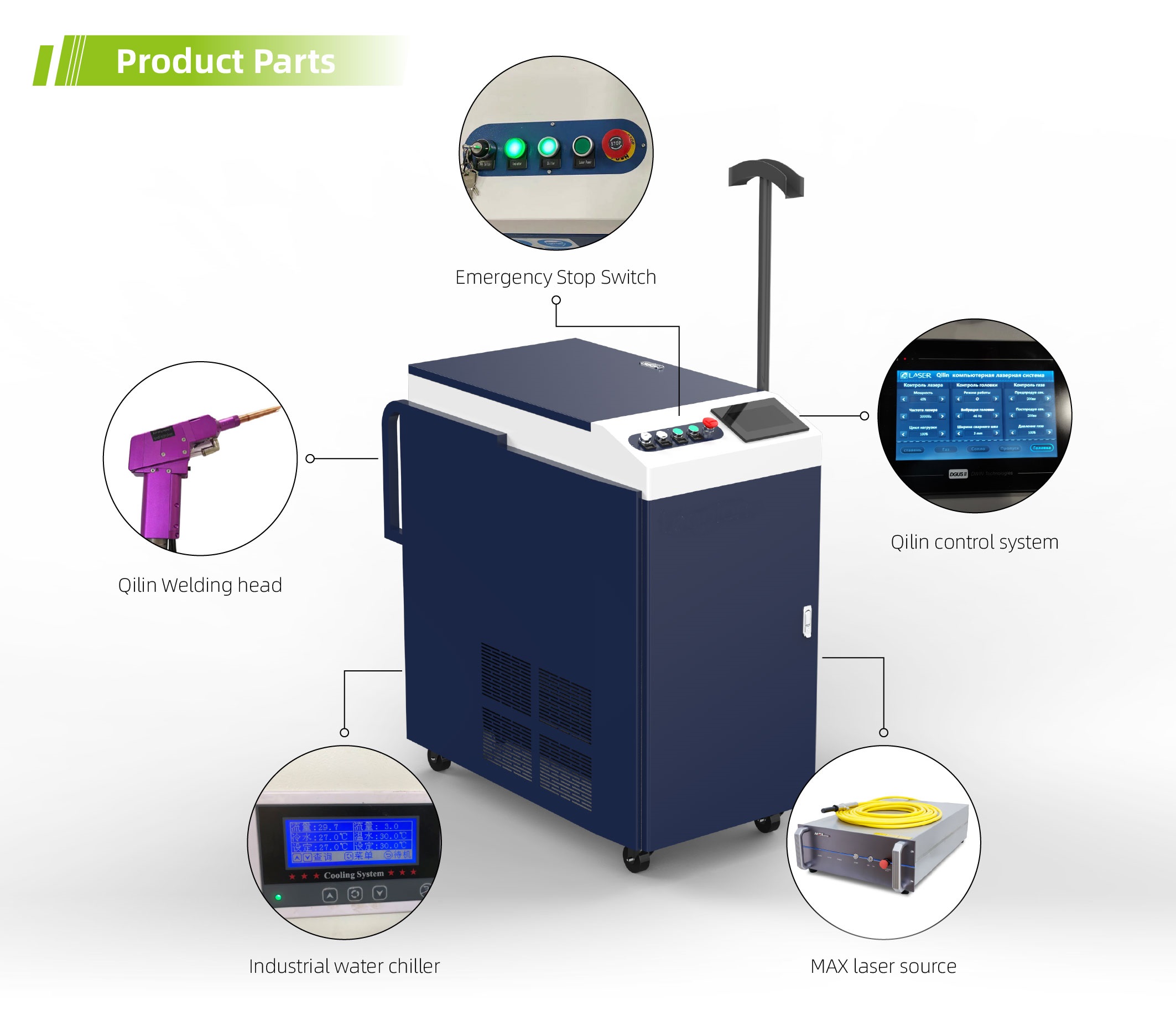
Industrial Application of Fiber Laser Welder
When a Fiber Laser Welder is applied to a 45-degree beveled joint, the beam can reach the root of the connection more efficiently. This geometry facilitates:
- Complete Root Penetration: Ensuring the weld metal fuses entirely through the thickness of the material.
- Controlled Dilution: Managing the mix between the base metal and the filler wire (if utilized) to maintain chemical consistency.
- Stress Distribution: A beveled joint allows for a smoother transition of mechanical loads across the weldment, reducing points of failure.
In the context of Mendoza’s industrial fabrication, this precision beveling is often performed using CNC fiber cutting systems before the welding phase, ensuring that the fit-up tolerances remain within the narrow margins required for automated or handheld laser processing.
Achieving Seamless Integration through Wobble Welding Technology
One of the technical challenges of laser welding is the requirement for extremely tight fit-up tolerances. In large-scale manufacturing, maintaining a zero-gap fit-up is often impractical. To address this, modern fiber laser systems in Argentina are employing Wobble Welding Technology. This involves the high-speed oscillation of the laser beam in various patterns—such as circles, lines, or figure-eights—as it moves along the joint.
The “wobble” effect effectively widens the beam’s path, allowing it to bridge larger gaps in the 45-degree bevel while still maintaining the benefits of high power density. This technique is instrumental in achieving a “seamless” look. The resulting weld bead is exceptionally flat and smooth, often requiring zero post-weld grinding or polishing. For the food and beverage industry in Mendoza, where hygienic surfaces are mandatory, the elimination of porosity and the achievement of a flush finish are significant operational advantages.
Comparative Efficiency: Fiber Laser vs. Traditional Methods
The transition to fiber laser systems in South American manufacturing hubs is driven by quantifiable performance metrics. When comparing a 2kW fiber laser to a traditional TIG setup for a 45-degree beveled stainless steel joint, several data points emerge:
- Processing Speed: Fiber lasers typically operate at speeds 4 to 10 times faster than manual TIG welding, depending on material thickness.
- Energy Consumption: The wall-plug efficiency of fiber lasers is approximately 30-40%, whereas CO2 lasers and traditional arc welders operate at much lower efficiency levels, leading to higher operational costs.
- Consumables: Laser welding reduces the reliance on shielding gas and filler rods, significantly lowering the cost per linear meter of the weld.
Furthermore, the reduction in post-processing is a major factor in the ROI for Mendoza’s workshops. Traditional arc welding on beveled edges often leaves significant reinforcement (over-weld) and spatter, necessitating labor-intensive manual finishing. The fiber laser’s ability to produce a clean, aesthetic joint in a single pass eliminates these secondary steps.
Material Versatility and Local Application
The versatility of the fiber laser allows Mendoza’s engineers to work with a wide array of materials. While stainless steel (304 and 316L) is dominant in the local wine industry, the region’s involvement in the mining and aerospace sectors requires the welding of aluminum alloys and carbon steels.
Aluminum, known for its high thermal conductivity and reflectivity, has historically been difficult to weld with lasers. However, the specific wavelength and high brightness of modern fiber lasers overcome these reflective barriers. When combined with a 45-degree bevel, the laser ensures that the oxide layer is fully penetrated, resulting in a high-strength, low-porosity bond that meets international structural codes.
Concluding Industry Insight: The Future of Localized High-Tech Manufacturing
The adoption of Fiber Laser Welder technology in Mendoza, Argentina, represents a broader trend in the global manufacturing sector: the democratization of high-precision engineering. As the cost of fiber laser sources continues to stabilize, regional industrial hubs are no longer dependent on importing high-spec components from overseas. Instead, they are developing the internal capacity to produce export-grade equipment with superior structural and aesthetic qualities.
The integration of 45-degree beveling with laser technology indicates a move toward “Industry 4.0” standards, where precision at the preparation stage dictates the efficiency of the entire production cycle. For the global market, this means that regions like Mendoza are becoming highly competitive alternatives for specialized fabrication. The industry insight here is clear: the future of B2B manufacturing lies in the ability to marry traditional metallurgical knowledge with high-energy beam precision. As “seamless” becomes the baseline requirement for structural and hygienic applications, the fiber laser will remain the primary instrument for achieving that standard in an increasingly demanding global economy.
Industrial Expertise & Support
Are you looking for high-performance Fiber Laser Welder tailored for the Global market? Our engineering team provides comprehensive solutions for modern manufacturing.