The Evolution of Precision Metal Fabrication in Lima, Peru
The industrial landscape of Lima, Peru, has undergone a significant transformation within the metalworking and manufacturing sectors. As the region positions itself as a strategic hub for South American logistics and infrastructure, the demand for high-precision joining technologies has escalated. Central to this shift is the adoption of the Fiber Laser Welder, a tool that has redefined the parameters of structural integrity and aesthetic finishing in heavy-duty and precision engineering. The transition from traditional Gas Tungsten Arc Welding (GTAW) and Metal Inert Gas (MIG) welding to fiber laser systems is driven by the requirement for higher throughput and reduced post-processing. In Lima’s competitive fabrication market, the ability to deliver seamless welds on complex geometries is no longer a luxury but a baseline requirement for global export standards.
Technical Fundamentals of 45-Degree Beveling
Beveling is a critical phase in weld preparation, particularly when dealing with medium-to-thick plate materials. A 45-degree bevel creates a V-groove geometry that allows the laser beam to access the root of the joint, ensuring full-thickness fusion. In the context of fiber laser technology, this preparation is essential for achieving a “seamless” finish. Unlike mechanical shearing or plasma cutting, laser-based beveling maintains the metallurgical integrity of the edge. The precision of a 45-degree angle ensures that the filler wire, if used, or the parent metal itself, flows uniformly into the joint cavity. This geometric precision minimizes the volume of the weld pool, which in turn reduces the energy input required to achieve a stable bond.
Optimizing the Fiber Laser Welder for Seamless Integration
The Fiber Laser Welder operates at a wavelength of approximately 1.06μm, allowing for high absorption rates in most industrial metals, including stainless steel, carbon steel, and aluminum. When integrated with a 45-degree beveling head, the system utilizes high-speed galvanometers to direct the beam with micron-level accuracy. The seamless nature of the weld is a direct result of the high energy density concentrated at the focal point. This concentration allows for “keyhole” welding, where the laser vaporizes a small column of metal, creating a narrow, deep weld profile. By utilizing a 45-degree preparation, the laser can effectively bridge the gap between two workpieces, resulting in a joint that requires little to no grinding or polishing after the process is complete.
Minimizing the Heat-Affected Zone (HAZ) in Structural Components
One of the primary technical advantages of utilizing laser technology in Lima’s manufacturing plants is the significant reduction of the Heat-Affected Zone (HAZ). Traditional welding methods distribute heat across a wide area, often leading to thermal distortion, warping, and a loss of mechanical properties in the base metal. The fiber laser’s ability to deliver a concentrated, coherent beam means that the heat is localized strictly within the weld path. In 45-degree beveling applications, this localized heating is crucial. It ensures that the structural characteristics of the surrounding material remain unchanged, which is vital for components destined for high-stress environments such as mining equipment or maritime infrastructure. The reduction in HAZ also translates to higher dimensional stability, ensuring that large-scale assemblies meet strict tolerance specifications without the need for secondary straightening processes.
Achieving Superior Weld Penetration Depth through Precision Beveling
For industrial applications in Peru, particularly in the construction of pressure vessels and heavy machinery, Weld Penetration Depth is a non-negotiable metric. A 45-degree bevel facilitates deeper penetration by allowing the laser beam to interact more efficiently with the joint interface. By adjusting the focal position and the power output of the fiber laser—typically ranging from 1kW to 3kW for handheld units and higher for automated systems—operators can achieve full penetration in a single pass. This is a significant improvement over traditional multi-pass welding, which increases the risk of porosity and inclusions. The synergy between the bevel angle and the laser’s power density ensures that the molten pool is stabilized, leading to a homogenous microstructure across the weld seam.
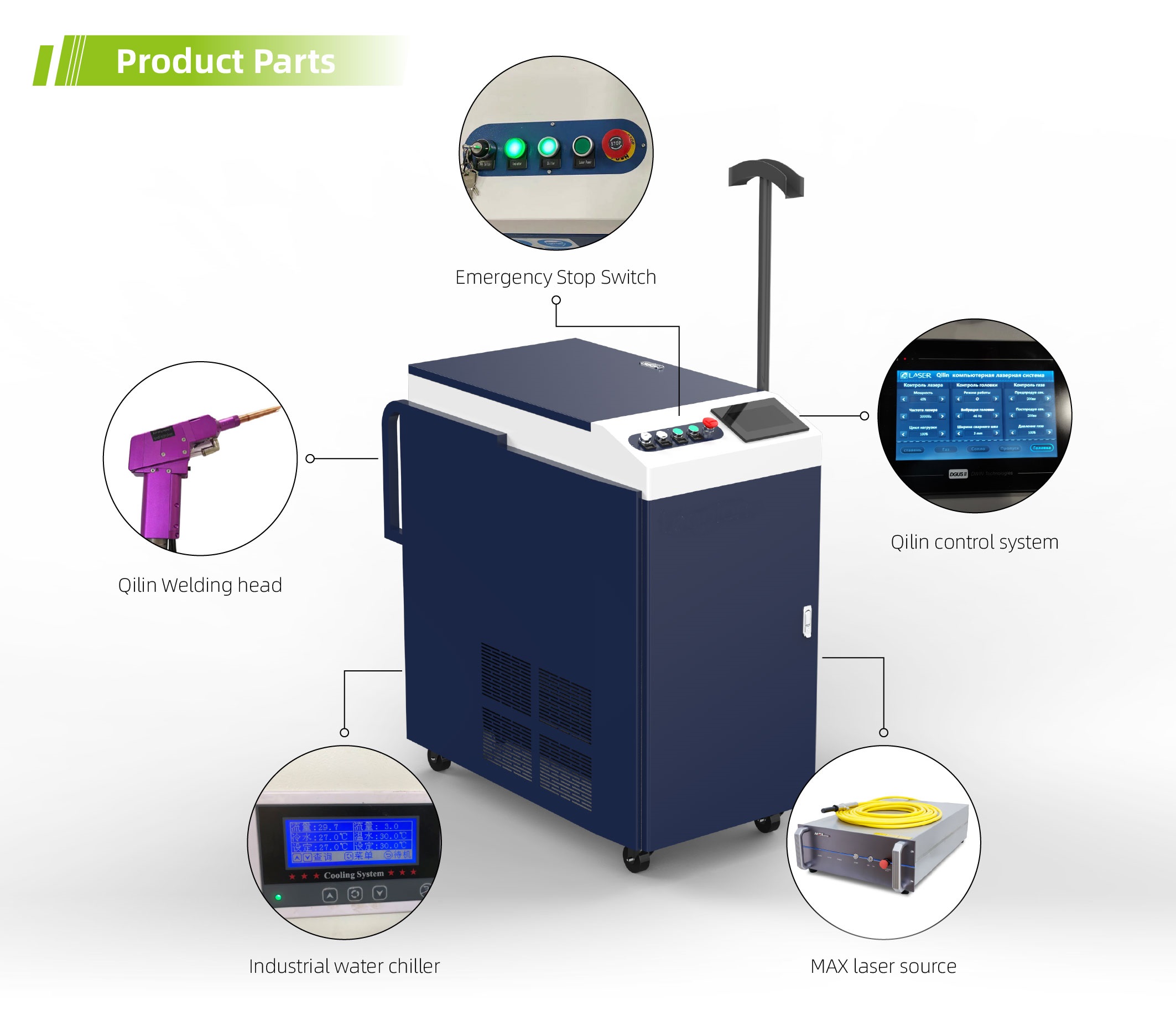
Industrial Application of Fiber Laser Welder
The Importance of Beam Parameter Product (BPP) in Bevel Welding
In high-end fabrication, the quality of the laser beam is quantified by the Beam Parameter Product (BPP). A lower BPP indicates a beam that can be focused to a smaller spot size over a longer working distance, which is essential when navigating the tight tolerances of a 45-degree beveled joint. For manufacturers in Lima, sourcing machines with a superior BPP ensures that the 45-degree beveling process remains consistent even at varying speeds. This consistency is what allows for the “seamless” appearance, as it prevents fluctuations in the weld bead width and height. When the BPP is optimized, the transition between the base metal and the weld metal becomes nearly invisible to the naked eye, fulfilling the aesthetic and functional requirements of high-value engineering projects.
Gas Dynamics and Shielding in 45-Degree Bevel Welding
The role of assist gases—typically Nitrogen or Argon—cannot be overlooked in the fiber laser welding process. When performing 45-degree beveling, the gas flow must be precisely calibrated to shield the molten pool from atmospheric contamination while also assisting in the removal of any residual vapor. The angle of the bevel can sometimes create turbulence in the gas flow; therefore, specialized nozzle designs are employed to ensure a laminar flow. This protection is critical for preventing oxidation, which can compromise the “seamless” finish and the structural integrity of the joint. In the humid coastal climate of Lima, managing gas purity and flow rates is a technical necessity to prevent hydrogen embrittlement and other metallurgical defects.
Concluding Industry Insight: The Global Shift Toward Automated Precision
The integration of 45-degree beveling with Fiber Laser Welder technology in Lima, Peru, represents a broader global trend toward the “democratization” of high-precision manufacturing. As labor costs for highly skilled manual welders rise and the demand for faster production cycles increases, the industry is pivoting toward systems that offer repeatable, high-quality results with minimal human intervention. The adoption of these technologies in emerging industrial hubs suggests a future where regional manufacturing centers can compete on a global scale by offering the same level of precision as established markets. For the B2B sector, the focus will continue to shift away from simple equipment acquisition toward the optimization of integrated processes—where beveling, welding, and finishing are treated as a single, continuous workflow. This holistic approach to metal fabrication is the key to unlocking new levels of efficiency and structural performance in the next decade of industrial growth.
Industrial Expertise & Support
Are you looking for high-performance Fiber Laser Welder tailored for the Global market? Our engineering team provides comprehensive solutions for modern manufacturing.

