Introduction: The Industrial Shift in Southern Peru
Arequipa, the primary industrial and mining hub of Southern Peru, is currently experiencing a significant technological transition within its metal fabrication sector. Traditionally reliant on Gas Tungsten Arc Welding (TIG) and Gas Metal Arc Welding (MIG), local workshops supporting the mining and construction industries are facing rising operational costs and a shortage of highly skilled manual welders. The integration of the Fiber Laser Welder into these production lines is no longer a luxury but a strategic financial decision. By transitioning from manual-intensive legacy processes to high-density energy beam welding, facilities in the region are reporting operational savings exceeding $5,000 USD per month. This analysis explores the technical and economic variables driving this shift, focusing on throughput, consumable reduction, and the elimination of secondary processing.
Technical Specifications of Fiber Laser Integration
The efficiency of fiber laser technology is rooted in its 1070nm wavelength and superior Photoelectric Conversion Efficiency, which typically exceeds 30 percent. In contrast to traditional arc welding, which disperses heat over a wide area, a fiber laser concentrates energy into a microscopic focal point. This results in a significantly narrower Heat-Affected Zone (HAZ), minimizing the risk of thermal distortion in thin-gauge stainless steel and aluminum alloys—materials frequently used in Arequipa’s food processing and mining equipment sectors.
Most industrial units deployed in this region utilize a continuous wave (CW) laser source ranging from 1.5kW to 3kW. These systems are equipped with a Wobble Welding Head, which allows the operator to adjust the beam width. This technical feature compensates for irregular fit-ups in joint preparation, a common challenge in large-scale manual fabrication. The ability to control the oscillation frequency and pattern (linear, circular, or ovoid) ensures that the weld bead remains consistent even when the material gap is not perfectly uniform.
Quantifying the $5,000 Monthly Operational Savings
The financial justification for replacing manual labor with fiber laser systems is calculated through three primary vectors: labor overhead, consumable lifecycle, and post-weld processing time.
1. Labor Optimization and Training Compression
In Arequipa, a certified TIG welder capable of high-precision work on pressure vessels or food-grade stainless steel commands a premium wage. To maintain a high-output production line, a facility typically requires three to four such specialists. A fiber laser system allows a lower-tier technician to achieve superior weld aesthetics and structural integrity with minimal training. By consolidating the tasks of three manual welders into one laser station, a company can save approximately $3,000 per month in direct salary and social benefit obligations. The learning curve for the laser system is measured in days, whereas TIG proficiency takes years to master.
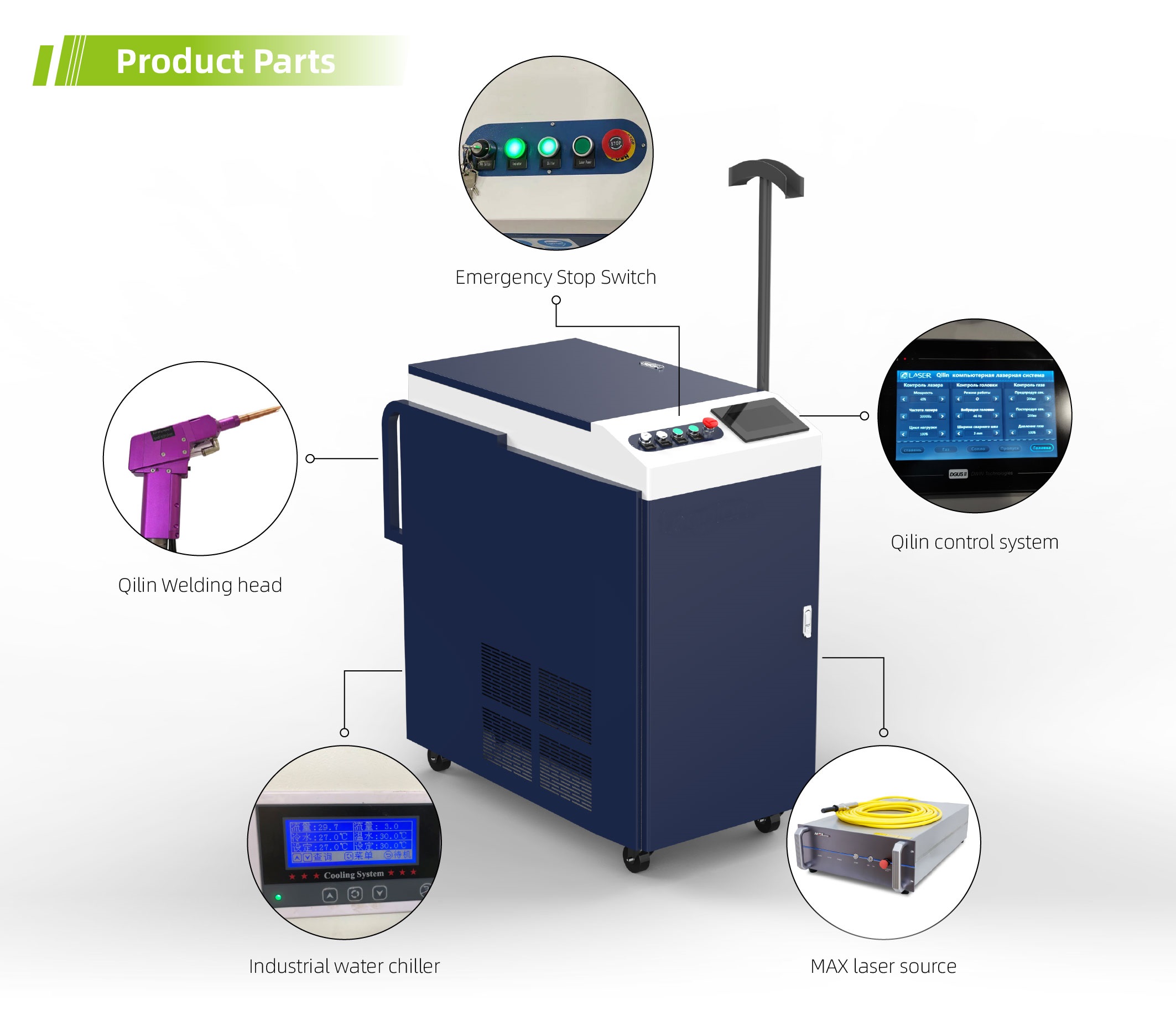
Industrial Application of Fiber Laser Welder
2. Elimination of Secondary Post-Processing
Manual arc welding inherently produces spatter and significant oxidation, requiring mechanical grinding, sanding, and chemical pickling to reach a finished state. In many Arequipa-based shops, for every hour spent welding, another hour is spent on surface finishing. The concentrated energy of the fiber laser produces a clean, aesthetic bead that requires zero post-weld grinding. By reclaiming these man-hours, facilities reduce labor costs by an additional $1,200 to $1,500 per month. Furthermore, the reduction in abrasives, grinding discs, and polishing compounds contributes directly to the bottom line.
3. Consumable and Energy Efficiency
Traditional welding requires high volumes of shielding gas and expensive tungsten electrodes or filler wire. While laser welding still utilizes shielding gas (typically Argon or Nitrogen), the localized nature of the weld consumes significantly less volume per linear meter. Additionally, the power factor of a fiber laser power supply is much higher than that of an old-fashioned transformer-based welder. The combined savings in gas, filler material, and electricity typically account for the remaining $500 to $800 of the monthly $5,000 target.
Structural Integrity and Metallurgical Advantages
Beyond the financial metrics, the technical performance of the Fiber Laser Welder provides a competitive advantage in the Arequipa market. The high power density allows for deep penetration with minimal heat input. This is critical for maintaining the mechanical properties of the base metal. In mining applications, where components are subject to high vibration and stress, the fine grain structure of a laser-welded joint often outperforms the coarse grain structure found in high-heat manual arc welds.
The systems also feature integrated cooling units, often utilizing a dual-circuit water chiller to maintain the temperature of both the laser source and the welding torch. This ensures a 100 percent duty cycle, allowing for continuous 24/7 operation in high-altitude environments like Arequipa, where air cooling is less efficient due to lower atmospheric density.
Implementation Challenges and Mitigation
While the transition offers clear fiscal benefits, it requires a shift in safety protocols. Laser radiation necessitates the use of dedicated welding enclosures or safety curtains with specific optical density (OD) ratings. Facilities in Peru must invest in proper PPE, including laser-safe eyewear, to protect operators from reflected beams. Furthermore, joint preparation must be more precise than in MIG welding. While the wobble head provides some flexibility, the technology thrives on tight tolerances, pushing local machine shops to upgrade their cutting and bending precision—often through the parallel adoption of fiber laser cutting tables.
Industry Insight: The Future of South American Fabrication
The adoption of fiber laser welding in Arequipa is a microcosm of a larger global trend: the “democratization” of high-precision photonics. As the hardware becomes more robust and portable, the reliance on scarce, highly specialized manual labor is diminishing. For B2B stakeholders, the insight is clear: the competitive edge in the next decade will not be defined by the size of the workforce, but by the level of technological integration per square meter of floor space.
In the South American context, where logistics and labor volatility can impact project timelines, the stability offered by automated or semi-automated laser systems is invaluable. Companies that fail to pivot from traditional manual methods will find themselves unable to compete on price or lead times. The $5,000 monthly saving identified in Arequipa is merely the entry-point; the long-term value lies in the ability to scale production without a linear increase in headcount, effectively decoupling output from labor availability.
Industrial Expertise & Support
Are you looking for high-performance Fiber Laser Welder tailored for the Global market? Our engineering team provides comprehensive solutions for modern manufacturing.

