Integration of Fiber Laser Welding Technology in the Antofagasta Industrial Sector
Antofagasta, Chile, serves as a critical epicenter for the global copper mining industry and heavy-scale mineral processing. As industrial fabrication requirements in this region shift toward higher precision and faster throughput, the adoption of the Fiber Laser Welder has accelerated. Unlike traditional Gas Metal Arc Welding (GMAW) or Tungsten Inert Gas (TIG) processes, fiber laser technology utilizes a solid-state laser source to generate a high-density coherent light beam. This beam is delivered via a flexible optical fiber to a handheld or automated welding head, allowing for deep penetration and minimal thermal distortion.
In the high-altitude and high-salinity environments characteristic of the Antofagasta region, equipment reliability is paramount. However, the transition to laser technology introduces specific safety risks related to high-intensity radiation and electrical discharge. Consequently, procurement and operation of these systems must strictly adhere to international safety benchmarks, specifically CE (Conformité Européenne) and the NR-12 (Norma Regulamentadora 12) safety standards. These frameworks ensure that the equipment is not only productive but also engineered to prevent catastrophic failure and operator injury.
Technical Specifications and Beam Dynamics
The core of a 1.5kW to 3kW Fiber Laser Welder typically involves a Ytterbium-doped fiber source operating at a wavelength of approximately 1070nm. This wavelength is highly absorbable by most industrial metals, including stainless steel, carbon steel, and aluminum alloys. The high energy density allows for the creation of a “keyhole” welding effect, where the metal is vaporized and forms a narrow, deep cavity surrounded by molten material.
One of the primary technical advantages in the Antofagasta mining maintenance sector is the reduction of the Heat-Affected Zone (HAZ). A minimized HAZ preserves the mechanical properties of the base metal, such as tensile strength and corrosion resistance, which are vital for structural components used in mineral leaching and transport. Furthermore, the integration of a high-speed Galvanometer Scanner within the welding head enables “wobble” functionality. This oscillation of the laser beam compensates for poor fit-up tolerances in large-scale industrial parts, ensuring a consistent weld bead without the excessive use of filler wire.
CE Certification: European Safety Compliance
For a Fiber Laser Welder to be deployed in a global B2B context, CE certification is a fundamental requirement. This indicates that the manufacturer has evaluated the product and deemed it to meet EU safety, health, and environmental protection requirements. In the context of laser welding, this involves compliance with the Machinery Directive (2006/42/EC), the Low Voltage Directive (2014/35/EU), and the EMC Directive (2014/30/EU) for electromagnetic compatibility.
Specifically, the equipment must comply with EN 60825-1, which governs the safety of laser products. Given that a handheld fiber laser is classified as a Class 4 Laser Safety device, it is capable of causing permanent eye damage and skin burns from direct or reflected beams. CE-compliant systems must include integrated safety interlocks, laser emission indicators, and emergency stop circuits that are hard-wired to the power source to ensure immediate de-energization in the event of a fault.
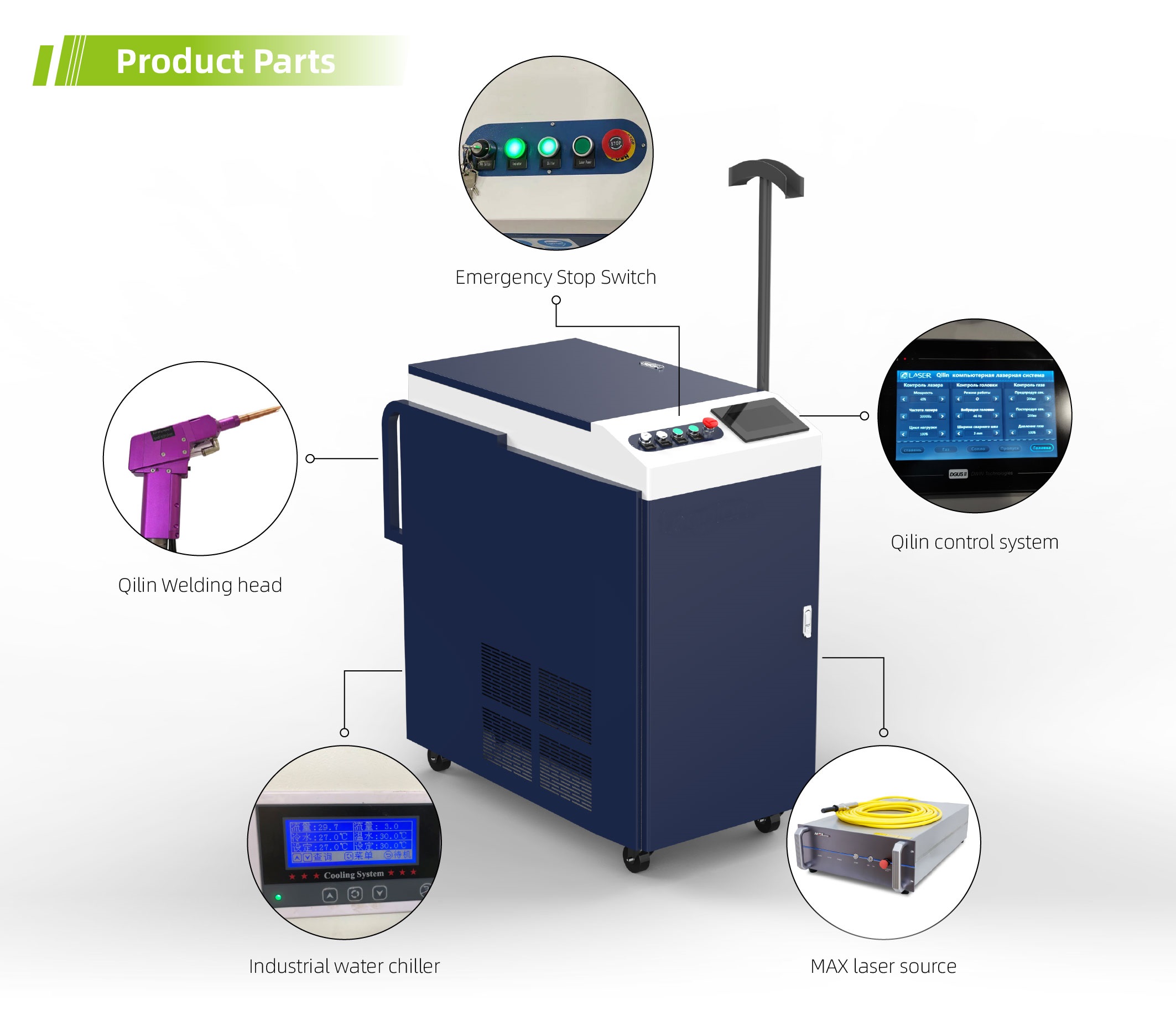
Industrial Application of Fiber Laser Welder
NR-12 Compliance: Rigorous Safety for South American Operations
While CE is a global baseline, the NR-12 standard is a rigorous regulatory framework originally established in Brazil but frequently adopted as a benchmark for machinery safety throughout South American industrial hubs, including Chile. NR-12 mandates a comprehensive lifecycle approach to machine safety, focusing on the protection of the worker through physical barriers, electronic monitoring, and administrative controls.
For a Fiber Laser Welder operating in Antofagasta to be considered NR-12 compliant, it must feature:
- Redundant Safety Circuits: The use of dual-channel safety relays to monitor emergency stops and interlocking switches, ensuring that a single component failure does not lead to a loss of the safety function.
- Physical Guarding and Enclosures: Implementation of laser-safe barriers that are opaque to the 1070nm wavelength, preventing the escape of stray reflections into the broader workspace.
- Safety Interlock at the Nozzle: A pressure-sensitive or capacitive sensor at the welding tip that prevents laser emission unless the nozzle is in direct contact with the grounded workpiece.
- Detailed Documentation: NR-12 requires a complete technical file in the local language, including risk assessments, maintenance schedules, and electrical schematics.
Environmental Adaptability in the Antofagasta Region
The geographical conditions of Antofagasta—characterized by high UV radiation, particulate matter from mining operations, and fluctuating power grids—require specific hardware adaptations. Fiber laser systems must be equipped with high-efficiency industrial chillers utilizing dual-circuit cooling. These systems maintain the laser source and the optical head at precise temperatures to prevent thermal lensing, which can degrade beam quality and weld consistency.
Furthermore, the optical path must be protected by high-purity nitrogen or argon shielding gas. This not only prevents oxidation of the weld pool but also protects the final delivery lens from spatter and dust. In Antofagasta’s heavy industrial sites, the use of reinforced, armored fiber cables is recommended to prevent mechanical damage in environments where heavy machinery and sharp metal debris are prevalent.
Operational Efficiency and ROI Analysis
From a B2B procurement perspective, the transition to fiber laser welding is justified by the significant reduction in post-processing costs. Traditional welding methods often require extensive grinding and straightening due to thermal warping. The precision of the fiber laser eliminates these steps, directly reducing labor hours per unit. In the context of Antofagasta’s mining logistics, where downtime is measured in significant financial loss, the ability to perform rapid, high-strength repairs on-site provides a substantial competitive advantage.
The energy conversion efficiency of fiber lasers is also a critical factor. These systems typically exhibit a wall-plug efficiency of over 30 percent, compared to less than 10 percent for legacy CO2 lasers or traditional arc welders. This leads to lower operational expenditure (OPEX) regarding electricity consumption and cooling requirements.
Concluding Industry Insight
The integration of fiber laser technology in Antofagasta represents a broader trend in the industrial sector: the convergence of high-output manufacturing and stringent safety regulation. As global supply chains demand higher accountability, the reliance on non-compliant machinery becomes a significant liability for Tier 1 and Tier 2 contractors. The future of industrial fabrication in South America will likely see a mandatory shift toward systems that integrate Class 4 Laser Safety protocols and redundant electronic architectures as standard features rather than optional upgrades. For manufacturers and distributors, the ability to demonstrate verified CE and NR-12 compliance is no longer a secondary marketing point; it is a prerequisite for entry into the high-value mining and energy infrastructure markets. Precision, when decoupled from safety, is an industrial risk; when integrated, it is the primary driver of modern manufacturing resilience.
Industrial Expertise & Support
Are you looking for high-performance Fiber Laser Welder tailored for the Global market? Our engineering team provides comprehensive solutions for modern manufacturing.

