Introduction to Industrial Laser Integration in the Manaus Free Trade Zone
The industrial landscape of Manaus, Brazil, specifically within the Polo Industrial de Manaus (PIM), has undergone a significant shift toward high-precision manufacturing. As a primary hub for electronics, automotive components, and heavy machinery in South America, the demand for localized, high-efficiency joining technologies has escalated. The implementation of the Fiber Laser Welder within this ecosystem represents a move away from traditional metal inert gas (MIG) and tungsten inert gas (TIG) processes toward photonics-based solutions. This transition is driven by the need for higher throughput, reduced thermal distortion, and superior energy metrics. By leveraging the strategic logistical advantages of the Manaus Free Trade Zone, manufacturers are integrating advanced fiber source technologies that meet international standards for precision and sustainability.
The Physics of Energy-Efficient Fiber Source Technology
At the core of modern welding systems in Manaus is the ytterbium-doped fiber laser source. Unlike CO2 lasers that rely on gas mixtures and high-voltage discharges, or Nd:YAG lasers that utilize flashlamp pumping, fiber lasers generate beams through an active optical fiber doped with rare-earth elements. This architecture allows for a significantly higher Wall-Plug Efficiency (WPE), often exceeding 30 percent to 40 percent. In a technical context, this means that a higher proportion of electrical input is converted directly into laser power rather than waste heat.
The 1070nm wavelength produced by these fiber sources is highly absorbable by a wide range of industrial metals, including aluminum, copper, and stainless steel. This absorption efficiency reduces the total kilowatt-hours required to achieve full penetration welds. For the high-volume production lines in Manaus, where energy costs and thermal management are critical operational variables, the adoption of high-efficiency fiber sources results in a direct reduction in the carbon footprint per unit produced.
Minimizing the Heat-Affected Zone (HAZ) in Precision Components
One of the primary technical advantages of using a Fiber Laser Welder is the concentration of energy into a microscopic focal point. This concentration results in a narrow and deep weld profile, characterized by a minimal Heat-Affected Zone (HAZ). In traditional welding, the broad application of heat alters the metallurgical properties of the surrounding material, often leading to warping, residual stress, or the need for post-weld machining.
In the electronics and motorcycle manufacturing sectors of Manaus, maintaining the structural integrity of thin-gauge materials is paramount. The high power density of fiber lasers allows for “keyhole” welding, where the material is vaporized to create a narrow hole that is subsequently filled by molten metal as the beam moves. This process occurs at high speeds, ensuring that the total heat input remains low. Consequently, the mechanical properties of the base metal are preserved, and the need for secondary straightening or finishing processes is virtually eliminated.
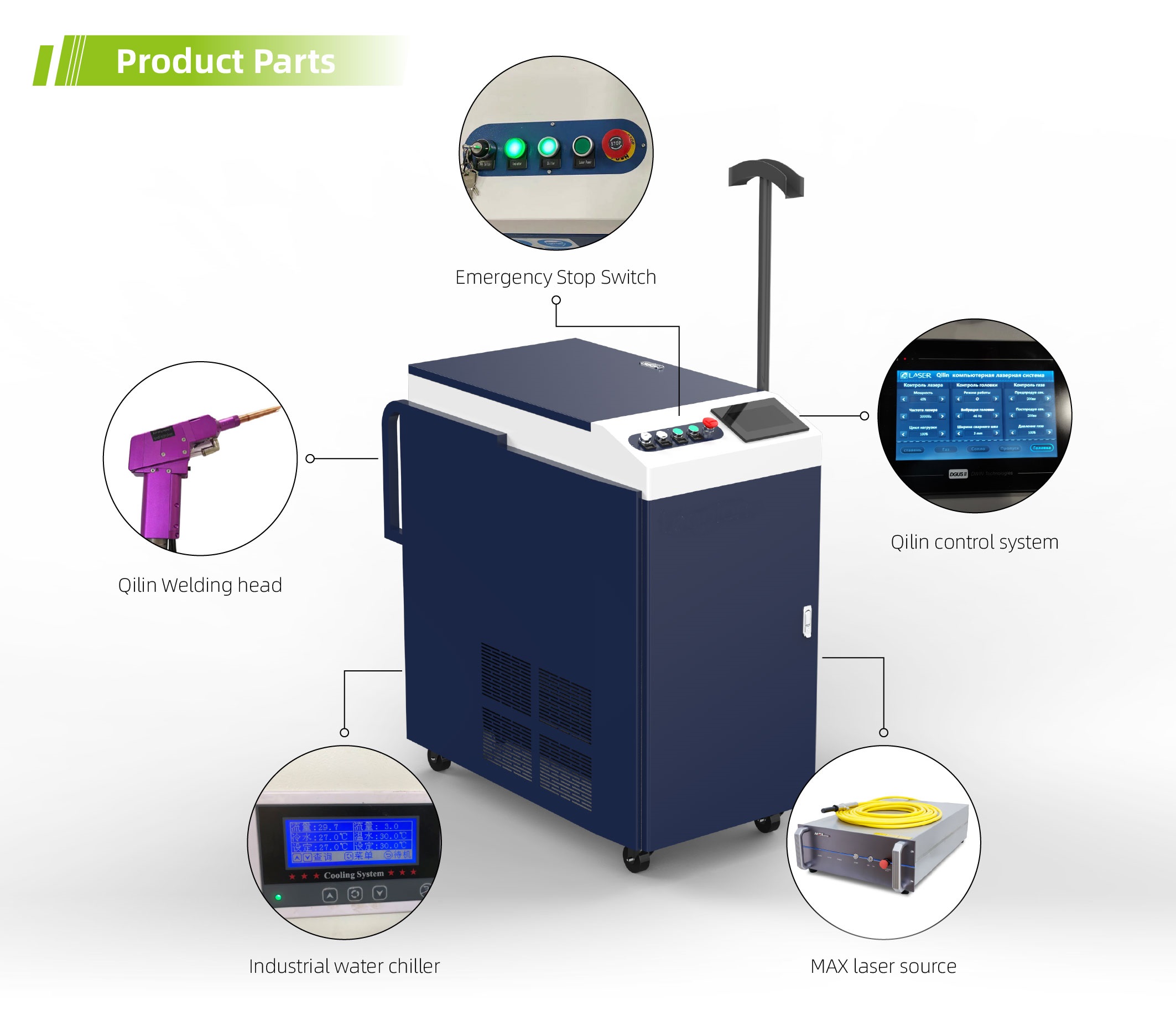
Industrial Application of Fiber Laser Welder
Beam Quality and the Beam Parameter Product (BPP)
The performance of a laser welding system is dictated by its beam quality, mathematically represented by the Beam Parameter Product (BPP). Fiber lasers inherently offer superior beam quality compared to other laser types because the beam is generated and confined within a single-mode or low-order multi-mode fiber. This results in a nearly Gaussian beam profile that can be focused to a much smaller spot size over a longer working distance.
For industrial operators in Brazil, this high beam quality translates to greater process stability. Whether the application involves robotic integration for complex 3D geometries or handheld units for manual assembly, the consistency of the power distribution across the focal spot ensures repeatable weld quality. The low divergence of the fiber-delivered beam also allows for the use of long-focal-length optics, which protects the laser head from spatter and fumes, thereby increasing the lifespan of optical consumables and reducing maintenance intervals.
Operational Sustainability and Thermal Management
Manaus is characterized by high ambient temperatures and humidity, conditions that present unique challenges for industrial cooling systems. The energy efficiency of fiber source technology is particularly beneficial in this climate. Because the fiber laser generates less waste heat per watt of output, the requirements for industrial chillers are reduced. Modern fiber laser units utilize advanced closed-loop cooling systems that precisely regulate the temperature of the diode modules and the delivery fiber.
By reducing the load on the cooling infrastructure, the overall system reliability is improved. Diode degradation is a function of thermal stress; therefore, the high efficiency of the fiber architecture extends the Mean Time Between Failures (MTBF) of the pump diodes, often exceeding 100,000 hours of operation. This longevity is a critical factor for B2B stakeholders in the Amazon region, where the supply chain for specialized replacement parts can involve complex logistics. A system that requires fewer interventions and consumes less power directly supports the lean manufacturing goals of the PIM industrial park.
Strategic Integration within the Global Supply Chain
The decision to deploy fiber laser technology in Manaus is not merely a technical upgrade but a strategic economic move. As global brands seek to diversify their manufacturing bases, the ability to produce high-precision, export-quality goods in South America becomes a competitive advantage. The fiber laser’s ability to weld dissimilar metals—such as copper to aluminum for EV battery busbars—positions Manaus-based factories at the forefront of the green energy transition.
Furthermore, the digital nature of fiber laser systems allows for seamless integration into Industry 4.0 frameworks. Real-time monitoring of laser parameters, such as pulse frequency, duty cycle, and average power, enables data-driven quality assurance. This level of traceability is essential for sectors like aerospace and medical device manufacturing, which are expanding their footprint in the Brazilian market. By adopting energy-efficient fiber sources, local manufacturers can comply with increasingly stringent international environmental regulations while maintaining high productivity levels.
Concluding Industry Insight: The Future of Photonic Manufacturing
The integration of the Fiber Laser Welder in Manaus serves as a microcosm for the broader global trend toward “Green Photonics.” The industry is moving beyond simple power metrics to focus on the optimization of the energy-to-output ratio. As fiber source technology continues to evolve, we anticipate a further increase in brightness and the refinement of beam-shaping techniques that allow for even more precise control over the melt pool dynamics. For the B2B sector, the shift toward fiber technology represents a decoupling of industrial growth from exponential energy consumption. The future of manufacturing in hubs like Manaus will be defined by the ability to leverage these high-efficiency tools to produce complex, high-value components with minimal environmental impact. The transition to fiber-based systems is no longer an optional upgrade but a fundamental requirement for remaining competitive in a global market that prioritizes both technical precision and operational sustainability.
Industrial Expertise & Support
Are you looking for high-performance Fiber Laser Welder tailored for the Global market? Our engineering team provides comprehensive solutions for modern manufacturing.

