Introduction: The Industrial Evolution of Joinville
Joinville, situated in the state of Santa Catarina, represents the largest industrial cluster in southern Brazil. Historically rooted in the metal-mechanic and automotive sectors, the region’s manufacturing landscape is currently undergoing a significant technological transition. As global supply chains demand higher precision and shorter lead times, local enterprises are moving away from traditional metal inert gas (MIG) and tungsten inert gas (TIG) processes. The adoption of the Fiber Laser Welder has emerged as a primary driver for maintaining competitiveness in a market characterized by rising labor costs and stringent quality standards. This article analyzes the technical parameters and the Return on Investment (ROI) metrics associated with implementing fiber laser technology within Joinville’s industrial parks.
Technical Specifications and Operational Advantages
Fiber laser welding utilizes an optical fiber doped with rare-earth elements, such as ytterbium, to amplify light. Unlike CO2 lasers, which rely on gas mixtures and complex mirror systems, fiber lasers operate at a wavelength of approximately 1.07 microns. This shorter wavelength allows for higher absorption rates in metallic materials, particularly in reflective metals like aluminum and copper, which are prevalent in Joinville’s appliance and automotive component manufacturing sectors.
One of the critical technical advantages is the minimal Heat-Affected Zone (HAZ). Traditional welding methods introduce significant thermal energy into the substrate, often leading to macro-deformation and metallurgical alterations. The high power density of a fiber laser facilitates “keyhole” welding, where the energy is concentrated into a narrow, deep column. This results in a high aspect ratio weld with minimal thermal dissipation into the surrounding material, preserving the structural integrity of the workpiece and reducing the need for post-weld straightening or heat treatment.
Efficiency and Energy Consumption Metrics
From an engineering perspective, the Electro-optical efficiency of fiber laser systems is a decisive factor for ROI. Modern fiber laser sources achieve efficiency ratings of 30% to 45%, compared to the 8% to 10% seen in CO2 systems and the high parasitic losses associated with traditional arc welding power supplies. In the context of Joinville’s industrial electricity tariffs, this reduction in power consumption translates directly into lower operational expenditure (OPEX).
Furthermore, the solid-state nature of the fiber laser source eliminates the need for internal moving parts or consumable gases for the laser generation itself. Maintenance intervals are significantly extended, with many diodes rated for over 100,000 hours of operation. For a high-output facility in the Perini Business Park, this equates to a substantial reduction in downtime and a more predictable maintenance schedule.
ROI Analysis for Joinville’s Industrial Parks
The calculation of ROI for a Fiber Laser Welder in the Brazilian market must account for several variables: capital expenditure (CAPEX), labor costs, throughput speed, and secondary process elimination. While the initial investment for a fiber laser system is higher than that of a high-end TIG station, the amortization period is shortened by the sheer volume of production increases.
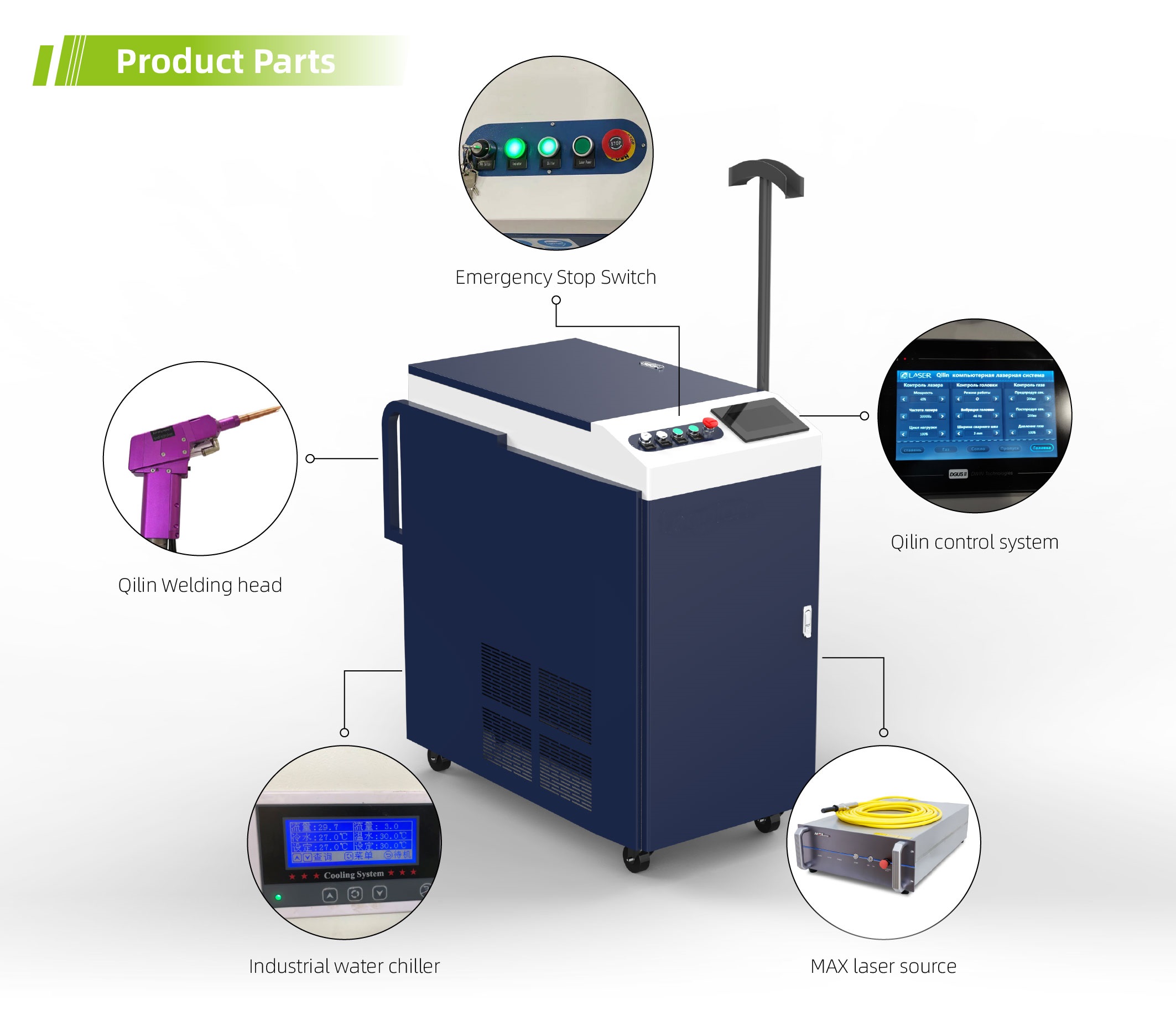
Industrial Application of Fiber Laser Welder
Throughput and Labor Optimization
In Joinville’s metal-mechanic sector, welding speed is a primary bottleneck. Fiber laser welding can be up to ten times faster than TIG welding on thin-gauge materials (0.5mm to 4.0mm). In a comparative study of stainless steel cabinet production, a manual TIG process requiring 15 minutes of weld time was reduced to 90 seconds using a handheld fiber laser system.
Moreover, the skill gap in Brazil’s labor market presents a challenge. TIG welding requires years of training to achieve consistent, high-quality beads. Conversely, the Beam parameter product (BPP) of a fiber laser ensures a consistent focal point, allowing operators with minimal specialized training to produce aerospace-grade welds. This reduces the reliance on a scarce pool of highly specialized welders and lowers the average hourly labor cost per unit produced.
Elimination of Post-Processing Costs
A significant portion of the ROI is derived from the “hidden” costs of traditional welding: grinding and polishing. Because fiber laser welding produces a clean, aesthetically pleasing bead with no spatter, the requirement for secondary finishing is often eliminated. In many Joinville-based factories producing hospital equipment or food-grade machinery, the reduction in abrasive consumption and grinding labor accounts for a 20% to 30% reduction in total part cost.
Integration into Local Manufacturing Ecosystems
Joinville’s industrial parks are increasingly adopting Industry 4.0 protocols. Fiber laser welders are inherently digital, allowing for seamless integration into robotic cells and automated production lines. The ability to modulate laser power in real-time and synchronize it with robotic motion allows for complex geometries that were previously impossible or too expensive to manufacture locally. This capability enables Joinville firms to compete for international contracts that require high-precision components for the electric vehicle (EV) and renewable energy sectors.
Material Versatility and Market Expansion
The ability to weld dissimilar metals is another technical advantage that expands the market reach of local manufacturers. Fiber lasers can successfully join materials with different melting points and thermal conductivities. This is particularly relevant for the local refrigeration industry, where joining copper tubing to aluminum fins or stainless steel chassis is a frequent requirement. The precision of the laser ensures a hermetic seal without the need for flux or fillers that could contaminate the system.
Concluding Industry Insight
The industrial landscape of Joinville is at a critical juncture. As Brazil integrates further into global value chains, the reliance on legacy welding technologies becomes a liability. The transition to fiber laser technology is not merely an incremental upgrade but a fundamental shift in manufacturing philosophy. The proven ROI—driven by energy efficiency, labor optimization, and the total elimination of secondary processes—positions the Fiber Laser Welder as the cornerstone of the modern Brazilian industrial park.
Looking forward, the integration of Artificial Intelligence (AI) with fiber laser systems will allow for real-time weld monitoring and autonomous parameter adjustment. For Joinville to maintain its status as a manufacturing powerhouse, the local industry must prioritize these high-precision, high-efficiency systems. The data indicates that the question is no longer whether the investment is justifiable, but rather how quickly a facility can integrate these systems to avoid obsolescence in an increasingly automated global market.
Industrial Expertise & Support
Are you looking for high-performance Fiber Laser Welder tailored for the Global market? Our engineering team provides comprehensive solutions for modern manufacturing.