Introduction: The Industrial Transition in Southern Brazil
Curitiba, the capital of Paraná, stands as one of the most significant industrial hubs in Latin America. The Cidade Industrial de Curitiba (CIC) and surrounding metropolitan clusters in São José dos Pinhais and Araucária host a dense concentration of automotive, agribusiness, and heavy machinery manufacturers. As global supply chains demand higher precision and faster turnaround times, these facilities are transitioning from traditional Gas Tungsten Arc Welding (GTAW) and Gas Metal Arc Welding (GMAW) toward advanced photonics. The adoption of the Fiber Laser Welder within these industrial parks is no longer a matter of speculative innovation but a calculated move to optimize Return on Investment (ROI) through technical efficiency and structural cost reduction.
Technical Parameters and Efficiency Benchmarks
The core advantage of fiber laser technology lies in its beam quality and energy delivery mechanism. Unlike traditional methods that rely on electrical arcs, a fiber laser utilizes a high-intensity coherent light beam focused through a flexible optical fiber. This results in a power density exceeding 10^6 W/cm2. For industrial operators in Curitiba, this translates to a significantly narrowed Heat-Affected Zone (HAZ). By minimizing the area impacted by thermal conduction, manufacturers can weld thin-gauge materials—common in automotive body-in-white and food processing equipment—without the risk of warping or structural deformation.
Furthermore, the Photoelectric Conversion Efficiency of modern fiber laser systems reaches up to 30 to 40 percent. In contrast, legacy CO2 lasers operate at approximately 8 to 10 percent efficiency. For large-scale manufacturing plants in Curitiba’s industrial sector, where energy tariffs are a significant component of operational expenditure (OPEX), the reduction in kilowatt-hour consumption per meter of weld provides an immediate and measurable impact on the bottom line. The high energy density allows for travel speeds that are five to ten times faster than manual TIG welding, effectively multiplying the throughput of a single workstation.
Quantifying ROI: Labor, Consumables, and Post-Processing
To understand the ROI of a Fiber Laser Welder in the context of Curitiba’s manufacturing landscape, one must analyze the total cost of ownership (TCO). The traditional welding process involves three primary cost drivers: skilled labor, gas/wire consumables, and secondary finishing operations. Curitiba currently faces a tightening market for highly certified TIG welders, leading to increased labor costs and production bottlenecks.
Fiber laser systems mitigate this by lowering the barrier to entry for operators. A handheld fiber laser unit equipped with a Wobble Welding Head allows for greater tolerance in joint gaps and requires less manual dexterity than traditional arc manipulation. This technical simplification enables manufacturers to reallocate their most skilled personnel to complex metallurgical engineering tasks while maintaining high-quality output on the production line. Data from local implementations suggest that training time for a laser operator is approximately 70 percent lower than that required for a proficient TIG welder.
Moreover, the elimination of post-weld grinding and polishing represents the most significant hidden ROI. Because the laser process produces a clean, aesthetically superior bead with minimal spatter, the secondary processing stage is often entirely removed. In the stainless steel fabrication sectors of Araucária, this has resulted in a 40 percent reduction in total cycle time per component. When factoring in the reduced consumption of abrasive materials and the decrease in rework due to thermal distortion, the capital expenditure (CAPEX) of a fiber laser system is typically recovered within 12 to 18 months of high-volume operation.
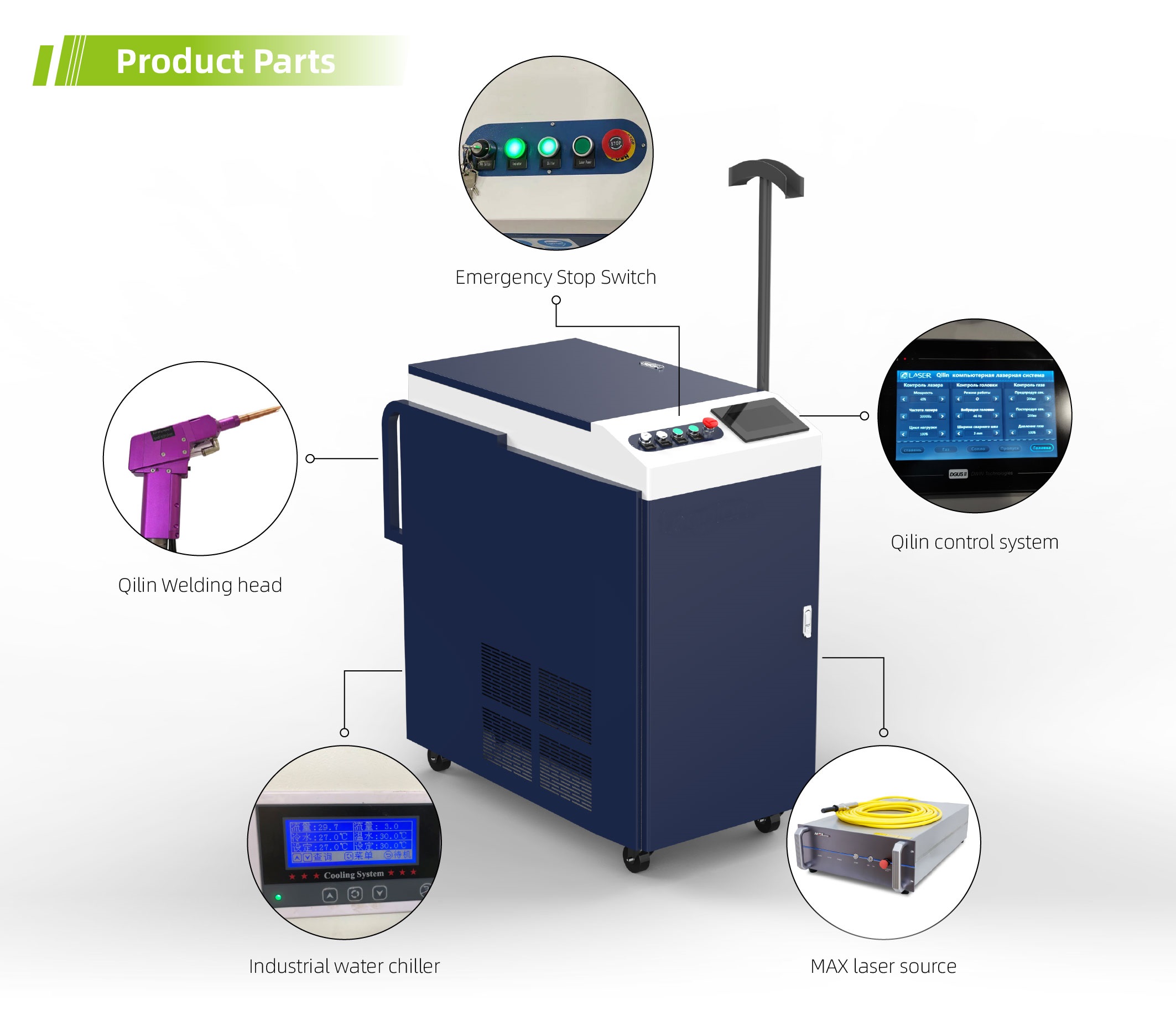
Industrial Application of Fiber Laser Welder
Integration within Curitiba’s Automotive and Ag-Tech Clusters
The automotive cluster in the Curitiba metropolitan area, which includes major global OEMs and Tier 1 suppliers, demands rigorous adherence to ISO and AWS standards. The Fiber Laser Welder excels in these environments due to its ability to join dissimilar metals and high-strength steels. The precision of the laser allows for deep penetration welds with a high aspect ratio, which is critical for structural integrity in vehicle frames and agricultural implements designed for the heavy soils of the Brazilian interior.
Industrial parks in the region are also seeing an uptick in the use of automated laser cells. By integrating the fiber laser source with robotic arms, facilities achieve 24/7 production capabilities with micron-level repeatability. This automation is vital for Curitiba-based exporters who must compete with global manufacturing costs. The integration of real-time monitoring sensors within the laser path allows for immediate quality assurance, identifying porosity or lack of fusion as it occurs, thereby reducing scrap rates to near-zero levels.
Environmental and Operational Safety Considerations
From a technical safety perspective, the transition to fiber lasers in Curitiba’s industrial parks aligns with modern ESG (Environmental, Social, and Governance) mandates. Traditional welding produces significant volumes of hexavalent chromium fumes and other hazardous particulates, necessitating expensive high-volume extraction systems. While fiber laser welding still requires fume extraction, the volume of particulate matter is drastically lower due to the concentrated nature of the melt pool.
Additionally, the modularity of fiber laser sources ensures high uptime. Unlike CO2 lasers that require internal mirrors and gas refills, fiber lasers are solid-state. This means there are no moving parts within the light-generating medium, leading to a Mean Time Between Failures (MTBF) of over 100,000 hours. For a 24-hour operation in the CIC, this reliability is a cornerstone of the ROI calculation, preventing the costly downtime associated with optical misalignment or gas contamination found in older technologies.
Concluding Industry Insight: The Future of Localized Manufacturing
The industrial landscape of Curitiba serves as a microcosm for the global shift toward localized, high-efficiency manufacturing hubs. The data gathered from the implementation of fiber laser technology in this region suggests a broader trend: the decoupling of production volume from labor scarcity. As industrial parks evolve, the competitive advantage will no longer be determined by the size of the workforce, but by the density of the technology deployed per square meter of factory floor.
For global stakeholders, the Curitiba model proves that high-precision Fiber Laser Welder technology is not merely an upgrade for elite aerospace applications but a necessary utility for general industrial manufacturing. The future of ROI in manufacturing lies in the reduction of “process steps.” By combining joining, finishing, and quality control into a single, high-speed photonic process, Curitiba’s industrial sector is setting a benchmark for how regional hubs can maintain global competitiveness through targeted technical investment. As the technology continues to scale, we expect to see a total displacement of traditional arc welding in high-throughput environments by the end of the decade.
Industrial Expertise & Support
Are you looking for high-performance Fiber Laser Welder tailored for the Global market? Our engineering team provides comprehensive solutions for modern manufacturing.

