Operational Efficiency and Cost Amortization: The Impact of Fiber Laser Welding in the Caxias do Sul Metal-Mechanical Hub
Caxias do Sul, located in the state of Rio Grande do Sul, stands as Brazil’s second-largest metal-mechanical cluster. The regional industry, dominated by transport equipment, machinery, and stainless steel fabrication, has historically relied on manual Tungsten Inert Gas (TIG) and Metal Inert Gas (MIG) welding processes. However, the rising cost of specialized labor and the requirement for higher throughput have driven a shift toward advanced photonics. This report analyzes how the integration of a Fiber Laser Welder has allowed local manufacturers to achieve a documented saving of $5,000 per month by optimizing operational expenditures and reducing reliance on high-cost manual labor.
Quantifying the Economic Transition: Labor and Throughput Analysis
The primary driver for the $5,000 monthly saving is the discrepancy between the efficiency of traditional arc welding and laser-based systems. In a standard Caxias do Sul fabrication facility specializing in thin-gauge stainless steel (1mm to 4mm), a single Fiber Laser Welder can replace the output of approximately three skilled TIG welders.
The economic breakdown is structured as follows:
- Direct Labor Costs: A certified TIG welder in the Brazilian industrial sector requires competitive wages, social security contributions, and benefits. By consolidating the workload of three stations into one laser-operated station, the facility eliminates two full-time equivalent (FTE) positions, saving approximately $3,200 in gross salary and payroll taxes.
- Post-Processing Mitigation: Traditional welding induces significant thermal distortion, requiring secondary grinding and polishing. Laser welding reduces post-processing time by 80%. The elimination of abrasives and the labor associated with finishing accounts for an additional $1,200 in monthly savings.
- Energy and Consumables: While the initial capital expenditure (CAPEX) for laser technology is higher, the Photoelectric Conversion Efficiency of modern fiber sources exceeds 30%, compared to the lower efficiency of traditional rectifiers. This, combined with reduced shielding gas consumption, contributes the remaining $600 to the monthly total.
Technical Parameters of the Fiber Laser Welder
The systems currently being deployed in the Caxias do Sul region typically utilize continuous wave (CW) fiber laser sources ranging from 1.5kW to 3kW. The 1070nm wavelength produced by these units is highly absorbed by metallic substrates, allowing for deep penetration welds with minimal power input. Unlike TIG welding, which relies on an electric arc to melt the base metal and filler rod, the laser focuses high-density photon energy into a concentrated spot, often smaller than 0.2mm in diameter.
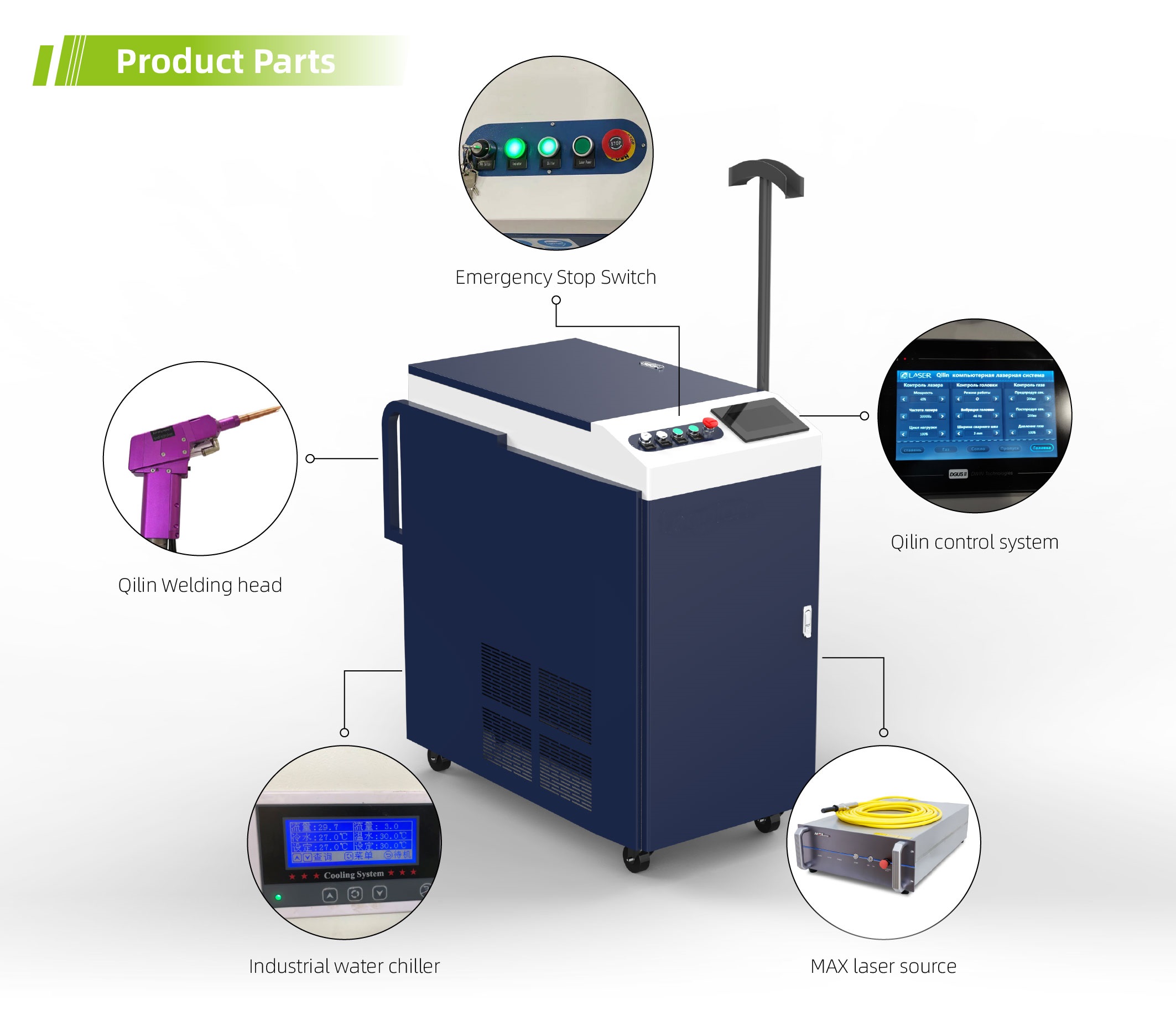
Industrial Application of Fiber Laser Welder
This concentration of energy results in a significantly reduced Heat-Affected Zone (HAZ). The HAZ is the area of the base metal that has not been melted but has had its microstructure and mechanical properties altered by the heat. By narrowing this zone, the structural integrity of the component is maintained, and the risk of warping—a common failure point in thin-wall Caxias do Sul transport manufacturing—is virtually eliminated.
Integration of the Wobble Welding Head
One of the technical advancements facilitating the replacement of manual labor is the Wobble Welding Head. Manual laser welding previously required extreme precision in joint fit-up, as the beam diameter was too small to bridge gaps. The integration of galvanometric mirrors within the welding torch allows the beam to oscillate in various patterns (circles, lines, or figures-of-eight).
This “wobble” effect increases the effective width of the weld pool, allowing operators with minimal training to achieve high-quality results even on joints with imperfect fit-up (up to 0.5mm gaps). This technological assist lowers the barrier to entry for operators, allowing companies to utilize semi-skilled labor for tasks that previously required decades of manual dexterity training.
Metallurgical Advantages and Material Integrity
In the context of the Caxias do Sul food and beverage equipment industry, weld aesthetics and hygiene are paramount. The Fiber Laser Welder produces a smooth, consistent bead that requires no chemical pickling or aggressive mechanical grinding to meet sanitary standards. The high cooling rate associated with laser welding leads to a finer grain structure in the fusion zone, which often results in superior tensile strength compared to traditional manual welds.
Furthermore, the process allows for the welding of dissimilar metals—such as copper to stainless steel or different grades of aluminum—which are notoriously difficult for manual arc processes due to differences in thermal conductivity and melting points. The precise control over the power modulation (duty cycle and frequency) ensures that the intermetallic layer is minimized, preventing brittle fractures in the joint.
Operational Expenditure (OPEX) Comparison
To understand the $5,000/month saving, it is necessary to examine the operational duty cycle. A manual TIG welder operates at a travel speed of approximately 5 to 10 centimeters per minute on 2mm stainless steel. In contrast, a 2kW fiber laser system operates at speeds exceeding 60 centimeters per minute.
This 6x increase in linear speed means that the time-to-market for a standard production run is slashed. In the Caxias do Sul industrial parks, where floor space carries a specific overhead cost, increasing the throughput per square meter directly improves the bottom line. The reduction in “work in progress” (WIP) inventory also frees up capital that was previously tied up in components waiting for secondary finishing stages.
Safety and Infrastructure Requirements
Transitioning to laser technology requires specific infrastructure, primarily Class 4 laser safety enclosures. While this represents an initial setup cost, the long-term health benefits for the workforce include the elimination of high-intensity UV radiation and a significant reduction in welding fumes. Modern systems are equipped with integrated dual-circuit water cooling and protective gas monitoring, ensuring high uptime and reducing the maintenance intervals compared to traditional transformer-based welders.
Concluding Industry Insight
The case study of Caxias do Sul serves as a microcosm for the global shift in manufacturing. The transition from manual arc welding to fiber laser technology is no longer a luxury reserved for high-end aerospace applications; it has become a fundamental requirement for mid-market competitiveness. As the global labor market continues to experience a shortage of certified welders, the “democratization” of high-precision welding through Wobble Welding Head technology and automated fiber sources is inevitable.
The $5,000 monthly saving identified in this region is a conservative estimate when considering the long-term reduction in scrap rates and the ability to scale production without a linear increase in headcount. For global B2B stakeholders, the technical takeaway is clear: the ROI of fiber laser integration is driven less by the “novelty” of the laser and more by the radical compression of the production cycle and the near-total elimination of post-weld rectification. Manufacturers who fail to adopt these photonics-based workflows will likely find themselves unable to compete on price or lead time in an increasingly automated global supply chain.
Industrial Expertise & Support
Are you looking for high-performance Fiber Laser Welder tailored for the Global market? Our engineering team provides comprehensive solutions for modern manufacturing.

