The Industrial Evolution of Caxias do Sul: Integrating Advanced Fiber Laser Systems
Caxias do Sul, located in the southern Brazilian state of Rio Grande do Sul, stands as the second-largest metal-mechanical hub in the country. Traditionally recognized for its robust automotive, transport, and heavy machinery manufacturing sectors, the region is currently undergoing a significant technological transition. Local manufacturers are increasingly moving away from conventional Gas Metal Arc Welding (GMAW) and Tungsten Inert Gas (TIG) processes toward high-precision automated systems. Central to this shift is the implementation of the Fiber Laser Welder, a tool that leverages solid-state laser technology to meet the rigorous demands of modern metallurgy.
The global manufacturing landscape demands higher throughput with reduced operational overhead. In Caxias do Sul, where the supply chain supports international giants in the bus and trailer industries, the adoption of energy-efficient fiber sources is not merely a preference but a strategic necessity. This article examines the technical specifications of fiber laser sources, their energy efficiency metrics, and the specific impact of this technology on the regional industrial infrastructure.
Technical Architecture of High-Efficiency Fiber Sources
A fiber laser source generates a high-intensity beam by utilizing an optical fiber doped with rare-earth elements, typically Ytterbium (Yb). Unlike CO2 lasers that rely on gas mixtures and complex mirror arrays, fiber lasers generate the beam within a flexible medium. This architecture eliminates the need for beam alignment maintenance and reduces the risk of contamination within the optical path.
The primary technical advantage of this source is its wavelength, which typically operates around 1070 nm. This near-infrared wavelength exhibits a significantly higher absorption rate in metallic materials—particularly reflective metals like aluminum and copper—compared to the 10,600 nm wavelength of CO2 lasers. For the manufacturers in Caxias do Sul, this translates to faster processing speeds and a more concentrated energy delivery, which minimizes the Heat-Affected Zone (HAZ). A reduced HAZ is critical for maintaining the structural integrity and metallurgical properties of high-strength alloys used in automotive chassis and heavy-duty components.
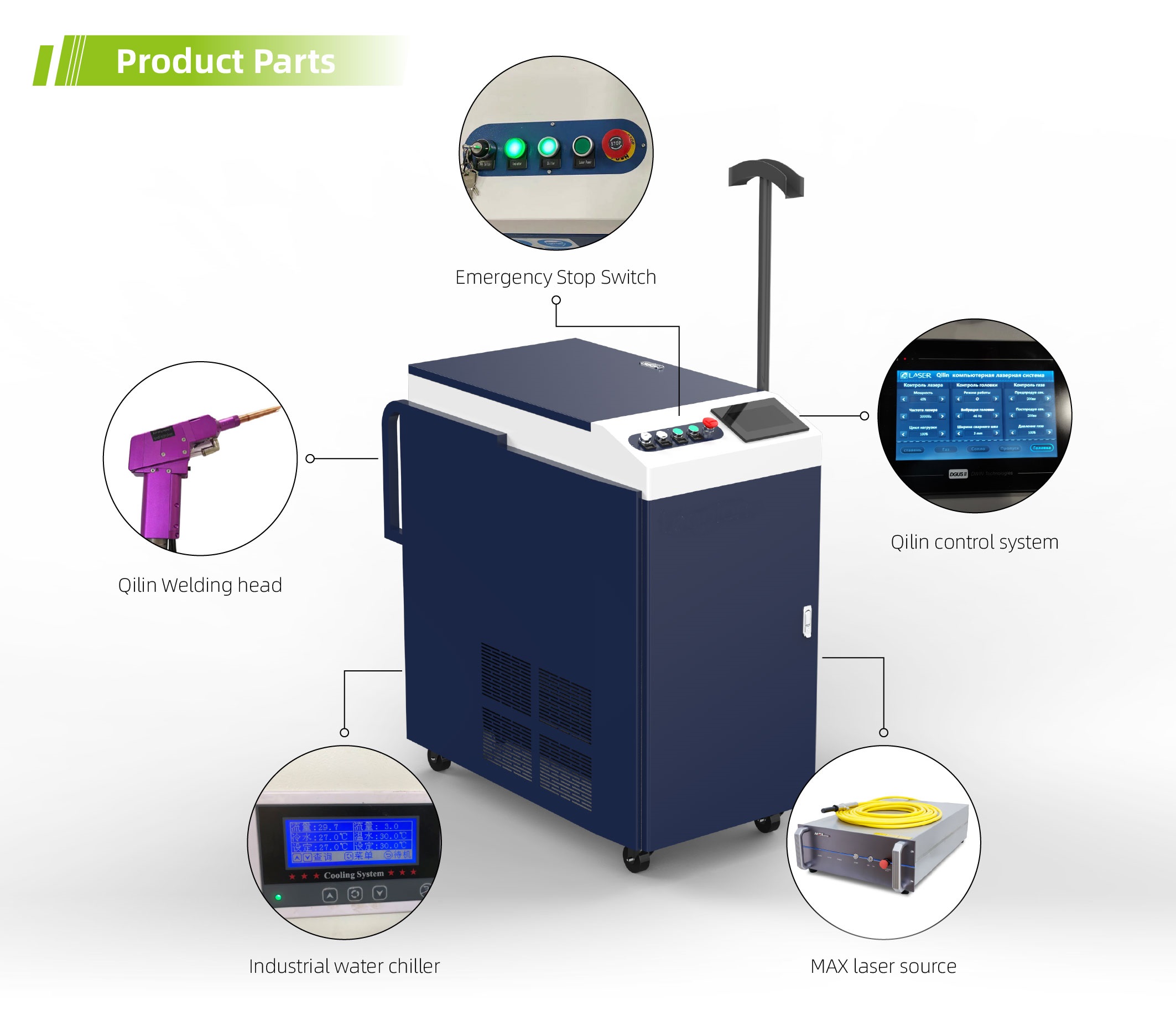
Industrial Application of Fiber Laser Welder
Quantifying Energy Efficiency: Wall-Plug Efficiency Metrics
Energy efficiency in industrial laser applications is measured by Wall-Plug Efficiency (WPE), which is the ratio of optical output power to the electrical input power consumed by the entire system. Traditional CO2 laser systems often struggle to exceed a WPE of 8% to 10%. In contrast, modern fiber laser sources utilized in industrial welding achieve WPE ratings of 30% to 45%.
This discrepancy in efficiency has profound implications for large-scale fabrication facilities in Brazil. A higher WPE means that less electrical energy is converted into waste heat. Consequently, the cooling requirements for the system are drastically reduced. While a 4kW CO2 laser requires a massive industrial chiller to dissipate excess thermal energy, a 4kW fiber laser can operate with a much smaller, more efficient cooling unit. This reduction in ancillary power consumption lowers the total kilowatt-hour (kWh) per meter of weld, directly impacting the bottom line of B2B manufacturing contracts.
Precision and Beam Quality: The BPP Factor
The performance of a Fiber Laser Welder is also defined by its Beam Parameter Product (BPP). BPP is a metric that quantifies the focusability of the laser beam, calculated as the product of the beam’s minimum radius and its half-angle divergence. A lower BPP indicates a higher quality beam that can be focused to a smaller spot size over a longer working distance.
In the context of the complex geometries found in the Caxias do Sul metal-mechanic sector, high beam quality allows for deep penetration welding with a high aspect ratio (depth-to-width). This capability is essential for “keyhole” welding, where the laser vaporizes the metal to create a narrow hole, allowing the energy to reach deep into the joint. This process results in welds with minimal distortion and high mechanical strength, surpassing the capabilities of traditional arc welding where thermal diffusion often leads to component warping.
Local Implementation: Adapting to the Brazilian Industrial Grid
Manufacturers in Caxias do Sul face specific challenges, including fluctuating energy costs and the need for high-uptime machinery. The solid-state nature of fiber lasers makes them exceptionally resilient to industrial environments. The absence of moving parts in the resonator and the use of modular diode pumping ensure that these systems have a Mean Time Between Failures (MTBF) exceeding 100,000 hours.
Furthermore, the compact footprint of fiber laser units allows for easy integration into existing production lines. Local integrators in Rio Grande do Sul are increasingly pairing these laser sources with robotic arms to create six-axis welding cells. These automated cells provide repeatable precision that manual welding cannot match, reducing the rate of scrap and rework. In a global B2B market, the ability to provide certified, high-quality welds with documented process parameters is a significant competitive advantage for Brazilian exporters.
Economic Analysis of Fiber Laser Adoption
While the initial capital expenditure (CAPEX) for fiber laser technology is higher than that of traditional welding equipment, the operational expenditure (OPEX) is significantly lower. The primary drivers for ROI include:
1. Reduced Consumable Costs: Fiber lasers do not require replacement electrodes, nozzles, or gas mixtures at the same frequency as GMAW or CO2 systems.
2. Increased Throughput: Welding speeds for thin to medium-gauge materials can be 3 to 10 times faster than TIG welding.
3. Post-Processing Elimination: The high-quality finish of a fiber laser weld often eliminates the need for secondary grinding or polishing, reducing labor costs.
For a Tier 1 automotive supplier in Caxias do Sul, these factors result in a payback period that is often less than 24 months, depending on the shift structure and volume of production.
Concluding Industry Insight: The Path to Sustainable Manufacturing
The transition toward fiber laser welding in Caxias do Sul reflects a broader global trend: the convergence of high-precision engineering and energy sustainability. As international carbon regulations become more stringent, the energy-efficient profile of fiber laser sources will transition from a cost-saving measure to a regulatory requirement. The ability to produce complex metal assemblies with a lower carbon footprint per unit will define the next generation of industrial leadership.
Industry stakeholders must recognize that the Fiber Laser Welder is not just a tool for joining metal; it is a data-driven instrument that enables Industry 4.0 integration. By monitoring real-time power consumption and beam stability, manufacturers can achieve a level of process control that was previously impossible. In the coming decade, the success of the Caxias do Sul industrial hub will likely depend on its ability to further refine these high-efficiency processes, ensuring that Brazilian manufacturing remains a vital and competitive force in the global B2B ecosystem.
Industrial Expertise & Support
Are you looking for high-performance Fiber Laser Welder tailored for the Global market? Our engineering team provides comprehensive solutions for modern manufacturing.

