Introduction to High-Efficiency Industrial Welding in Buenos Aires
The industrial landscape of Buenos Aires, Argentina, is currently undergoing a significant transition toward advanced manufacturing technologies. As the primary economic engine of the country, the Buenos Aires metropolitan area hosts a dense concentration of automotive, aerospace, and heavy machinery fabrication facilities. Central to this modernization is the adoption of the Fiber Laser Welder, a tool that has redefined precision and throughput in metal joining processes. This shift is driven not only by the demand for higher weld quality but also by the critical need for energy efficiency in a region where industrial utility costs and carbon footprint regulations are becoming increasingly stringent.
Fiber laser technology represents the pinnacle of solid-state laser development. Unlike traditional CO2 or Nd:YAG systems, fiber lasers utilize an optical fiber doped with rare-earth elements such as ytterbium as the active gain medium. This configuration allows for a more compact design, superior beam quality, and, most importantly, a drastic reduction in power consumption. For manufacturers in Buenos Aires looking to compete in global export markets, the integration of energy-efficient fiber source technology is no longer an optional upgrade but a strategic necessity.
Technical Specifications of Fiber Laser Source Technology
The core of a modern fiber laser welding system is the resonator. In these systems, the laser light is generated and confined within a flexible fiber optic cable. This design eliminates the need for complex mirror alignments and sensitive gas mixtures required by older laser types. The wavelength of a fiber laser typically falls within the 1064nm to 1080nm range, which is highly absorbed by most industrial metals, including reflective materials like aluminum and copper that were historically difficult to weld with CO2 lasers.
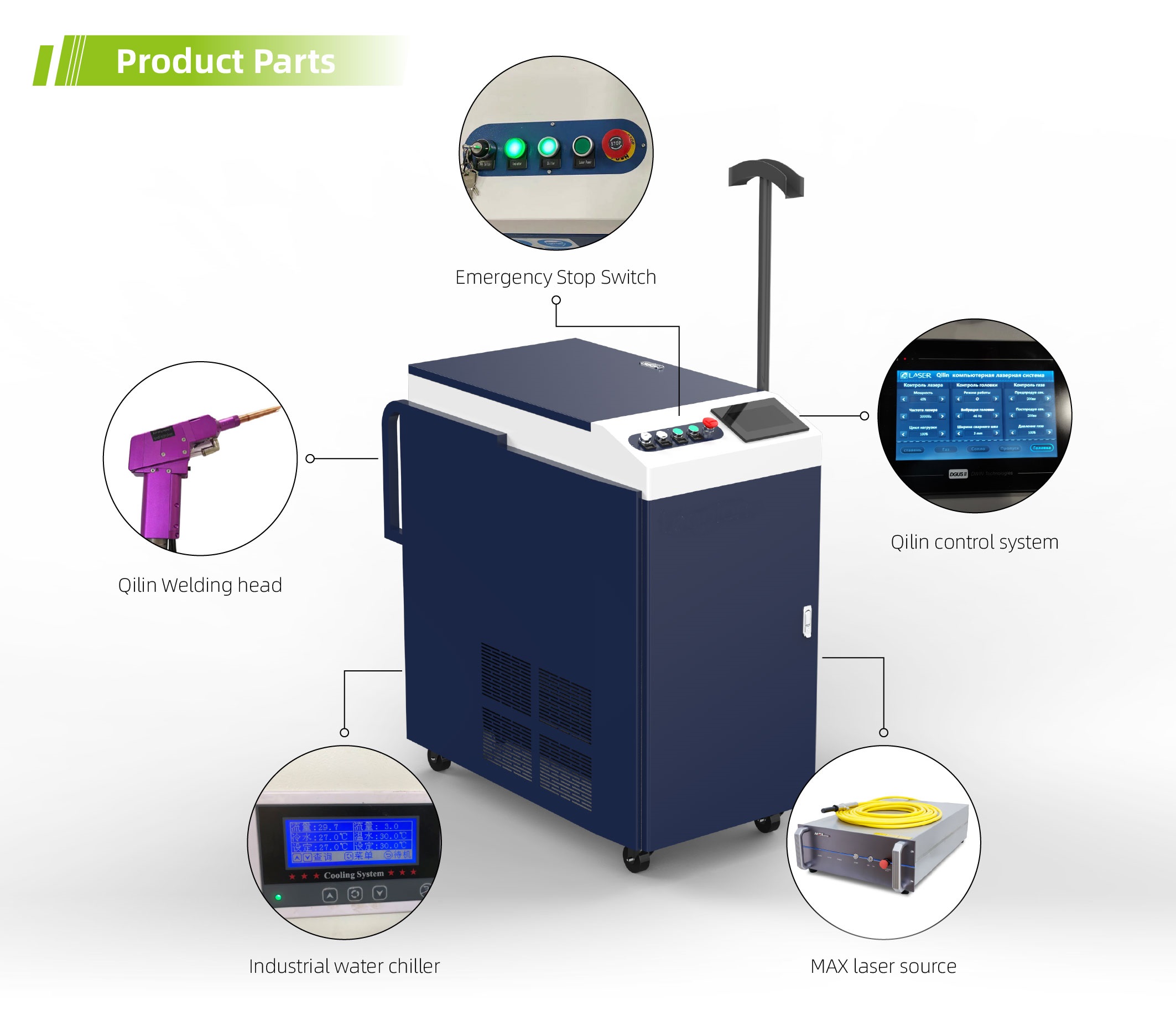
Industrial Application of Fiber Laser Welder
A critical metric for evaluating these systems is the Beam Parameter Product (BPP). The BPP defines the focusability of the laser beam; a lower BPP indicates a beam that can be focused to a smaller spot size, resulting in higher power density at the workpiece. This high power density enables deep penetration welding with minimal heat input, which is essential for maintaining the structural integrity of the base metal. In the context of Buenos Aires’ specialized stainless steel fabrication sector, this precision ensures that the corrosion resistance of the material is not compromised during the thermal cycle.
Energy Efficiency and Wall-Plug Efficiency (WPE)
When analyzing the operational costs of industrial equipment in Argentina, energy consumption is a primary variable. Fiber laser sources are characterized by their exceptional Wall-Plug Efficiency (WPE), which typically ranges between 30% and 40%. In comparison, CO2 lasers often struggle to exceed 10% WPE, while lamp-pumped Nd:YAG lasers frequently operate below 3% efficiency. This means that for every kilowatt of electricity drawn from the grid, a fiber laser converts a significantly higher portion into usable laser power, with less energy wasted as dissipated heat.
The thermal management requirements of these systems are also reduced. Because the fiber source generates less waste heat, the cooling requirements for the associated chiller units are lower. This creates a secondary energy saving, as the refrigeration cycle of the chiller consumes less power to maintain the system’s optimal operating temperature. For a high-volume manufacturing plant in the Greater Buenos Aires area, the cumulative reduction in electrical overhead can result in a return on investment (ROI) that is measured in months rather than years.
Minimizing the Heat-Affected Zone (HAZ) in Precision Fabrication
One of the most significant technical advantages of using a fiber laser source is the reduction of the Heat-Affected Zone (HAZ). The HAZ is the area of the base metal that has not been melted but has had its microstructure and mechanical properties altered by the heat of the welding process. Excessive heat input can lead to distortion, residual stress, and a decrease in tensile strength.
Because the fiber laser delivers energy with extreme focus and high travel speeds, the time the metal is exposed to high temperatures is minimized. This is particularly advantageous for the automotive components industry in Buenos Aires, where high-strength low-alloy (HSLA) steels are common. By maintaining a narrow HAZ, manufacturers can produce lightweight components that meet rigorous safety standards without the need for extensive post-weld heat treatments or mechanical straightening. The concentrated energy also allows for “wobble” welding techniques, where the beam oscillates at high frequencies to bridge larger gaps in fit-up while still maintaining a low total heat input.
Integration with Automation and Robotic Systems
The compact and flexible nature of the fiber delivery cable makes the fiber laser welder ideally suited for robotic integration. In the industrial corridors of Pacheco and Ferreyra, robotic welding cells are becoming the standard for high-volume production. Unlike traditional welding methods that require heavy copper cabling or complex hard-optic delivery systems, the fiber optic cable can be easily routed through the internal dress-pack of a six-axis robotic arm.
This integration allows for high-speed 3D welding of complex geometries. The stability of the fiber source ensures that the power output remains constant regardless of the robot’s position or the curvature of the delivery fiber. Furthermore, many modern fiber laser systems are equipped with real-time monitoring sensors that track weld penetration and seam alignment, providing a data-driven approach to quality control that aligns with Industry 4.0 standards.
Operational Longevity and Maintenance Requirements
From a technical maintenance perspective, fiber lasers offer a significant advantage over alternative technologies. The pump diodes, which provide the energy to the gain medium, have an expected operational life exceeding 100,000 hours. Because the system is entirely solid-state and the beam is contained within a fiber, there are no internal optics to clean or replace, and no gas consumables are required for the laser generation itself.
For businesses operating in Buenos Aires, this translates to higher machine uptime and lower spare parts inventory. The absence of mirrors and the sealed nature of the laser source protect the system from the environmental contaminants often found in heavy industrial environments. While standard preventive maintenance on the external delivery optics and the chiller system is still required, the core laser engine remains virtually maintenance-free for the duration of its service life.
Material Versatility in the Argentine Market
The industrial sector in Argentina is diverse, requiring the ability to weld a wide range of materials. Fiber laser welders are proficient in joining dissimilar metals, such as copper to aluminum or stainless steel to carbon steel. This versatility is critical for the burgeoning renewable energy sector in the region, particularly in the production of battery packs and electrical busbars where high conductivity and structural integrity are paramount.
The ability to weld thin-gauge materials (down to 0.5mm) without burn-through, while also being capable of deep penetration on thicker plates (up to 10mm or more depending on wattage), provides a single-tool solution for diverse fabrication needs. This flexibility reduces the need for multiple specialized welding machines, further optimizing the floor space and capital expenditure of Buenos Aires manufacturing facilities.
Concluding Industry Insight: The Future of Laser Welding in South America
The adoption of fiber laser welding technology in Buenos Aires is indicative of a broader global trend toward high-precision, low-waste manufacturing. As energy costs continue to fluctuate and international quality standards become more rigorous, the efficiency of the laser source becomes a primary competitive differentiator. The transition from traditional arc welding and CO2 laser systems to fiber-based technology is not merely a change in equipment but a fundamental shift in metallurgical processing.
In the coming decade, we expect to see further integration of artificial intelligence within these laser systems to provide predictive maintenance and autonomous parameter adjustment. For the Argentine market, the successful implementation of these energy-efficient systems will be the cornerstone of a resilient and technologically advanced manufacturing sector, capable of meeting the demands of both domestic infrastructure projects and high-precision global supply chains. The technical superiority of the fiber source ensures that it will remain the standard for industrial joining for the foreseeable future.
Industrial Expertise & Support
Are you looking for high-performance Fiber Laser Welder tailored for the Global market? Our engineering team provides comprehensive solutions for modern manufacturing.

