Advancements in Fiber Laser Welder Integration: Overcoming Reflectivity in Buenos Aires’ Industrial Sector
The industrial landscape of Buenos Aires, Argentina, has undergone a significant transformation as manufacturing facilities transition from traditional joining methods to high-precision laser systems. As a primary hub for automotive assembly, aerospace components, and electronics packaging within the Mercosur trade bloc, the region requires robust solutions for welding non-ferrous metals. The primary challenge in these applications is the inherent high reflectivity and high thermal conductivity of materials such as C10100 copper and 6061 aluminum alloys. Implementing a Fiber Laser Welder in this environment necessitates specialized anti-reflection technology to ensure equipment longevity and weld integrity.
The Technical Challenge of High-Reflectivity Materials
Copper and aluminum present unique metallurgical and optical hurdles for standard laser processing. At the common fiber laser wavelength of approximately 1070 nm, polished copper can reflect over 90 percent of incident laser energy. This physical property creates two distinct problems: inefficient energy coupling into the workpiece and the risk of back-reflection. When laser energy is reflected directly back into the delivery fiber, it can cause catastrophic failure of the laser diodes and optical components due to localized overheating.
In the industrial corridors of Greater Buenos Aires, where production uptime is critical for maintaining supply chain commitments, the risk of back-reflection damage is a significant barrier to entry for standard laser systems. To mitigate this, modern systems utilize sophisticated back-reflection protection mechanisms. These systems are designed to detect reflected light and either divert it safely to a water-cooled beam dump or terminate the pulse before damage occurs to the resonator.
Anti-Reflection Technological Architecture
The core of anti-reflection technology in high-power fiber lasers involves a multi-stage hardware and software approach. The first line of defense is the optical isolator, a passive component that allows light to pass in one direction while blocking or diverting light returning from the workpiece. This is particularly vital in 1kW to 3kW systems frequently deployed in Argentine automotive part manufacturing.
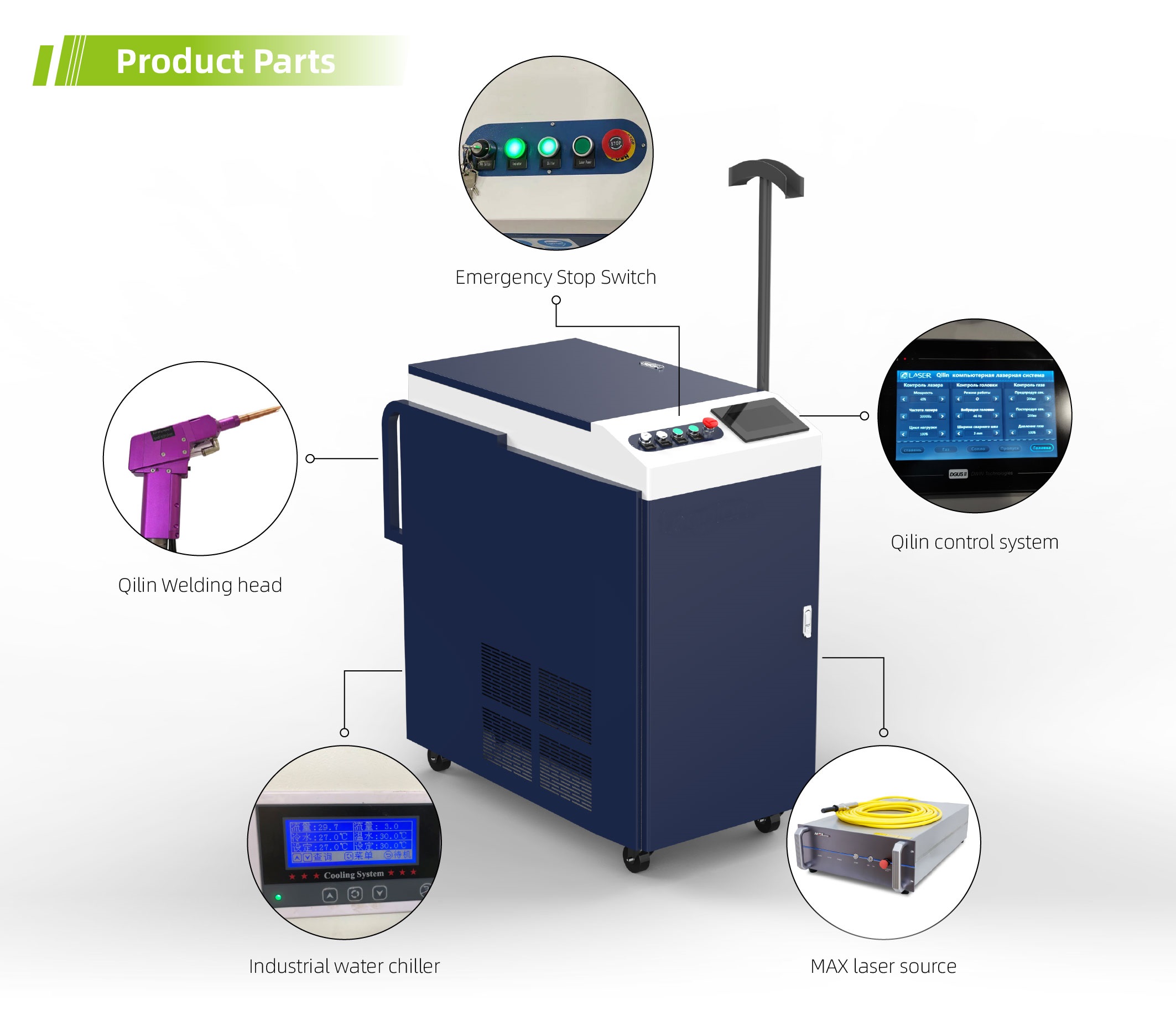
Industrial Application of Fiber Laser Welder
Beyond passive isolation, modern fiber laser welders utilize beam modulation and “wobble” technology. By oscillating the laser beam in specific patterns—such as circles, figure-eights, or zig-zags—the system maintains a stable keyhole during the welding process. This oscillation increases the effective width of the weld and allows for better degassing of the melt pool, which is essential for aluminum alloys prone to porosity. Furthermore, the constant movement of the beam prevents a direct, static perpendicular reflection back into the delivery optics.
Optimizing Power Density for Non-Ferrous Metals
To successfully weld copper in a B2B production environment, the Fiber Laser Welder must achieve a power density high enough to initiate the “keyhole” mode almost instantaneously. Once the material melts, its absorption rate increases significantly, rising from roughly 5 percent to over 60 percent. Anti-reflection technology ensures that the initial spike of reflected energy during the transition from solid to liquid phase does not compromise the laser source.
Technical data suggests that using a high-brightness fiber laser with a small spot size (typically 14 to 50 microns) allows for a higher power density at lower total wattages. This precision is favored by electronics manufacturers in the Buenos Aires region who require deep penetration welds in busbars and battery interconnects without excessive heat input that could damage sensitive internal components.
Operational Implementation in the Argentine Market
The adoption of these systems in Buenos Aires is driven by the need for localized high-tech manufacturing capabilities. Local engineering firms are increasingly integrating fiber laser sources into automated robotic cells. These integrations focus on the following technical parameters:
1. Real-time Monitoring: Systems equipped with sensors to monitor the power levels of back-reflected light. If the reflection exceeds a calibrated threshold, the system adjusts parameters or halts the process.
2. Beam Geometry: Utilizing specific focal lengths (typically 150mm to 300mm) to balance the depth-of-field with the required spot size for copper processing.
3. Shielding Gas Optimization: The use of Argon or Helium-Argon mixes to stabilize the plasma plume, which also plays a role in reducing the optical feedback to the laser head.
Material Specifics: Aluminum vs. Copper
While both are reflective, aluminum and copper require different modulation strategies. Aluminum welding in the aerospace sector near Buenos Aires often focuses on crack sensitivity in the 2000 and 7000 series alloys. Anti-reflection technology here is coupled with high-frequency beam modulation to refine the grain structure of the weld. In contrast, copper welding focuses on overcoming the extreme thermal sink effect, requiring the laser to maintain a consistent energy input despite the material’s tendency to dissipate heat away from the joint rapidly.
Economic and Reliability Factors for Global Supply Chains
For global companies sourcing components from Argentina, the reliability of the welding process is paramount. A Fiber Laser Welder equipped with anti-reflection tech provides a level of repeatability that MIG or TIG welding cannot match. The reduction in heat-affected zones (HAZ) means that components maintain their structural integrity and dimensional tolerances, reducing the need for post-processing or straightening. This efficiency is a critical factor in the cost-benefit analysis for Argentine manufacturers competing on a global scale.
Furthermore, the energy efficiency of fiber lasers—often exceeding 30 percent wall-plug efficiency—compared to older CO2 or Nd:YAG systems, aligns with global industrial trends toward reducing carbon footprints and operational costs. In an economy where energy costs and material waste are scrutinized, the ability to weld highly reflective materials with minimal scrap is a significant competitive advantage.
Industry Insight: The Future of Laser Material Processing
The trajectory of laser welding technology is moving toward the integration of multi-wavelength systems and artificial intelligence-driven process control. In the context of Buenos Aires’ industrial evolution, the next step involves the adoption of “Blue Laser” technology or hybrid Blue-Infrared systems. Blue lasers (operating at approximately 450 nm) exhibit significantly higher absorption rates in copper and gold compared to infrared lasers. However, until these systems reach the power levels and cost-effectiveness of current fiber lasers, anti-reflection technology remains the industry standard for processing non-ferrous metals. The convergence of high-power IR fiber lasers with advanced optical isolation and beam shaping is currently the most viable solution for high-volume production of reflective metal components. As the Argentine manufacturing sector continues to modernize, the focus will shift from simple equipment acquisition to the optimization of the light-matter interaction, ensuring that even the most reflective alloys can be joined with surgical precision and industrial-grade reliability.
Industrial Expertise & Support
Are you looking for high-performance Fiber Laser Welder tailored for the Global market? Our engineering team provides comprehensive solutions for modern manufacturing.

