Introduction: The Industrial Evolution of Belo Horizonte
Belo Horizonte, the capital of Minas Gerais, stands as a critical node in Brazil’s “Steel Valley” and a primary hub for the South American metallurgical sector. As global manufacturing demands shift toward higher precision and faster throughput, the regional industrial base is transitioning from conventional metal inert gas (MIG) and tungsten inert gas (TIG) processes to advanced laser-based solutions. Central to this evolution is the implementation of the Fiber Laser Welder, a technology that leverages high-intensity coherent light to achieve structural bonds with minimal thermal distortion. In the context of Belo Horizonte’s heavy machinery and automotive supply chains, the integration of 45-degree beveling techniques is proving essential for achieving deep-penetration, seamless welds that meet international ISO and ASTM standards.
The Physics of Fiber Laser Welding in Heavy Metallurgy
The efficiency of a fiber laser system is derived from its ytterbium-doped optical fiber source, which produces a beam with a wavelength of approximately 1070 nm. This specific wavelength allows for high absorption rates in ferrous and non-ferrous metals, facilitating the “keyhole” welding mode. In this mode, the energy density is sufficient to vaporize the metal, creating a narrow cavity that allows the laser beam to penetrate deep into the substrate.
For industrial operators in Belo Horizonte, the primary advantage of this technology lies in the reduction of the Heat-Affected Zone (HAZ). Traditional welding methods distribute heat across a wide area, often leading to grain growth and reduced mechanical properties in the base metal. A fiber laser concentrates energy so precisely that the metallurgical structure surrounding the weld remains largely unaltered, ensuring that the tensile strength and corrosion resistance of the component are maintained. This is particularly vital for the mining equipment manufactured in the Minas Gerais region, where components are subjected to extreme cyclical loading.
45-Degree Beveling: Optimizing Joint Geometry for Seamless Integration
While fiber lasers are capable of autogenous welding (welding without filler material), thick-plate applications common in Brazilian heavy industry often require specific edge preparation. The 45-degree bevel is a strategic geometry utilized to facilitate full Weld Penetration. By creating a V-groove preparation, the laser beam can access the root of the joint more effectively, ensuring that the fusion zone extends through the entire thickness of the material.
The 45-degree angle is mathematically optimized for fiber laser dynamics. It provides a balance between the volume of the molten pool and the accessibility of the beam. When two 45-degree beveled edges are joined, they form a 90-degree included angle. This configuration allows the laser’s high Power Density to create a stable keyhole while providing enough space for the outgassing of impurities, which significantly reduces porosity. The result is a “seamless” weld—a joint that is aesthetically flush and structurally indistinguishable from the parent material under radiographic testing.
Technical Challenges and Solutions in the Belo Horizonte Market
Implementing 45-degree beveling in a fiber laser workflow requires rigorous control over fit-up tolerances. Unlike manual arc welding, which can compensate for gaps of several millimeters, laser welding typically requires tolerances within 10% of the material thickness. In Belo Horizonte’s fabrication shops, this necessitates the use of precision CNC plasma or waterjet cutting systems to prepare the bevels before the welding phase.
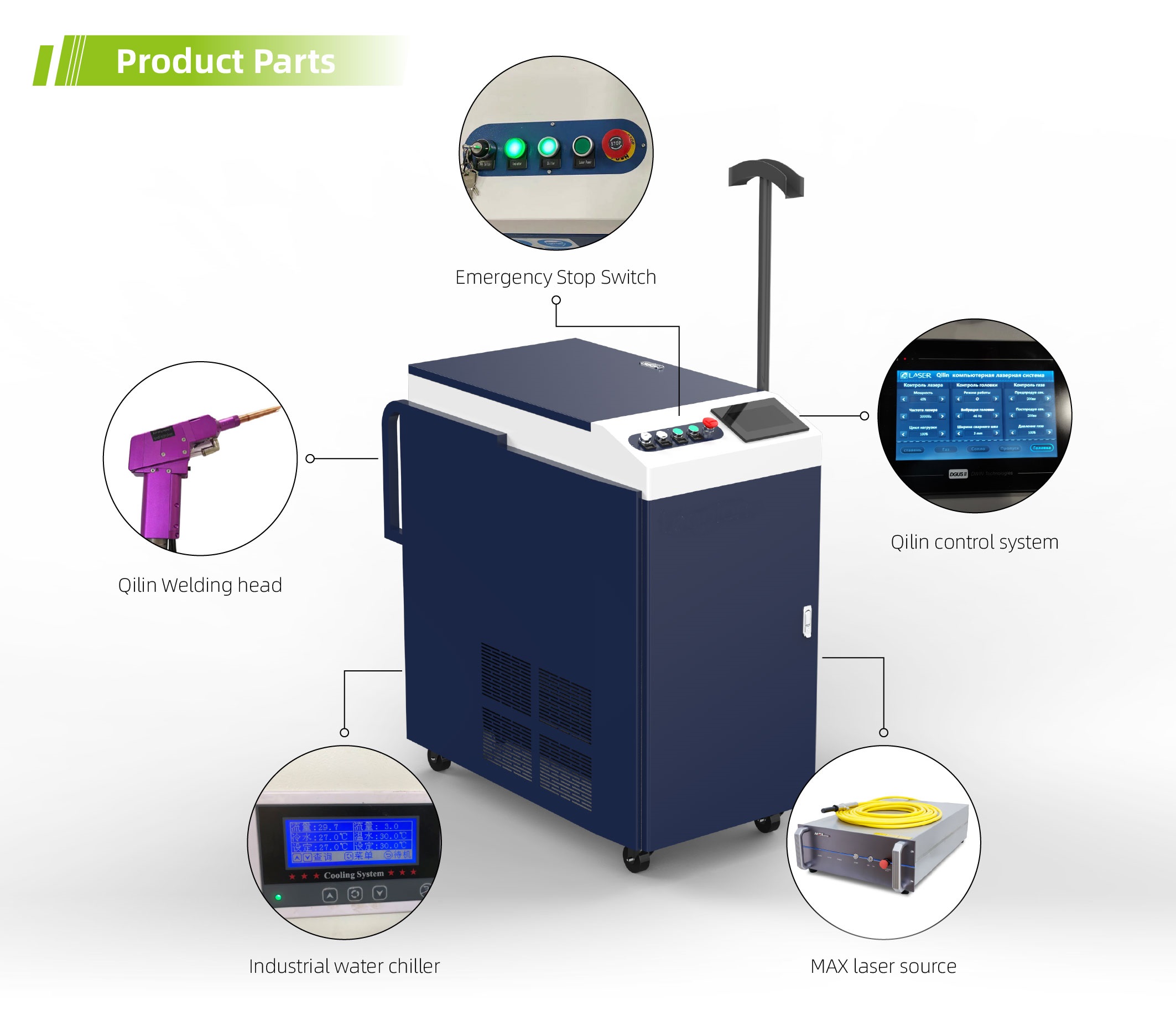
Industrial Application of Fiber Laser Welder
Furthermore, the high thermal conductivity of materials like aluminum (frequently used in the regional automotive sector) presents a challenge for beam stability. To counteract this, modern fiber laser welders in the region are equipped with “wobble” welding heads. This technology oscillates the beam in specific patterns (circular, zig-zag, or figure-eight) across the 45-degree bevel. This oscillation increases the effective width of the weld bead, allowing for better bridge-gap capability and ensuring that the sidewalls of the bevel are fully fused without requiring excessive heat input.
Comparative Analysis: Fiber Laser vs. Conventional Methods
When analyzing the return on investment (ROI) for manufacturers in Minas Gerais, several technical metrics distinguish the fiber laser from legacy systems:
1. Processing Speed: Fiber lasers can operate at speeds 4 to 10 times faster than TIG welding, particularly on stainless steel and carbon steel gauges between 2mm and 6mm.
2. Post-Processing: Due to the concentrated energy of the laser, the weld bead is exceptionally clean. This eliminates the need for grinding, polishing, or pickling, which are labor-intensive steps in traditional Brazilian metalworking shops.
3. Energy Efficiency: Fiber laser sources boast wall-plug efficiencies of over 30%, compared to less than 10% for older CO2 lasers or high-amperage arc welders. This reduces the operational cost per meter of weld, a critical factor in the competitive global export market.
Safety and Integration Standards
The adoption of fiber laser technology in Belo Horizonte also involves adherence to strict safety protocols. Because the 1070 nm wavelength is invisible to the human eye and can cause permanent retinal damage even through reflections, the welding process must be contained within Class 1 laser-safe enclosures. Local firms are increasingly investing in robotic integration, where the fiber laser head is mounted on a multi-axis robotic arm. This not only enhances the consistency of the 45-degree bevel tracking but also removes the operator from the immediate vicinity of the laser radiation and welding fumes.
Industry Insight: The Future of High-Power Laser Welding
The industrial landscape in Belo Horizonte is moving toward a “Light-as-a-Tool” paradigm. As fiber laser power outputs continue to scale—with 12kW and 20kW systems becoming more accessible—the ability to weld 20mm+ plates with a single pass becomes a reality. The future of seamless welding lies in the convergence of real-time sensor feedback and artificial intelligence. We anticipate that the next generation of welders in Brazil will utilize “Through-the-Lens” monitoring systems. These systems analyze the spectral emission of the melt pool in real-time, automatically adjusting the laser power and travel speed to compensate for any irregularities in the 45-degree bevel preparation.
For global B2B stakeholders, the message is clear: the technical proficiency of the Belo Horizonte industrial cluster, combined with the precision of 45-degree beveling in fiber laser applications, represents a new benchmark for structural integrity. Facilities that fail to transition from high-heat, low-precision methods will likely face increasing pressure from the superior mechanical performance and cost-efficiency of laser-welded components. The shift toward seamless, deep-penetration welding is not merely a trend but a fundamental requirement for the next era of global infrastructure and manufacturing.
Industrial Expertise & Support
Are you looking for high-performance Fiber Laser Welder tailored for the Global market? Our engineering team provides comprehensive solutions for modern manufacturing.