Precision Metallurgy: The Shift to Fiber Laser Welding in Belo Horizonte’s Industrial Sector
Belo Horizonte, the capital of Minas Gerais, stands as a critical node in the global metallurgical supply chain. Traditionally dominated by heavy mining equipment fabrication and automotive assembly, the regional manufacturing sector is currently undergoing a significant transition from conventional Gas Metal Arc Welding (GMAW) and Tungsten Inert Gas (TIG) processes to high-density energy beam technologies. The integration of the Fiber Laser Welder into these production lines is not merely an incremental upgrade but a fundamental shift in thermal management and structural integrity standards. As global demand for lighter, stronger assemblies increases, the ability to minimize thermal distortion while maintaining high throughput has become a primary objective for Tier 1 and Tier 2 suppliers in the region.
The technical challenge has historically been the high barrier to entry regarding operator skill. Traditional precision welding requires years of manual dexterity and an intuitive understanding of pool dynamics. However, the introduction of Artificial Intelligence (AI) integrated into the Human-Machine Interface (HMI) has compressed the traditional multi-year apprenticeship into a structured 48-hour onboarding process. This article examines the technical parameters of this transition and the specific mechanics of the two-day learning curve observed in industrial applications within the Belo Horizonte corridor.
Technical Specifications of Modern Fiber Laser Systems
The systems currently being deployed utilize a 1070nm wavelength ytterbium-doped fiber source. Unlike CO2 lasers, the fiber delivery system allows for a smaller spot size and higher power density, which facilitates deep-penetration “keyhole” welding. For the stainless steel and carbon steel alloys common in Brazilian manufacturing, these units typically operate between 1.5kW and 3kW of continuous wave power. The Electro-Optical Efficiency of these systems exceeds 30 percent, significantly reducing the electrical overhead compared to legacy systems.
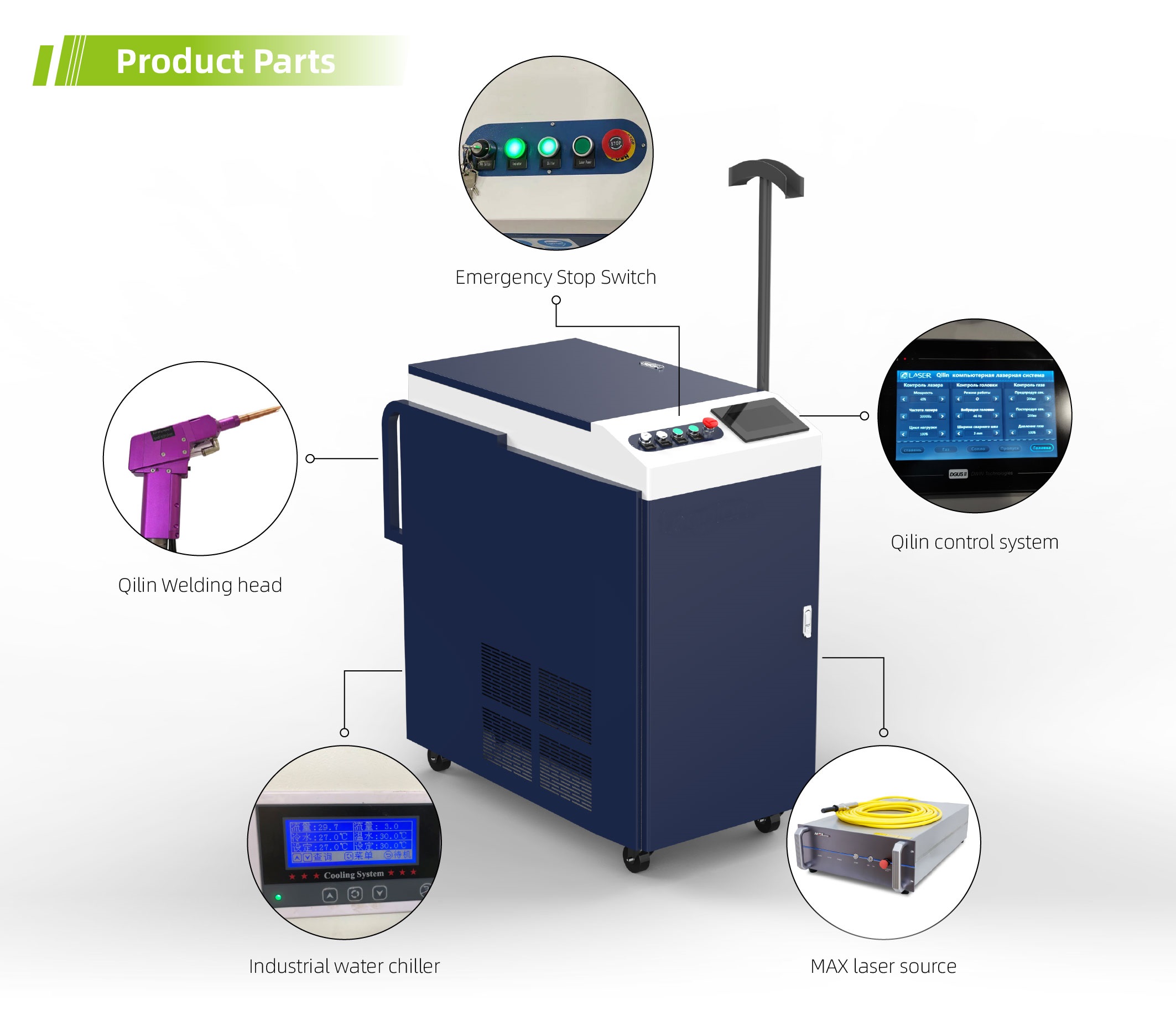
Industrial Application of Fiber Laser Welder
A critical technical advantage is the reduction of the Heat-Affected Zone (HAZ). In traditional TIG welding, the broad thermal input alters the microstructure of the base metal, often leading to warping or the need for post-weld heat treatment. Fiber laser technology concentrates energy so precisely that the HAZ is reduced by up to 80 percent. This is particularly vital for the automotive components manufactured in Betim and Contagem, where dimensional tolerances are measured in microns and material deformation can lead to catastrophic assembly failure.
The AI HMI: Bridging the Skills Gap
The core of the rapid learning curve is the AI-driven HMI. Conventional laser systems required manual calculation of pulse frequency, duty cycle, and gas flow rates based on material thickness and alloy composition. The new generation of interfaces utilizes a neural network-based library of pre-set parameters. When an operator inputs the material type (e.g., 304 Stainless Steel) and the thickness (e.g., 3.0mm), the AI calculates the optimal power-to-speed ratio and beam oscillation pattern.
The AI HMI also performs real-time diagnostics. It monitors back-reflection—a common cause of diode failure when welding reflective materials like aluminum or copper—and adjusts the beam characteristics instantaneously to protect the hardware. For the workforce in Belo Horizonte, this means the focus shifts from the physics of the arc to the geometry of the joint, allowing operators to achieve X-ray quality welds without the decades of “torch time” previously required.
Day 1: Safety Protocols and System Architecture
The first 24 hours of the learning curve are dedicated to the physics of laser safety and hardware synchronization. Because fiber lasers operate in the invisible infrared spectrum, safety training focuses on the use of OD6+ rated optical shielding and the management of Class 4 laser environments. Operators learn the critical importance of the protective lens, a consumable component that prevents spatter from damaging the primary delivery optics.
Technical instruction on Day 1 covers the delivery system: the fiber optic cable, the collimator, and the focusing lens. Operators are taught to calibrate the wire feeder—if used—to ensure that the filler material enters the melt pool at the precise focal point of the laser. By the end of the first day, a technician with zero prior laser experience can execute basic butt joints and lap joints on carbon steel with a level of consistency that exceeds manual TIG processes. The AI HMI assists by providing visual feedback on the stability of the melt pool, alerting the operator if the travel speed is inconsistent with the programmed power level.
Day 2: Advanced Geometries and Parameter Optimization
The second day focuses on the nuances of complex fabrication. This includes vertical welding, overhead positions, and the joining of dissimilar metals—a task that is notoriously difficult in traditional metallurgy. The training utilizes the “wobble” function of the laser head, where the beam oscillates in various patterns (circular, O-type, or triangle) to bridge wider gaps in poorly fitted parts. This function is controlled via the HMI, allowing the operator to widen the weld bead without increasing the total heat input.
Advanced modules on Day 2 involve the optimization of shielding gases. While Argon is standard, the AI HMI helps operators understand when to utilize Nitrogen for increased tensile strength in specific stainless applications or Helium for deeper penetration in thick-section aluminum. By the conclusion of the second day, the operator is capable of performing non-destructive testing (NDT) prep and producing welds that meet ISO 13919-1 standards for electron and laser beam welding. The transition from a trainee to a productive asset is completed through the synergy of automated parameter control and simplified hardware manipulation.
Economic Implications for the Minas Gerais Industrial Hub
The adoption of this technology in Belo Horizonte addresses a critical labor shortage. As the veteran welding workforce nears retirement, the 2-day learning curve allows companies to upskill general laborers into high-precision technicians rapidly. Furthermore, the speed of the Fiber Laser Welder—often 4 to 10 times faster than TIG—directly impacts the bottom line by reducing the cost per meter of weld. In a globalized market, where Brazilian exports must compete with highly automated factories in Asia and Europe, this increase in productivity is essential.
Maintenance cycles are also significantly improved. Traditional welding machines involve numerous wear parts and sensitive transformers. Fiber laser sources are solid-state, with a Mean Time To Failure (MTTF) of over 100,000 hours. For the rugged industrial environments of Minas Gerais, where dust and temperature fluctuations are common, the sealed optical path of modern laser systems provides a level of reliability that legacy equipment cannot match.
Concluding Industry Insight: The Future of Autonomous Fabrication
The rapid adoption of fiber laser technology in Belo Horizonte is a precursor to a broader trend in global manufacturing: the decoupling of high-quality output from manual labor intensity. As AI HMIs become more sophisticated, we are moving toward a “closed-loop” welding environment. In this future state, sensors will monitor the weld pool in real-time, and the AI will adjust parameters mid-weld to compensate for material impurities or fit-up inconsistencies.
For the B2B sector, the takeaway is clear: the competitive advantage no longer resides solely in the mastery of a manual craft, but in the strategic implementation of intelligent hardware. The 2-day learning curve is not just a training metric; it is a disruptive economic force that lowers the barrier to high-precision manufacturing, allowing regional hubs like Belo Horizonte to maintain their relevance in an increasingly automated global economy. Companies that fail to transition from high-heat, low-speed manual processes to low-heat, high-speed laser systems will likely find themselves marginalized by the superior efficiency and metallurgical quality of the fiber laser revolution.
Industrial Expertise & Support
Are you looking for high-performance Fiber Laser Welder tailored for the Global market? Our engineering team provides comprehensive solutions for modern manufacturing.

