1.Application of Welding Robots in the Shipbuilding Industry
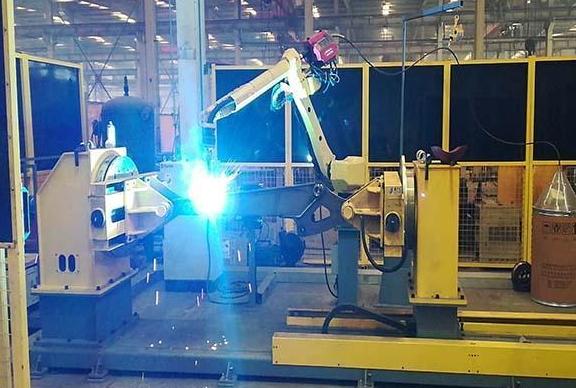
A welding robot workstation is a functional unit where welding robots perform tasks. Based on the combination and collaboration of robots and auxiliary equipment, these workstations can be categorized into:
- Simple welding workstations,
- Workstations combining welding robots and positioners,
- Workstations integrating welding robots with peripheral equipment for coordinated operations.
In the shipbuilding industry, mid-to-small assembly tasks involve a variety of types, a large number of components, and significant workloads for assembly and welding. The target workpieces for sectional welding vary widely in size and style, with notable differences in height, large surface areas, and long weld seams. The welding equipment must be capable of rapid and flexible movement across a vast space.
A standalone welding robot cannot meet the requirements of mid-to-small assembly welding tasks. Therefore, to expand the operational range of welding robots, a gantry-style positioner is introduced. This system increases the degrees of freedom in three axes and extends the movement range, forming a welding workstation system with 17 degrees of freedom. The robots and the gantry are controlled by two separate control cabinets, enabling the welding of various types of seams in large structural components during mid-to-small assembly tasks in shipbuilding.
2.Structural Features of Welding Robots
The welding robot discussed in this paper is developed by SHANDONG PCL GROUP Intelligent Equipment CO., LTD, representing a standard six-degree-of-freedom serial industrial robot. It is lightweight, highly flexible, compact, and agile.
The main functions of this robot include:
- Teaching and programming,
- End-effector motion trajectory control,
- Electrical limit settings,
- Fault detection and alarms,
- Mechanical limit settings,
- Safety protection mechanisms.
The structure of the robot comprises three parts: the main body, control system, and drive system. This robot is widely used in welding applications across industries such as agricultural machinery and construction machinery.
3.Coordination Between the Gantry System and Welding Robots
The gantry system, serving as the positioner in the welding workstation system, plays a critical role by suspending two welding robots from the crossbeam and cantilever of the gantry. This configuration extends the movement range of the welding robots in the vertical, horizontal, and lateral directions. By coordinating the gantry system and the welding robots, a complex welding robot system with over nine degrees of freedom is formed.
This type of welding workstation offers significant advantages in terms of flexibility and clear structural design. Consequently, it is widely adopted by domestic and international shipbuilding companies for welding applications in the shipbuilding industry.

