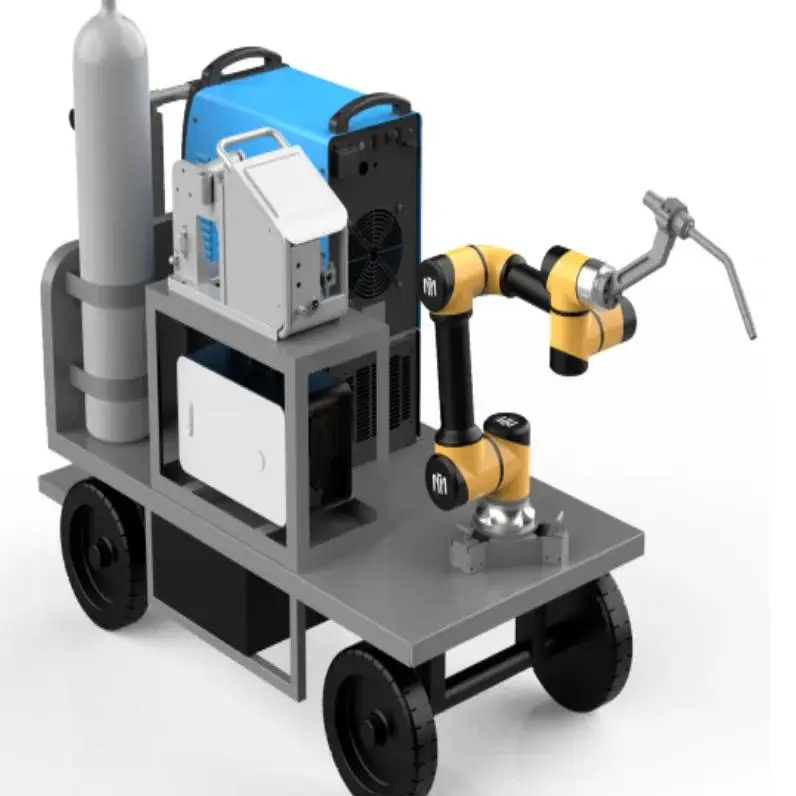
- Optimized for Stainless Steel TIG/MIG Hybrid Welding Cobot
- Industrial Grade Duty Cycle & Precision
- Easy Plug-and-Play Integration
Executive Summary: CMC-HYBRID-TIG-600 Precision Welding System
The CMC-HYBRID-TIG-600 represents a paradigm shift in automated stainless steel fabrication. Engineered specifically for high-specification B2B manufacturing environments, this hybrid cobot system integrates the aesthetic finish and metallurgical purity of Tungsten Inert Gas (TIG) welding with the high-deposition rates and speed of Metal Inert Gas (MIG) processes. Designed for industries requiring vacuum-tight seals, surgical-grade finishes, and structural integrity—such as aerospace, pharmaceutical processing, and semiconductor equipment manufacturing—the CMC-HYBRID-TIG-600 eliminates the traditional trade-off between speed and quality.
The primary use case for the CMC-HYBRID-TIG-600 is the high-volume production of thin-to-medium gauge stainless steel assemblies (0.8mm to 6.0mm). By utilizing a proprietary hybrid torch head, the system achieves a duty cycle of 100% at 300A, allowing for continuous multi-shift operation without thermal degradation of the power source or torch components. For engineering buyers, the immediate ROI is realized through a 40% reduction in cycle times compared to manual TIG welding and a 95% reduction in post-weld grinding and finishing costs due to the precision of the beam quality M2 laser-tracking stabilization.
Detailed Technical Specification Matrix
The following table outlines the critical engineering parameters of the CMC-HYBRID-TIG-600 system. These specifications are validated under ISO 9283 standards for industrial robots.
| Parameter | Specification Details |
|---|---|
| Model Number | CMC-HYBRID-TIG-600 |
| Degree of Freedom | 6-Axis Kinematic Chain |
| Maximum Payload | 10 kg (at wrist flange) |
| Reach Radius | 1300 mm |
| Pose Repeatability | ±0.03 mm |
| Duty Cycle | 100% @ 300A / 60% @ 400A |
| Wire Feed Speed | 0.5 m/min to 20.0 m/min (±0.1% accuracy) |
| Beam Quality M2 (Laser Tracking) | M2 < 1.1 (Single-mode fiber diode) |
| Ingress Protection Rating | IP54 (Controller and Manipulator) |
| Input Voltage | 380V – 480V, 3-Phase, 50/60 Hz |
| Communication Protocols | EtherCAT, Profinet, Modbus TCP/IP |
| Cooling System | Integrated Liquid-to-Air Heat Exchanger (5kW capacity) |
| Safety Compliance | ISO 10218-1, ISO 13849-1 (Cat. 3, PLd) |
Advanced Motion Control and Process Features
The CMC-HYBRID-TIG-600 is powered by the CMC-Core-V4 Motion Engine, which provides real-time synchronization between the robotic arm’s path and the welding power source’s output parameters. This level of integration is critical for stainless steel, where heat input management is essential to prevent warping and maintain corrosion resistance.
Adaptive Seam Tracking and Beam Quality: The system utilizes a high-resolution laser sensor with a beam quality M2 factor of less than 1.1. This near-perfect beam quality allows the sensor to identify joint geometries with micron-level precision, even on highly reflective stainless steel surfaces. The motion controller adjusts the torch position in real-time at a frequency of 1000Hz, compensating for material deformation caused by thermal expansion during the weld cycle.
Dynamic Wire Feed Synchronization: Unlike standard MIG systems, the CMC-HYBRID-TIG-600 features a pulsed wire feed speed control that is slave-synced to the arc voltage. This prevents “stubbing” and ensures a consistent bead profile. For TIG-heavy applications, the cold-wire feed mechanism can be modulated to simulate the “dab” technique of a master manual welder, providing the characteristic “stack of dimes” appearance required for high-end B2B components.
Through-Arc Sensing (TAS): For heavy-gauge stainless steel applications, the system employs TAS to monitor changes in the welding current. If the cobot detects a change in the arc gap, the motion control algorithm automatically adjusts the Z-axis height to maintain a constant voltage. This feature is particularly useful for large-diameter cylindrical vessels where slight out-of-roundness is common.
Environmental Resilience: The entire unit carries an IP54 rating. This ensures that the internal electronics, encoders, and drive systems are protected against the fine metallic dust and pressurized coolant sprays common in heavy fabrication environments. The IP54 rating reduces the frequency of unplanned downtime and extends the mean time between failures (MTBF) to over 25,000 operational hours.
ROI Case Study: Manual vs. CMC-HYBRID-TIG-600
To demonstrate the financial viability of the CMC-HYBRID-TIG-600, we conducted a comparative analysis based on a standard production run of 500 stainless steel pressure manifolds. The comparison evaluates labor costs, consumable efficiency, and rework rates.
Manual Welding Baseline: A certified TIG welder (Level III) typically earns $45.00 per hour including benefits. For this manifold project, the manual cycle time per unit is 120 minutes. Due to the physical fatigue associated with high-precision TIG welding, the effective duty cycle of a human operator is approximately 40%. Total labor cost per unit: $150.00. Rework rate due to human error or inconsistent penetration: 8%.
CMC-HYBRID-TIG-600 Implementation: The cobot completes the same manifold in 45 minutes. Because the system operates at a 100% duty cycle, it can run continuously through breaks and shift changes. The operator (Level I technician) earns $25.00 per hour and can manage two cobot cells simultaneously. Effective labor cost per unit: $9.38. Rework rate: <0.5%.
Annual Savings Projection: In a single-shift operation (2,000 hours/year), the CMC-HYBRID-TIG-600 produces 2,666 units compared to the manual welder’s 1,000 units. The total annual savings in labor and rework costs exceed $185,000. With a system purchase price of approximately $110,000, the Payback Period is 7.1 months. This does not include the additional revenue generated by the 166% increase in production capacity.
Post-Installation Maintenance FAQ
What are the primary maintenance requirements for the IP54-rated components?
The IP54 rating protects against dust and splashing water, but it does not eliminate the need for regular inspection. Every 1,000 hours, the seals on the controller cabinet and the axis gaskets should be inspected for wear. The cooling fans’ filters must be cleaned or replaced to ensure the internal power electronics remain within the optimal thermal range.
How does the system maintain wire feed speed accuracy over time?
The wire feed speed is maintained via a closed-loop encoder on the drive motor. Maintenance involves checking the drive rolls for groove wear every 500 hours of arc-on time. We recommend using high-quality, precision-drawn stainless steel wire to prevent “bird-nesting” and to ensure the friction coefficients remain within the calibrated limits of the CMC-Core-V4 engine.
Does the beam quality M2 of the laser sensor require recalibration?
The beam quality M2 is a characteristic of the laser source and does not change; however, the external protective lens of the laser sensor must be cleaned daily. If the lens becomes pitted or clouded by weld spatter, the sensor’s ability to resolve the seam will degrade. The system includes a “Quick-Change” lens cartridge to minimize downtime during this process.
What is the expected lifespan of the torch consumables at a 100% duty cycle?
When operating at a 100% duty cycle at 300A, the tungsten electrode (for TIG) should be inspected every 4 hours of arc-on time. The MIG contact tip should be replaced every 8-10 hours of arc-on time to prevent keyholing, which can affect the stability of the arc and the precision of the weld bead.
How are software updates handled for the motion control system?
The CMC-HYBRID-TIG-600 supports remote diagnostics and over-the-air (OTA) updates via the EtherCAT or Profinet connection. This allows our engineering team to push performance optimizations for specific stainless steel alloys (e.g., Duplex or 316L) without requiring an on-site technician.
cobot welding 01
cobot welder 02
free programming 03
robot welding 04
how to use Teach pendant 05