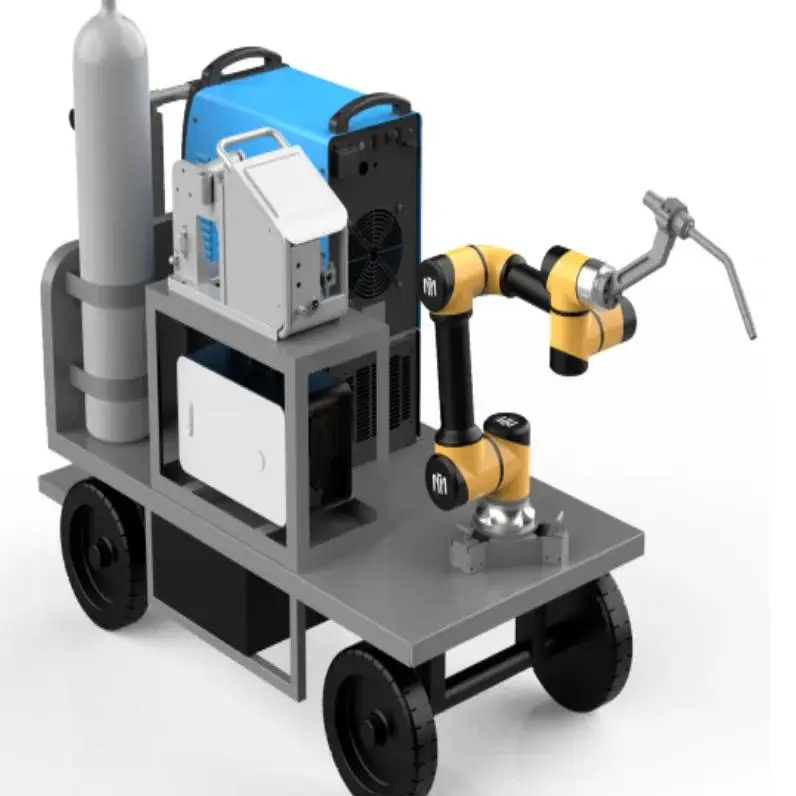
- Optimized for Heavy Duty Pulse MIG Welding Cobot for Thick Plate
- Industrial Grade Duty Cycle & Precision
- Easy Plug-and-Play Integration
Executive Summary: High-Deposition Automation for Structural Integrity
The CMC-PULSE-MIG-500 is a high-performance industrial welding cobot engineered specifically for heavy-duty applications involving thick plate carbon steel, stainless steel, and aluminum alloys. Designed to bridge the gap between manual labor shortages and the high capital expenditure of traditional fixed automation, this system provides an immediate Return on Investment (ROI) by increasing arc-on time from a typical manual average of 25% to over 85%.
The primary use case for the CMC-PULSE-MIG-500 involves multi-pass welding on plates exceeding 10mm in thickness. By utilizing advanced pulse-on-pulse waveforms, the system minimizes weld spatter and reduces heat-affected zones (HAZ), ensuring structural integrity in high-stress components such as heavy machinery frames, pressure vessels, and structural steel beams. The integration of an IP54-rated chassis ensures the cobot operates reliably in harsh shop floor environments characterized by metallic dust and high ambient temperatures.
Engineered for rapid deployment, the CMC-PULSE-MIG-500 features a lead-through programming interface, allowing welding engineers to teach complex paths in minutes rather than hours. This flexibility makes it an ideal solution for high-mix, low-volume production environments where traditional robotic cells are economically unfeasible.
Detailed Technical Specification Matrix
The following table outlines the critical engineering parameters for the CMC-PULSE-MIG-500 system. These specifications are validated under standard industrial operating conditions.
| Parameter | Specification Details |
|---|---|
| Rated Output Current | 500A @ 100% Duty Cycle (40°C) |
| Wire Feed Speed Range | 1.5 – 22.0 m/min (60 – 866 ipm) |
| Input Power Phase/Voltage | 3-Phase, 380V – 480V, 50/60 Hz |
| Cobot Reach (Radius) | 1300 mm (Standard) / 1800 mm (Extended) |
| Payload Capacity | 10 kg (at wrist flange) |
| Pose Repeatability | ±0.05 mm |
| Ingress Protection (IP) Rating | IP54 (Arm and Controller) |
| Laser Seam Tracking Beam Quality (M2) | M2 < 1.2 (High-precision diode) |
| Welding Process Support | Pulse MIG, Double Pulse, Spray Transfer, Short Circuit |
| Wire Diameter Compatibility | 0.8 mm to 1.6 mm (0.030″ to 0.062″) |
| Communication Protocols | EtherNet/IP, Modbus TCP, Profinet |
| Cooling System | Integrated Liquid Cooling (Closed Loop) |
| Safety Compliance | ISO 10218-1, ISO/TS 15066 |
Advanced Motion Control and Waveform Modulation
The CMC-PULSE-MIG-500 leverages a proprietary 6-axis kinematic controller designed to handle the high-inertia movements associated with heavy-duty welding torches and liquid-cooled lead sets. Unlike standard collaborative robots, the CMC-PULSE-MIG-500 utilizes Advanced Motion Control (AMC) algorithms that compensate for gravity and friction in real-time, ensuring that the torch velocity remains constant even during complex weave patterns.
Through-the-Arc Seam Tracking (TAST)
For thick plate applications, part fit-up consistency is often a challenge. The CMC-PULSE-MIG-500 features integrated Through-the-Arc Seam Tracking (TAST). By monitoring the electrical characteristics of the arc at high frequencies, the cobot can detect deviations in the weld joint and automatically adjust the torch position in the Y and Z axes. This is critical for maintaining the correct stick-out and penetration depth in multi-pass V-groove welds.
Laser Vision and Beam Quality
In addition to TAST, the system utilizes a high-resolution laser line sensor for pre-weld joint mapping. The sensor’s beam quality M2 factor of less than 1.2 allows for a highly focused spot size, enabling the system to detect gaps as small as 0.1mm. This precision is essential when calculating the necessary volume for adaptive fill passes in heavy structural joints.
Pulse-on-Pulse Waveform Technology
The 500A power source is equipped with a high-speed inverter capable of modulating the current at frequencies up to 200 kHz. The “Pulse-on-Pulse” mode alternates between high and low energy pulses, which controls the agitation of the weld pool. This technique is particularly effective for vertical-up welding on thick aluminum plates, as it mimics the “stacked dimes” appearance of TIG welding while maintaining the high deposition rates of MIG.
ROI Case Study: Manual Welding vs. CMC-PULSE-MIG-500
To evaluate the economic impact of the CMC-PULSE-MIG-500, we conducted a comparative analysis based on a mid-sized structural steel fabrication facility producing heavy equipment chassis. The study focuses on a 15mm thick fillet weld, 1000mm in length.
Manual Welding Baseline
A skilled manual welder typically achieves an arc-on time of 20-30% due to the physical demands of managing a 500A torch, heat fatigue, and the need for frequent repositioning. For a 1000mm weld, manual labor includes significant time for slag removal (if using flux-core) and inter-pass cleaning. Total cycle time per unit: 45 minutes. Labor cost (burdened): $45.00/hour. Cost per unit: $33.75.
CMC-PULSE-MIG-500 Implementation
The cobot operates at an arc-on time of 85%. Because the pulse process minimizes spatter, post-weld cleanup is reduced by 90%. The cobot maintains a consistent travel speed of 350 mm/min for the root pass and 280 mm/min for fill passes. Total cycle time per unit: 18 minutes. An operator can tend to three cobot stations simultaneously. Effective labor cost per unit: $4.50.
Annualized Savings
Based on a single-shift operation (2,000 hours/year), the CMC-PULSE-MIG-500 produces 6,666 units compared to the manual welder’s 2,666 units. The total annual savings in labor costs alone exceed $110,000. When factoring in the 15% reduction in wire waste and 20% reduction in shielding gas consumption due to optimized arc starts, the payback period is calculated at 8.4 months.
Post-Installation Maintenance FAQ
Q: What is the recommended maintenance interval for the cobot joints?
A: The CMC-PULSE-MIG-500 uses lifetime-lubricated harmonic drives. However, we recommend a visual inspection and a backlash check every 5,000 operating hours. The IP54 seals should be inspected annually for integrity, especially in environments with high concentrations of grinding dust.
Q: How often should the wire feed liner be replaced?
A: For high-volume 1.2mm or 1.6mm wire applications, the liner should be replaced every 150-200 kg of wire consumed. Using a high-quality chrome-plated or Teflon liner (for aluminum) will extend the life of the feed motor by reducing friction torque.
Q: Does the system require recalibration after a torch collision?
A: The cobot features built-in collision detection that halts motion within milliseconds of contact, usually preventing damage. However, if a high-force impact occurs, the Tool Center Point (TCP) should be verified using the integrated calibration routine. The system’s pose repeatability of ±0.05 mm is maintained through an automated “Check-Point” software feature.
Q: What are the coolant requirements for the 500A torch?
A: The system requires a low-conductivity glycol-based coolant. The integrated cooling unit monitors flow rate and temperature. If the flow rate drops below 1.5 L/min or the temperature exceeds 65°C, the system will trigger an emergency stop to protect the power cable and contact tip.
Q: How is the IP54 rating maintained over time?
A: Ensure that all cable glands are tightened to the specified torque and that the controller cabinet filters are cleaned or replaced monthly. Avoid using high-pressure compressed air directly on the joint seals during cleaning, as this can force particulates into the bearing races.
cobot welding 01
cobot welder 02
free programming 03
robot welding 04
how to use Teach pendant 05