- Optimized for Compact Collaborative Arc Welding Arm for Small Shops
- Industrial Grade Duty Cycle & Precision
- Easy Plug-and-Play Integration
Executive Summary: High-Precision Automation for High-Mix, Low-Volume Production
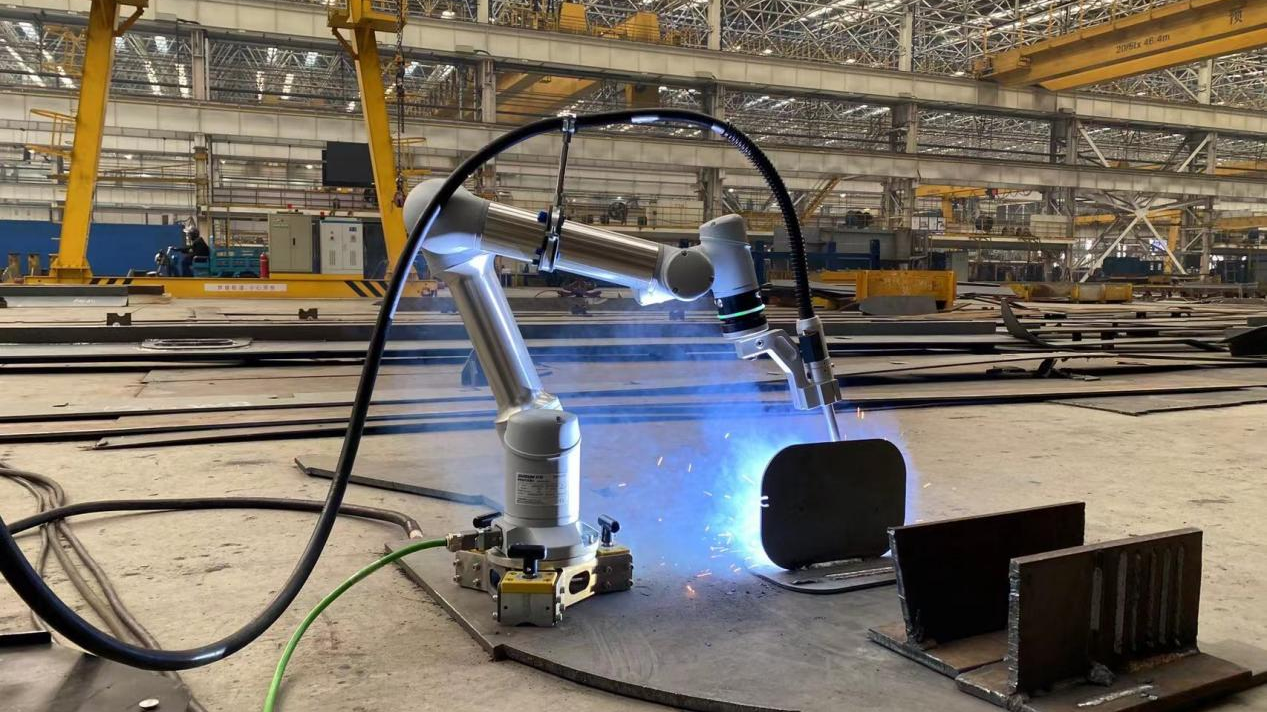
The CMC-ARC-MINI-800 is a compact collaborative robot (cobot) engineered specifically for small-to-medium enterprises (SMEs) and specialized fabrication shops requiring high-precision arc welding in constrained floor spaces. As the industry faces a critical shortage of certified welders, the MINI-800 provides a scalable solution to maintain throughput without the overhead of traditional industrial robotics. Unlike large-scale automated cells, the MINI-800 features a footprint of only 190mm at the base, allowing for integration into existing manual welding benches.
The primary use case for the CMC-ARC-MINI-800 is the automation of repetitive MIG/MAG and TIG welding tasks on workpieces where weld consistency and duty cycle optimization are paramount. By utilizing ISO 10218-1 compliant force-torque sensors, the arm operates safely alongside human technicians, eliminating the need for bulky safety fencing in many configurations. The system delivers immediate ROI by increasing arc-on time from a typical manual average of 30% to over 85%, while simultaneously reducing consumable waste through precise wire feed speed regulation.
Detailed Technical Specification Matrix
| Parameter | Specification Details |
|---|---|
| Model Number | CMC-ARC-MINI-800 |
| Reach | 800 mm |
| Payload Capacity | 5.0 kg (at full extension) |
| Pose Repeatability | +/- 0.03 mm |
| Ingress Protection | IP54 rating (Dust-protected and splash-resistant) |
| Duty Cycle | 100% at 200A / 60% at 250A |
| Wire Feed Speed Range | 1.5 – 22.0 m/min (+/- 1% accuracy) |
| Degrees of Freedom | 6 rotating joints |
| Joint Ranges | +/- 360 degrees (all joints) |
| Laser Seam Tracking (Optional) | Beam quality M2 < 1.1 for high-resolution edge detection |
| Power Requirements | Single-phase 200-240V, 50-60Hz |
| Communication Protocols | EtherNet/IP, Modbus TCP, PROFINET |
| Operating Temperature | 0°C to 50°C |
| System Weight | 24.5 kg (Arm only) |
Advanced Motion Control Features
The CMC-ARC-MINI-800 utilizes a proprietary motion control kernel that prioritizes path fidelity over raw speed, ensuring that the arc remains stable even during complex multi-axis transitions. This is particularly critical in thin-gauge sheet metal applications where heat input must be strictly controlled to prevent warping.
Adaptive Through-Arc Seam Tracking (TAST)
The system incorporates advanced TAST logic, which monitors changes in welding current to detect deviations in the weld joint. If the workpiece is slightly misaligned or suffers from thermal distortion during the pass, the MINI-800 automatically adjusts the torch position in real-time. This feature reduces the need for expensive, high-precision jigging, allowing shops to use standard modular welding tables.
Dynamic Weave Pattern Integration
To accommodate varying gap widths and fillet requirements, the controller supports customizable weave patterns including zig-zag, circular, and trapezoidal motions. Users can define weave frequency (up to 10Hz) and amplitude (0.1mm increments) directly through the pendant interface. This ensures deep penetration and proper sidewall fusion, meeting AWS D1.1 standards for structural integrity.
Lead-Through Teaching and Path Smoothing
For high-mix environments, the MINI-800 features a “Zero-Gravity” mode. An operator can manually guide the arm through the desired weld path, hitting a record button at critical waypoints. The software then applies a path-smoothing algorithm to convert these points into a fluid, continuous motion command. This reduces programming time from hours to minutes, making even small batches of 10-20 units economically viable for automation.
Integrated Laser Vision and Beam Quality
For high-specification aerospace or medical components, the MINI-800 can be equipped with an external laser displacement sensor. By maintaining a beam quality M2 of less than 1.1, the sensor provides a highly focused spot size, allowing the controller to map the joint geometry with sub-micron precision before the arc is struck. This pre-scan capability is essential for joints with non-linear fit-up issues.
ROI Case Study: Manual vs. Cobot Labor Savings
To evaluate the financial viability of the CMC-ARC-MINI-800, we conducted a comparative analysis based on a standard production run of 500 mild-steel brackets (6mm thickness, 200mm weld length per unit).
Scenario A: Manual Welding
A skilled manual welder typically achieves an arc-on time of 25-30% due to the need for part positioning, cleaning, and ergonomic breaks. At an average burdened labor rate of $45.00/hour, the cost per unit is significantly impacted by non-productive time. Furthermore, manual welding on this specific bracket showed a 4% rework rate due to inconsistent penetration at the start/stop points.
Scenario B: CMC-ARC-MINI-800 Implementation
The MINI-800 was deployed using a dual-station turntable. While the cobot welds on Station A, the operator loads/unloads Station B. This configuration increased arc-on time to 82%. Because the wire feed speed and travel speed are locked into the validated program, the rework rate dropped to 0.2%.
Financial Breakdown
Annual Labor Savings: By automating the primary welding task, the shop was able to reassign the skilled welder to complex tacking and quality control roles. The cobot performed the work of 2.2 manual shifts. Total annual labor savings: $94,000.
Consumable Efficiency: The precise control of the arc length and gas flow resulted in a 12% reduction in shielding gas consumption and a 15% reduction in welding wire waste. Total annual consumable savings: $4,200.
Payback Period: With an initial investment of $65,000 (including arm, power source, and integration), the CMC-ARC-MINI-800 reached the break-even point in approximately 7.9 months.
Post-Installation Maintenance FAQ
What are the daily maintenance requirements for the MINI-800? Daily maintenance is minimal. Operators should inspect the torch nozzle for spatter build-up and ensure the wire feeder rollers are free of debris. The IP54 rating ensures that the internal electronics are protected from the metallic dust common in welding environments, but the external arm should be wiped down to prevent heat-sink clogging.
How often does the system require recalibration? The MINI-800 uses absolute encoders, meaning it does not require homing upon power-up. However, a TCP (Tool Center Point) calibration check is recommended every 500 operational hours or after any torch collision. This ensures the +/- 0.03mm repeatability is maintained.
What is the lifespan of the cable management system? The internal cabling is rated for 5 million flex cycles. In a standard two-shift operation, we recommend a preventative replacement of the external dress pack (the cables leading to the torch) every 18 to 24 months, depending on the severity of the articulation angles used in your programs.
Can the system handle different wire diameters without hardware changes? The software supports various wire profiles, but physical drive rolls and torch liners must be matched to the wire diameter (e.g., 0.8mm, 1.0mm, or 1.2mm). The wire feed speed controller automatically adjusts its torque compensation based on the wire material selected in the GUI.
How does the system handle software updates? Updates are delivered via encrypted USB or through the secure EtherNet/IP port. These updates include new weave patterns, updated safety protocols, and optimizations for the motion control kernel. All updates are backwards compatible with existing weld programs.
cobot welding 01
cobot welder 02
free programming 03
robot welding 04
how to use Teach pendant 05