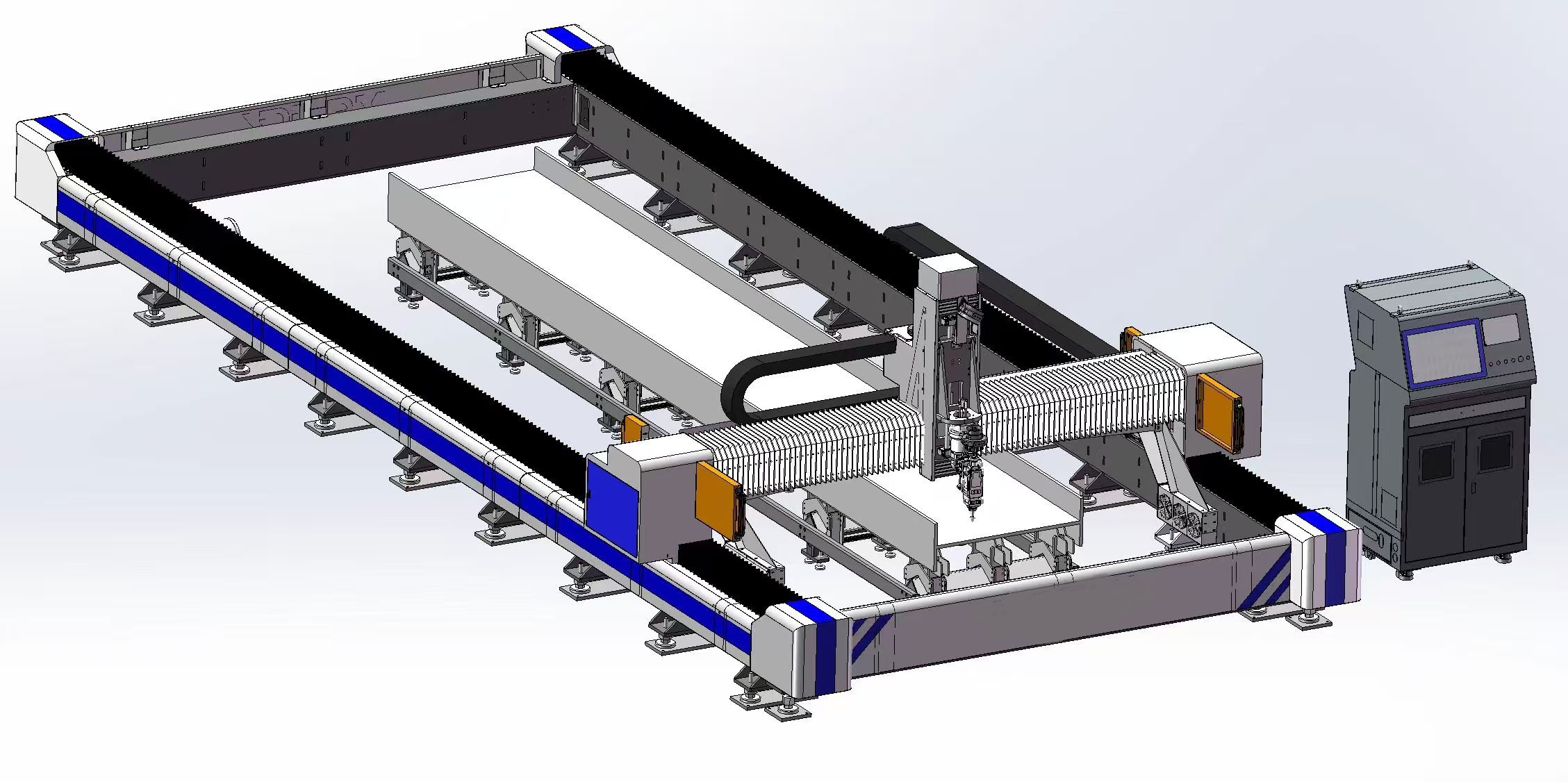
Tube and pipe cutting shares the same underlying laser physics as flat-sheet cutting -- same assist gases, same reflectivity concerns on aluminum and copper -- but the actual machine looks and works differently, with a rotary chuck and 4-axis motion replacing a flat gantry. This page covers which materials and power tiers we actually publish for tube work, and which ones we size per inquiry rather than off a fixed chart.

Tube CNC Fiber Laser Cutting Machine -- Φ20mm - Φ220mm (up to Φ500mm optional), 4-axis simultaneous motion, rotation up to 120 RPM.
Tube Materials: What's Published vs. What We Quote Per Job
Our Tube CNC Fiber Laser Cutting Machine explicitly lists carbon steel, stainless steel, aluminum as supported materials on its published spec sheet. That doesn't mean other metals can't be tube-cut on our equipment -- it means we'd rather tell you plainly which figures are documented versus which need a direct conversation, the same honesty standard we hold on every page of this site.
| Material | Tube Cutting Notes |
|---|---|
| Carbon Steel | Published and commonly ordered -- oxygen assist drives fast, low-cost cutting on tube walls the same way it does on flat carbon steel plate. |
| Stainless Steel | Published and commonly ordered -- nitrogen assist keeps the cut face bright on visible tube runs like railing and equipment frames, without the oxidation a plasma-cut tube edge would carry. |
| Aluminum | Published and commonly ordered -- reflectivity management at the cutting head matters as much on round tube as on flat sheet, and our tube platforms carry the same back-reflection protection. |
| Aluminum Alloy | Cuts on the same principles as pure aluminum tube -- confirm your specific alloy and wall thickness with us, since it isn't separately itemized on our published tube spec sheet. |
| Mild Steel | Cuts within the same range as carbon steel tube, since mild steel is simply low-carbon steel -- treat the carbon steel figures above as the reference point. |
| Galvanized Steel | Cuttable, but plan for real fume extraction -- the zinc coating vaporizes at the cut just as it does on flat galvanized sheet, and that's a health-and-safety requirement, not optional. |
| Copper | Copper tube cutting needs meaningfully more power than steel tube at the same wall thickness given copper's reflectivity and conductivity -- confirm your wall thickness and diameter directly rather than assuming a steel-equivalent power tier. |
| Brass | Similar reflectivity profile to copper, though somewhat reduced by its zinc content -- cuts more predictably than copper tube but still benefits from a conservative first test cut on a new job. |
| Titanium | A specialized case -- titanium tube work (aerospace and medical-adjacent applications) needs argon or high-purity nitrogen shielding and is quoted per configuration rather than off a standard tube spec sheet. |
Power Tiers for Tube Cutting: 500W to 6000W
Our Tube and Sheet Laser Cutting Machine combo publishes IPG 500W / 1000W / 2000W / 3000W configurations, with sheet-mode capacity of 0-15mm on carbon steel, 0-15mm on mild steel, and 0-10mm on stainless steel -- the closest published reference point we have for lower tube power tiers, since tube wall thickness capacity scales with power the same general way flat sheet does.
For 4000W and 6000W tube-specific configurations, our dedicated Tube CNC and Pipe Laser lines are built and quoted per configuration around your actual diameter, wall thickness, and material -- rather than a single fixed spec sheet, since tube geometry (diameter, wall thickness, and shape together) interacts with power differently than a flat sheet does.
The 3-in-1 Sheet-and-Tube Combo
For shops that don't run enough tube volume to justify a dedicated tube platform, the Tube and Sheet Laser Cutting Machine cuts both flat sheet and round/square tube on one machine -- removes the need for two separate machines on the shop floor, using the same PRECITEC (Germany) head and 0.02mm positioning accuracy in either mode. This is the honest answer for a shop asking "can one machine do both": yes, with the tradeoff that a combo machine won't match a dedicated tube platform's diameter range or rotation speed.
Diameter and Wall Thickness Capacity
Our dedicated Tube CNC line covers Φ20mm - Φ220mm (up to Φ500mm optional), handling round, square, rectangular, D-shaped, oval, polygonal cross-sections with 4-axis simultaneous motion. Wall thickness capacity at a given diameter depends on power tier and material together -- send your actual tube dimensions and material and we'll confirm the exact configuration rather than quoting a generic ceiling that might not hold for your specific combination.
Cutting Speed and Rotation
Rotation speed up to up to 120 RPM combined with 4-axis simultaneous motion lets the machine keep the tube moving continuously through most cuts rather than stopping and repositioning for every feature -- this is a meaningfully different throughput picture than flat-sheet cutting, where the head moves and the material stays still.
Cycle-time consistency, not just top speed, is what actually drives tube-materials-and-power readers quoting accuracy: a machine that holds the same per-part time on the 50th sheet of a run as the 1st lets you quote a job with confidence, where a machine that degrades under sustained load makes every quote a guess.
Nesting and Material Savings on Tube
Material savings up to 20% via intelligent nesting software -- on tube stock specifically, that comes from minimizing offcut length per bar rather than 2D sheet nesting, and it compounds meaningfully on higher-value materials like stainless or aluminum tube.
Two Perspectives Worth Considering
cycle-time math has to account for piercing overhead, not just linear cutting speed, when quoting a tube materials and power readers nest with a lot of small features -- treating a spec sheet's "cutting speed" number as the whole story undersells actual job time.
consistency across a long run is what actually gets noticed -- if part 200 needs the same touch-up as part 2, that's a parameter or gas-purity problem worth flagging before it becomes a full-shift's worth of rework on a tube materials and power readers order.
How a Tube Job's Cost Structure Differs From Flat Sheet
Fiber laser sources convert electricity to cutting power far more efficiently than the CO2 systems tube cutting shops shops ran a decade ago -- our 3D robotic laser cutting line alone documents better than 30% electrical efficiency, and that efficiency gap is most of why fiber laser cut per-part energy cost has fallen even as machines have gotten more powerful.
Automated nesting and, on higher-end lines, coil-fed or automated loading reduce how much operator attention tube cutting shops parts need between cuts -- an operator running a fiber laser is more often reviewing a nesting file and swapping finished sheets than hand-guiding the process the way older equipment required.
These operational factors don't change which machine is right for your tube work, but they do change what running it actually costs month to month -- worth factoring into your decision alongside the material and power questions above.
Fume Extraction on Tube Work
The honest engineering answer on fume extraction for tube cutting shops: size it to your worst material, not your average one. A tube cutting shops shop running mostly thin aluminum with an occasional galvanized job still needs extraction rated for the galvanized run, because that's the one with a real health-and-safety requirement behind it, not just a housekeeping preference.
Choosing Between the Combo and a Dedicated Platform
The practical decision point is volume and diameter range, not price alone. A shop running tube occasionally alongside a mostly flat-sheet job mix is well served by the Tube and Sheet combo, avoiding a second dedicated machine and a second footprint on the floor. A shop where tube is the primary product -- structural framing, railing manufacturing, or a dedicated tube fabrication line -- outgrows the combo's diameter range and rotation speed quickly enough that a dedicated Tube CNC or Pipe Laser platform pays for the added cost within the first year or two of real production.
There's a middle case worth naming honestly: a shop that's not sure yet which category it falls into. In that situation, starting with the combo and planning a dedicated platform once volume clarifies itself is usually the lower-risk path financially, even though it means revisiting the purchase decision again later rather than solving it once.
Whatever combination of material, power, and platform you land on, the underlying advice is the same across this whole page: ask us for the specific figure your job needs rather than extrapolating from a published range that may not apply cleanly to your exact combination of diameter, wall thickness, and material.
Reading a Tube Machine Spec Sheet Correctly
A tube spec sheet's diameter range is usually the widest number on the page, and it's worth reading skeptically the same way a flat-sheet cutting-speed figure deserves scrutiny -- accuracy and cycle time both vary across that range, and a machine rated for a wide diameter span doesn't necessarily perform identically at both ends of it. Ask specifically about performance at your actual diameter and wall thickness rather than assuming the headline range applies uniformly.
A Note on Assist Gas Consistency Across Materials
Switching between tube materials within the same shift -- carbon steel one job, stainless the next -- means switching assist gas too, the same as it would on flat sheet. The practical difference on a tube platform is that gas delivery has to reach a rotating chuck rather than a stationary sheet, which is a solved engineering problem on our platforms but worth confirming directly if you're comparing tube machines from different manufacturers, since gas-delivery design to a moving chuck varies more between suppliers than it does on flat-bed gas delivery.
Common Concerns Before Ordering
Buyers new to tube cutting sometimes assume it's simply "laser cutting, but round" and underestimate how much the chuck, rotation, and intersection-joint programming differ from flat-sheet work. That's exactly why we'd rather walk through your actual tube dimensions, material, and typical joint geometry before recommending a configuration, instead of assuming a flat-sheet machine's specs translate directly.
Whichever material, power tier, and platform end up being right for your job, the underlying guidance holds across the whole page: we'd rather confirm a real figure directly than let a generic chart set an expectation that doesn't hold for your specific combination of diameter, wall thickness, and material.
Warranty, Software, and Export for Tube Equipment
Every tube machine we ship carries the same manufacturer warranty structure as our flat-sheet lines, with documented maintenance schedules in writing, and installation guidance plus operator training included regardless of configuration. The control software runs the same nesting and cutting-parameter family as our other lines, adapted for bar-length nesting instead of 2D sheet layout, which shortens the learning curve for a team already trained on one of our flat-sheet machines.
PCL Group manufactures and exports tube cutting equipment directly, the same as our sheet-cutting lines -- lead time depends on configuration and current factory schedule, since each tube machine is built and tested against your specific diameter, material, and automation requirements rather than pulled from stock.
If you're evaluating tube equipment from more than one manufacturer, ask each one the same questions raised throughout this page -- which materials and power tiers are actually published versus quoted per job, what the warranty covers, and whether they'll provide real sample parts -- so you're comparing answers to the same questions rather than each supplier's own marketing framing.
Frequently Asked Questions
Can your tube machines cut copper or titanium tube?
Yes, but these aren't on our standard published tube spec sheet -- send your diameter, wall thickness, and material and we'll confirm the exact configuration.
What's the maximum tube diameter you can cut?
Our dedicated Tube CNC line covers Φ20mm-Φ220mm standard, with up to Φ500mm available as an option.
Do I need a dedicated tube machine, or does the combo cover my needs?
If tube is an occasional part of your job mix alongside flat sheet, the combo Tube and Sheet machine is often the more practical choice; if tube is your primary volume, a dedicated tube platform gives more diameter range and rotation speed.
Does wall thickness capacity scale the same way as flat sheet thickness?
The same general physics apply (more power cuts more thickness), but diameter and wall thickness interact in tube geometry differently than flat sheet -- send your specific dimensions rather than assuming a direct translation.
What materials come standard on your tube spec sheet?
Carbon steel, stainless steel, and aluminum are explicitly published; other metals are quoted per configuration.
How much does nesting software save on tube stock?
Our published figure is up to roughly 20% material savings via intelligent nesting, achieved by minimizing offcut length per bar rather than 2D sheet layout.
Is 4000W or 6000W available for tube cutting?
Yes, through our dedicated Tube CNC and Pipe Laser lines, built and quoted per configuration rather than off a fixed standard spec sheet.
Should I start with the combo machine or a dedicated tube platform?
If tube is occasional alongside mostly flat-sheet work, start with the combo; if tube is your primary product or volume is already high, a dedicated platform pays back faster.
Does switching materials mid-shift on a tube machine work the same as on flat sheet?
The gas-switching principle is the same, though gas delivery to a rotating chuck is a more complex engineering problem than to a stationary sheet -- confirm this design detail when comparing suppliers.
Is fume extraction different for tube cutting versus sheet cutting?
The same material-driven principle applies -- size extraction to whichever material in your mix needs it most, regardless of whether it's cut as tube or flat sheet.