Advanced Structural Steel Fabrication: The Role of H-Beam Plasma Cutting in Montevideo
The industrial landscape of Montevideo, Uruguay, has undergone a significant transformation as it positions itself as a strategic logistics and manufacturing hub for the Southern Cone. Central to this evolution is the adoption of high-precision thermal cutting technologies designed to meet the rigorous demands of international structural engineering standards. In the context of heavy-duty steel construction, the H-Beam Plasma Cutter has emerged as a critical instrument for achieving the dimensional accuracy required for complex assemblies. By integrating multi-axis robotic motion with high-definition plasma power sources, fabricators in the region are now capable of executing intricate geometries, specifically 45-degree beveling, which is a prerequisite for high-strength, seamless welding applications.
The transition from traditional mechanical sawing and manual oxy-fuel cutting to automated plasma systems represents a shift toward data-driven production. In Montevideo’s port expansion and infrastructure projects, the necessity for beams that require minimal post-processing is paramount. This article examines the technical specifications of 45-degree beveling via plasma technology and its direct impact on welding efficiency and structural integrity within the global B2B supply chain.
Technical Dynamics of 45-Degree Beveling
Beveling is the process of preparing a slope between the edge of a structural member and its surface. For H-beams, which consist of two flanges and a connecting web, the precision of this slope determines the quality of the subsequent weld joint. A 45-degree bevel is the industry standard for creating V-grooves or single-bevel butt joints, allowing for maximum weld penetration.
Utilizing an H-Beam Plasma Cutter equipped with a 5-axis or 6-axis robotic head allows the torch to maintain a constant standoff distance while rotating around the profile of the beam. This motion is controlled by complex Computer Numerical Control (CNC) algorithms that compensate for the natural variations in steel profiles, such as flange tilt or web eccentricity. The 45-degree angle is not merely a geometric requirement but a functional one; it ensures that the welding electrode can access the root of the joint, facilitating a Full Penetration (CJP) weld that meets ISO 5817 quality levels.
Thermal Management and the Heat-Affected Zone (HAZ)
One of the primary concerns in thermal cutting is the Heat-Affected Zone (HAZ). When cutting H-beams for structural use in Montevideo’s maritime or industrial sectors, excessive heat input can alter the metallurgical properties of the steel, leading to localized hardening or embrittlement. Modern high-definition plasma systems mitigate this through narrow arc constriction and high-speed gas flows.
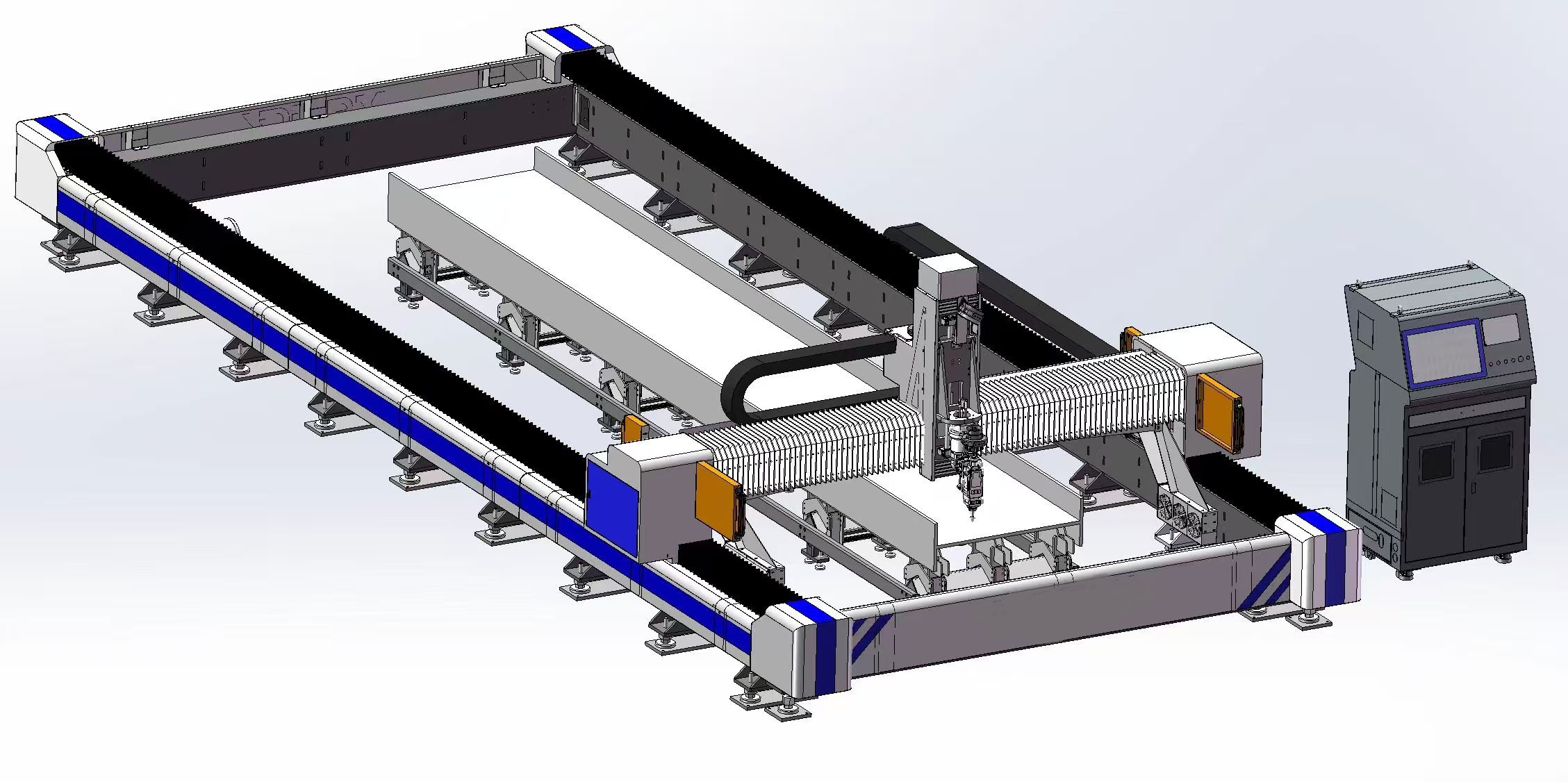
Industrial Application of H-Beam Plasma Cutter
By optimizing the cutting speed and gas pressure (typically using oxygen or nitrogen-water injection), the H-Beam Plasma Cutter minimizes the width of the HAZ. This is particularly vital for 45-degree bevels, as the increased surface area of the cut face is more susceptible to thermal absorption. A reduced HAZ ensures that the base metal retains its ductility and tensile strength, providing a stable substrate for the welding process. This technical precision eliminates the need for secondary grinding, which is often required after oxy-fuel cutting to remove the carbonized layer.
Achieving Seamless Welding Through Bevel Consistency
Seamless welding is defined by the absence of defects such as porosity, slag inclusions, or lack of fusion. The prerequisite for such a weld is Bevel Angle Consistency. If the bevel angle fluctuates even by a few degrees along the length of an H-beam flange, the welder or automated welding tractor will encounter varying gap widths. This variance leads to inconsistent heat distribution and potential structural weak points.
In the fabrication shops of Montevideo, the integration of robotic plasma cutting ensures that the 45-degree bevel is uniform across the entire cross-section of the beam. This uniformity allows for standardized weld parameters. When the bevel is precise, the volume of filler metal required is predictable, which optimizes consumables usage and reduces the overall cycle time per joint. Furthermore, the clean, dross-free edges produced by high-definition plasma allow for immediate fit-up, a critical factor in maintaining tight production schedules for global export projects.
Strategic Advantages for the Montevideo Industrial Sector
Montevideo’s geographic position as a gateway to the Mercosur market necessitates a high level of throughput. The implementation of automated H-beam processing centers reduces the reliance on skilled manual labor for layout and cutting, which are traditionally prone to human error.
1. Dimensional Accuracy: Plasma systems offer tolerances within +/- 0.5mm, ensuring that large-scale modular assemblies fit perfectly on-site, whether in Uruguay or at a remote global construction site.
2. Versatility: Beyond 45-degree bevels, these cutters can execute bolt holes, cope cuts, and slotting in a single pass, streamlining the entire fabrication workflow.
3. Economic Efficiency: By combining multiple processing steps into one machine, fabricators reduce material handling costs and floor space requirements.
Integration with BIM and Digital Workflows
The modern H-Beam Plasma Cutter does not operate in isolation. In the current B2B environment, these machines are integrated with Building Information Modeling (BIM) software. Files exported in DSTV or STEP formats from engineering offices are fed directly into the cutter’s controller. This digital continuity ensures that the 45-degree bevels specified in the structural design are executed with absolute fidelity. For international contractors sourcing fabricated steel from Montevideo, this digital traceability provides an added layer of quality assurance, confirming that every component meets the requisite geometric specifications before it leaves the facility.
Concluding Industry Insight
As the global construction industry moves toward increased modularization and off-site fabrication, the technical capabilities of regional hubs like Montevideo become a pivot point for supply chain resilience. The adoption of 45-degree beveling via advanced plasma technology is not merely a localized trend but a response to the escalating demand for “First-Time-Right” manufacturing.
The industry insight for the coming decade suggests that the gap between traditional fabrication and robotic automation will continue to widen. Facilities that invest in high-degree-of-freedom plasma cutting will dominate the market by offering superior weld preparation that directly translates to lower structural failure rates and reduced long-term maintenance costs. For Montevideo, leveraging these technical proficiencies allows it to compete not just on labor costs, but on the precision and reliability of its industrial output. The 45-degree bevel, while a specific technical detail, serves as a benchmark for a facility’s overall commitment to engineering excellence and its readiness to support the next generation of global infrastructure.
Industrial Expertise & Support
Are you looking for high-performance H-Beam Plasma Cutter tailored for the Global market? Our engineering team provides comprehensive solutions for modern manufacturing.
Contact Experts
