Advanced Structural Steel Fabrication: The Rise of 4-Chuck Systems in Asunción
The industrial landscape of Asunción, Paraguay, is undergoing a significant transformation driven by large-scale infrastructure projects and the expansion of the Paraguay-Paraná Waterway’s logistics hubs. Central to this growth is the demand for high-precision structural steel components. As local fabricators transition from manual processing to automated CNC solutions, the H-Beam Plasma Cutter equipped with 4-chuck stability has emerged as the definitive standard for processing heavy structural profiles. This technical analysis explores the mechanical advantages, operational efficiencies, and engineering specifications of 4-chuck plasma systems within the context of South American industrial expansion.
Mechanical Architecture: The Engineering Logic of 4-Chuck Stability
Traditional plasma cutting systems for structural steel often rely on a 2-chuck or 3-chuck configuration. While sufficient for lighter profiles, these setups frequently encounter stability issues when handling heavy H-beams or I-beams exceeding 12 meters in length. The 4-chuck system utilized in modern H-Beam Plasma Cutter units provides a redundant and synchronous support mechanism that fundamentally alters the physics of the cutting process.
The primary engineering challenge in beam processing is the management of torsional stress and gravitational sag. When a heavy beam is rotated for multi-face cutting, the center of gravity shifts. A 4-chuck system utilizes two main rotating chucks and two auxiliary support chucks that move along linear rails. This configuration ensures that the workpiece is clamped at four distinct points, effectively neutralizing vibration during the high-speed movement of the plasma torch. By maintaining a rigid axis of rotation, the system achieves a spatial positioning accuracy often within +/- 0.05mm, a critical requirement for complex architectural joints.
Optimizing Material Utilization through Zero-Tailing Technology
One of the most significant operational costs in structural steel fabrication is material waste, specifically the “tailing” or the unprocessed end of the beam that cannot be held by the chucks during the final cut. In the competitive market of Asunción, where steel import costs are a variable factor, minimizing waste is essential for profit margins.
The 4-chuck synchronous rotation allows for what is technically referred to as “zero-tailing” or “minimal tailing” processing. Because the chucks can pass through one another or hand off the workpiece in a relay sequence, the plasma torch can access the entirety of the beam. In a standard 2-chuck system, the tailing waste can range from 500mm to 1000mm. With a 4-chuck H-Beam Plasma Cutter, this waste is reduced to near zero. For a facility processing 500 tons of steel monthly, the cumulative savings in raw material costs provide a rapid return on investment for the machinery.
Technical Specifications and Plasma Power Integration
The efficacy of the hardware is dependent on the integration of the plasma power source and the CNC control loop. In Asunción’s industrial zones, the stability of the power grid is a consideration, requiring systems with robust voltage regulation. Most 4-chuck systems are paired with high-definition plasma units (ranging from 130A to 400A) capable of piercing heavy-walled H-beams with thicknesses up to 50mm.
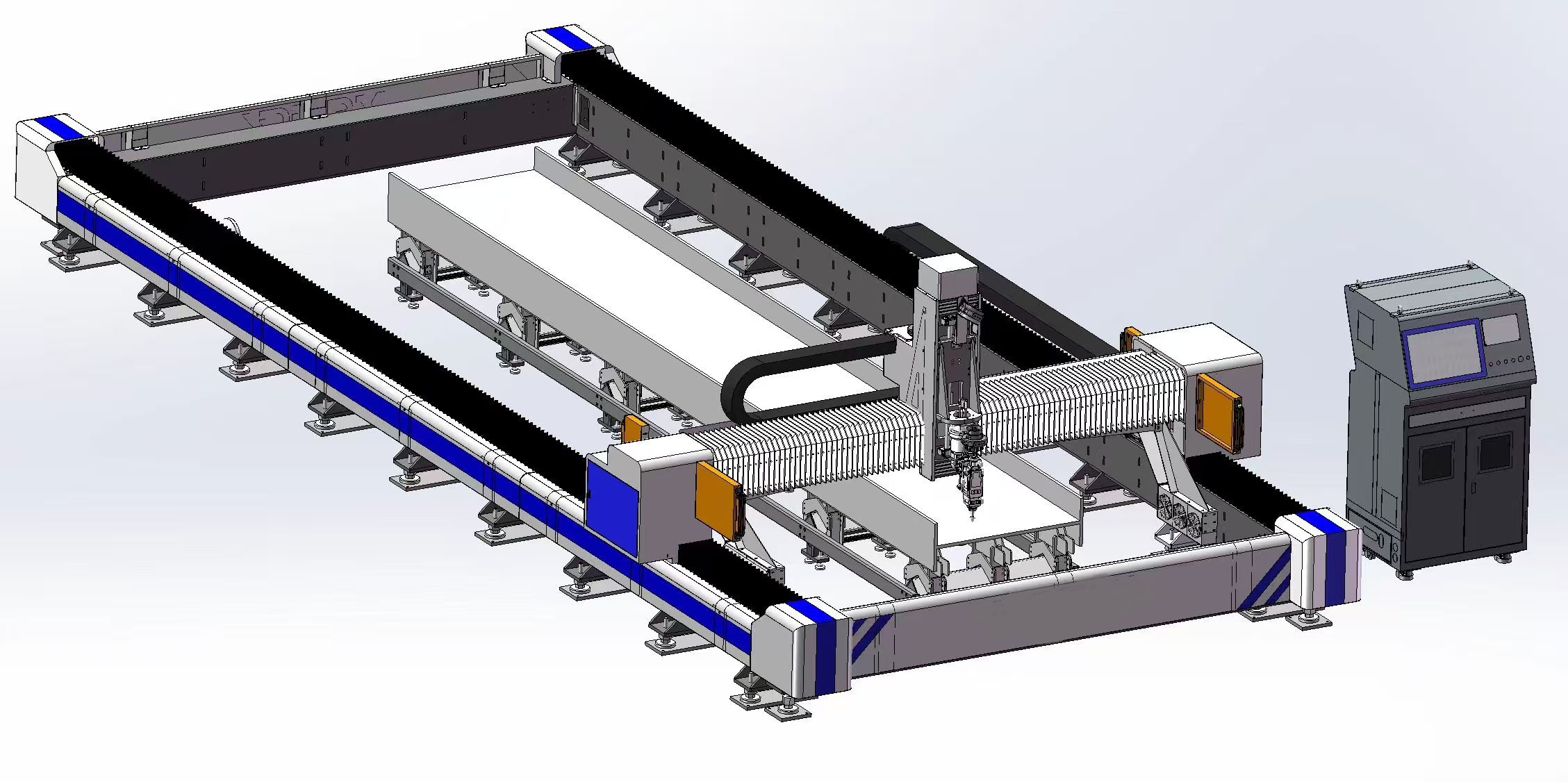
Industrial Application of H-Beam Plasma Cutter
Key technical parameters for these systems include:
- Maximum Processing Dimensions: 1200mm x 600mm profiles.
- Rotation Speed: Variable frequency drive (VFD) controlled rotation up to 15 RPM.
- Torch Degrees of Freedom: 5-axis or 6-axis robotic arm integration for 45-degree beveling.
- Positioning Speed: Rapid traverse speeds of up to 30,000 mm/min on the longitudinal axis.
The 5-axis capability is particularly vital for the preparation of weldments. By performing complex bevel cuts—including V, Y, K, and X-shaped preparations—directly on the plasma table, the need for secondary grinding or manual edge preparation is eliminated. This integration ensures that the structural integrity of the H-beam is maintained according to international AISC (American Institute of Steel Construction) standards.
Thermal Management and Kerf Compensation in Heavy Cutting
Processing heavy structural steel involves significant thermal input. As the plasma arc reaches temperatures exceeding 20,000 degrees Celsius, the risk of thermal deformation in the steel profile increases. The 4-chuck system mitigates this through mechanical restraint. By firmly clamping the beam at multiple points, the system resists the tendency of the steel to warp or “spring” as internal stresses are released during the cutting of flanges or webs.
Furthermore, the CNC structural fabrication software employs sophisticated kerf compensation algorithms. These algorithms calculate the width of the material removed by the plasma arc in real-time, adjusting the torch path to ensure that bolt holes and slots are cut to exact tolerances. This is crucial for “bolt-up” construction, where misalignment of even 2mm can halt the assembly of a multi-story building frame.
Operational Efficiency in the Asunción Industrial Sector
In the context of the Paraguayan labor market, the move toward 4-chuck automated cutters addresses the shortage of highly skilled manual layout specialists. A traditional manual workflow for a complex H-beam—involving marking, manual drilling, and oxy-fuel cutting—can take several hours per unit. A 4-chuck plasma system completes the same sequence in under 15 minutes.
The workflow integration involves importing TEKLA or AutoCAD DSTV files directly into the machine’s controller. The software automatically nests the parts, determines the optimal cutting sequence to manage heat distribution, and coordinates the movement of the four chucks. This digital thread from design to finished component reduces human error and ensures that every beam produced in an Asunción facility meets the same rigorous quality benchmarks as those produced in European or North American fabrication shops.
Industry Insight: The Future of Structural Automation
The transition to 4-chuck stability in H-Beam Plasma Cutter technology represents a broader shift in the global B2B manufacturing sector toward “Total Process Control.” In emerging industrial hubs like Asunción, the adoption of this technology is not merely an upgrade in cutting speed; it is a strategic move to integrate into the global supply chain. As infrastructure projects become more complex and delivery timelines more compressed, the ability to provide precision-cut, ready-to-assemble structural steel becomes a significant competitive advantage.
The future of the industry lies in the convergence of robotic handling and multi-chuck stabilization. We anticipate that the next generation of systems will further integrate artificial intelligence to predict thermal expansion variables based on ambient humidity and temperature—factors that are particularly relevant in the subtropical climate of Paraguay. For fabricators, the investment in 4-chuck stability is an investment in the structural reliability of the future built environment, ensuring that the heavy steel skeletons of our cities are processed with the highest possible degree of mechanical integrity.
Industrial Expertise & Support
Are you looking for high-performance H-Beam Plasma Cutter tailored for the Global market? Our engineering team provides comprehensive solutions for modern manufacturing.

