Advancing Structural Integrity in Agricultural Machinery: The Role of Heavy-Duty Beam Laser Technology in Joinville’s Manufacturing Hub
The global agricultural machinery sector is currently undergoing a shift toward high-capacity, high-durability equipment designed to withstand extreme mechanical stress and corrosive environments. Central to this evolution is the precision of primary metal processing. In Joinville, Brazil—a critical industrial cluster in South America—manufacturers are increasingly adopting Heavy-Duty Beam Laser systems to meet these rigorous standards. By focusing on the reduction of the Heat Affected Zone (HAZ), these facilities are enhancing the fatigue life and structural reliability of components used in harvesters, planters, and high-clearance sprayers.
This technical article examines the intersection of high-power laser optics and metallurgical stability, specifically focusing on how Joinville’s industrial infrastructure utilizes low-HAZ processing to optimize the longevity of agricultural assets for the global market.
The Physics of Heavy-Duty Beam Lasers in Thick-Plate Processing
Heavy-duty laser systems, typically categorized by power outputs ranging from 12kW to 30kW, utilize fiber-delivered solid-state laser sources. Unlike traditional CO2 lasers or plasma cutting methods, these high-power fiber lasers operate at a wavelength of approximately 1.07 microns. This shorter wavelength allows for higher absorption rates in ferrous metals, facilitating a high-density energy focus.
In the context of agricultural machinery, which relies heavily on thick-gauge structural steel (ranging from 12mm to 25mm), the Heavy-Duty Beam Laser utilizes advanced beam shaping technology. By modulating the beam profile—often shifting between a Gaussian distribution for piercing and a “ring” mode for cutting—the system maintains a stable keyhole during the melting process. This stability is critical for ensuring edge perpendicularity and minimizing dross, which are essential for subsequent automated welding processes.

Industrial Application of Heavy-Duty Beam Laser
Minimizing the Heat Affected Zone (HAZ)
The Heat Affected Zone (HAZ) is the area of base metal which has not been melted but has had its microstructure and mechanical properties altered by the intense heat of the cutting or welding process. In high-performance agricultural machinery, a large HAZ is a primary precursor to structural failure. When high-strength steels are subjected to excessive thermal cycles, the grain structure coarsens, leading to localized softening or embrittlement.
Modern beam laser technology in Joinville addresses this by maximizing power density and feed rates. By increasing the cutting speed, the “dwell time” of the heat source on any specific coordinate of the metal is significantly reduced. This rapid thermal cycle ensures that the temperature gradient drops off sharply from the cut edge, resulting in a narrow HAZ. Technical data indicates that high-power fiber lasers can reduce the HAZ width by up to 60% compared to conventional plasma cutting, preserving the original tensile strength and hardness of the High-Strength Low-Alloy (HSLA) steel.
Metallurgical Implications for Agri-Machinery Longevity
Agricultural equipment operates under dynamic loading conditions. Chassis components and boom arms are subjected to constant vibration and cyclic stress. In such environments, the microstructural integrity of the cut edge is paramount. A minimized HAZ directly correlates to improved Fatigue Resistance.
Grain Refinement and Phase Transformation
In traditional thermal cutting, the HAZ often undergoes a phase transformation that creates martensite in carbon steels, which is inherently brittle. If these brittle zones are present in the load-bearing joints of a harvester, they act as initiation points for stress-corrosion cracking. The precision of heavy-duty beam lasers ensures that the thermal input remains below the critical transformation temperatures for the majority of the material thickness, maintaining a more homogenous pearlitic or ferritic structure depending on the base alloy.
Optimizing Weldability
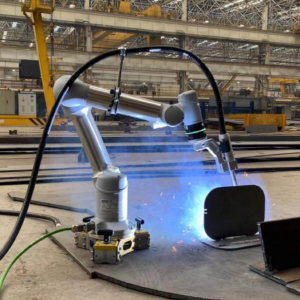
Joinville’s manufacturers emphasize that the quality of the laser-cut edge dictates the quality of the subsequent weld. A small HAZ means there is less carbon migration and fewer oxides trapped at the edge. This results in a cleaner fusion zone during robotic welding. For global OEMs (Original Equipment Manufacturers), this translates to fewer weld repairs and a lower probability of field failures, which is a critical metric for Total Cost of Ownership (TCO) in large-scale farming operations.
Joinville as a Strategic Hub for Technical Manufacturing
Joinville has established itself as a center of excellence for metal-mechanic industries due to its integrated supply chain and proximity to major steel producers. The adoption of small-HAZ technology in this region is not merely an equipment upgrade; it is a strategic response to the global demand for “over-engineered” agricultural solutions. The region’s technical workforce is increasingly specialized in CNC laser optimization, focusing on gas dynamics (using nitrogen or oxygen assists) to further refine the edge quality of heavy plates.
By utilizing Heavy-Duty Beam Laser systems, Joinville-based suppliers can produce complex geometries with tolerances that were previously unattainable for heavy-gauge components. This precision allows for “tab-and-slot” assembly designs, which reduce the need for heavy jigging and further minimize the residual stresses introduced during the assembly of large agri-frames.
Technical Data and Performance Metrics
Empirical studies on 20mm S355 structural steel show that fiber laser cutting at 15kW results in a HAZ of less than 0.2mm. In contrast, oxy-fuel cutting can produce a HAZ exceeding 2.0mm. The reduction in thermal distortion also ensures that large-format parts—such as 6-meter long side members for planting rows—remain within a flatness tolerance of +/- 0.5mm over their entire length. This level of dimensional stability is vital for the integration of sensors and automated steering components in modern precision agriculture equipment.
Conclusion: Industry Insight on the Future of Material Processing
The industrial landscape in Joinville serves as a microcosm for the global transition toward high-efficiency, high-durability manufacturing. As agricultural machinery continues to grow in size and complexity, the margin for material error decreases. The reliance on Heavy-Duty Beam Laser technology is no longer an optional luxury for high-end components; it is becoming a baseline requirement for structural integrity.
The industry insight for the coming decade points toward a “material-first” approach. As steel manufacturers develop even more advanced ultra-high-strength alloys to reduce vehicle weight and soil compaction, the processing technology must evolve to handle these materials without degrading their specialized properties. Joinville’s investment in small-HAZ technology positions it as a vital node in the global supply chain, proving that the longevity of heavy machinery begins at the molecular level, at the very moment the beam meets the plate. The focus will shift from simple “part-per-hour” metrics to “fatigue-cycles-per-component,” where the precision of the initial cut determines the decade-long performance of the machine in the field.
Industrial Expertise & Support
Are you looking for high-performance Heavy-Duty Beam Laser tailored for the Global market? Our engineering team provides comprehensive solutions for modern manufacturing.