Introduction: The Structural Steel Evolution in the Southern Cone
The industrial landscape of Buenos Aires, Argentina, has long served as a critical hub for structural steel fabrication, supporting massive infrastructure projects across South America. However, traditional fabrication workflows—relying on manual layout, mechanical drilling, and conventional bandsaw cutting—have historically faced significant throughput limitations. In a recent industrial upgrade within the Buenos Aires manufacturing corridor, the implementation of a Heavy-Duty Beam Laser has redefined the benchmarks for operational efficiency. By transitioning from fragmented mechanical processes to a unified laser-based system, a major regional fabricator successfully reduced the production cycle time for complex structural assemblies from 72 hours to just 3 hours. This 95.8% reduction in cycle time represents a fundamental shift in how heavy-section profiles are processed for the global construction and energy sectors.
The 72-Hour Bottleneck: Legacy Fabrication Constraints
Before the adoption of advanced laser technology, the fabrication of heavy-duty I-beams, channels, and H-sections required a multi-stage linear workflow. Each stage introduced cumulative delays and potential for human error. The process typically began with manual marking and layout, where technicians used physical templates and chalk lines to identify hole positions and cut-outs. This phase alone could consume up to 12 hours for a complex batch of beams.
Following layout, the material moved to mechanical drilling stations. Magnetic drills or CNC drill lines, while functional, necessitated significant setup time for tool changes and coolant management. Subsequent operations included oxy-fuel or plasma cutting for copes and notches, followed by a final trip to the bandsaw for length adjustments. The logistics of moving 12-meter structural members between these disparate workstations accounted for nearly 30% of the total 72-hour cycle. Furthermore, the requirement for secondary deburring and grinding—essential due to the rough edges left by mechanical tools—added another layer of non-value-added time.
The Technical Solution: High-Power 3D Laser Profiling
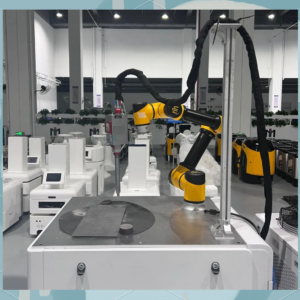
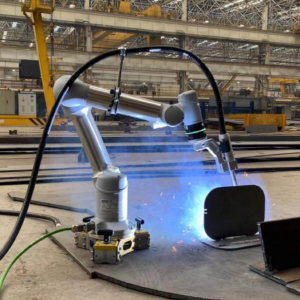
The core of the transformation in Buenos Aires lies in the deployment of a Heavy-Duty Beam Laser equipped with 6-axis robotic kinematics. Unlike traditional 2D plate lasers, these systems utilize a sophisticated spatial orientation mechanism that allows the cutting head to navigate around all four sides of a structural profile, including the internal radii of I-beams and H-sections.

Industrial Application of Heavy-Duty Beam Laser
The system integrates high-wattage fiber laser sources, typically ranging from 4kW to 12kW, capable of penetrating thick-walled structural steel with extreme precision. By utilizing automated nesting software, the system optimizes the arrangement of cuts across the raw material, significantly reducing scrap rates. This software communicates directly with the facility’s Building Information Modeling (BIM) data, ensuring that every bolt hole, slot, and miter cut is executed according to the digital twin of the structure.
Eliminating Secondary Operations via Precision Engineering
One of the primary drivers behind the reduction to a 3-hour cycle is the elimination of secondary finishing. The Heavy-Duty Beam Laser produces a finish with minimal heat-affected zones (HAZ). In traditional thermal cutting (such as oxy-fuel), the intense heat alters the metallurgical properties of the steel edge, often requiring mechanical removal to meet structural codes.
The fiber laser’s concentrated energy beam results in a kerf width of less than 1mm, providing a clean, weld-ready edge. Because the laser can perform marking, drilling (via circular interpolation), beveling, and cutting in a single setup, the beam never leaves the conveyor system until it is ready for assembly. This “all-in-one” approach removes the need for manual deburring and significantly reduces the labor hours required per ton of steel.
Data-Driven Throughput: Analysis of the 3-Hour Workflow
The transition to a 3-hour cycle is not merely a result of faster cutting speeds; it is a result of total process integration. In the Buenos Aires facility, the 3-hour window is categorized into three distinct phases:
1. Material Loading and Sensing (20 minutes): The automated infeed system loads the beam while laser sensors map the actual dimensions of the profile, accounting for any mill tolerances or slight deviations in the steel’s straightness.
2. Integrated Processing (140 minutes): The laser executes all structural features. This includes complex 45-degree miters for seismic connections, slotted holes for expansion joints, and etched part identification numbers for downstream traceability.
3. Outfeed and Quality Verification (20 minutes): The finished beam is moved to the discharge zone. Because the laser maintains a positional accuracy of +/- 0.2mm, the need for manual measurement verification is virtually eliminated, allowing for immediate transition to the coating or shipping department.
Operational Reliability in the Argentinian Industrial Context
Implementing such high-tier technology in Buenos Aires required addressing local infrastructure variables, such as power stability and technical support. The selected Heavy-Duty Beam Laser systems were outfitted with specialized voltage regulation to handle fluctuations in the local grid, ensuring that the high-frequency laser resonators remained stable. Furthermore, the shift from manual labor to CNC-based operation allowed the fabricator to upskill their workforce, moving employees from hazardous manual cutting roles to high-value technical programming and system oversight positions.
Concluding Industry Insight: The Global Shift Toward Integrated Fabrication
The success of the Buenos Aires facility serves as a microcosm for a broader trend in global B2B manufacturing: the convergence of disparate mechanical processes into single-source digital fabrication. For structural steel stakeholders, the reduction of cycle time from 72 hours to 3 hours is not just an internal efficiency gain; it is a strategic market advantage.
In an era of volatile material costs and tightening project timelines, the ability to deliver high-precision structural components in a fraction of the traditional time allows fabricators to bid on larger, more complex international contracts. The “just-in-time” delivery model, once reserved for automotive assembly, is now a reality for heavy structural engineering. As Heavy-Duty Beam Laser technology continues to evolve, the industry will likely see a move toward even greater autonomy, where AI-driven nesting and real-time defect detection further compress the fabrication window, making the 72-hour cycle a relic of the industrial past.
Industrial Expertise & Support
Are you looking for high-performance Heavy-Duty Beam Laser tailored for the Global market? Our engineering team provides comprehensive solutions for modern manufacturing.